Amelioration of Diastolic Dysfunction and Exercise Intolerance by the Selective HDAC6 Inhibitor, EKZ-102, in the ZSF1 Obese Rat Cardiometabolic HFpEF Model
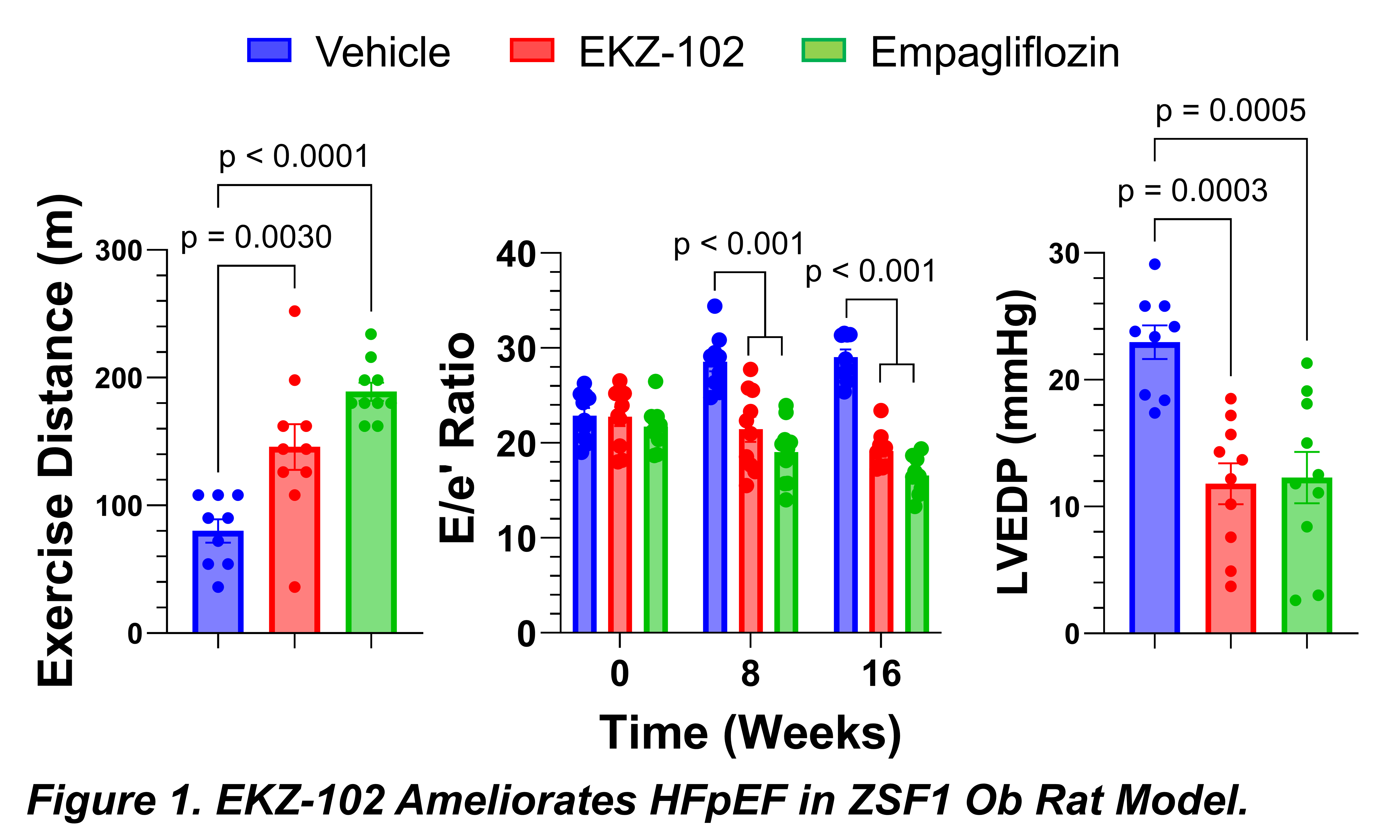
Abstract Body: Background Heart failure with preserved ejection fraction (HFpEF) is a complex condition with limited therapeutic options. Histone deacetylase 6 (HDAC6) regulates autophagy, mitochondrial function, and inflammation via deacetylation of non-histone proteins. We previously demonstrated the efficacy of EKZ-102—a highly selective (>1,000-fold), potent (low nM), and orally bioavailable HDAC6 inhibitor featuring a next-generation oxadiazole chemical scaffold—in a "two-hit" mouse model of HFpEF. To confirm and extend the efficacy of EKZ-102 for HFpEF, we next evaluated EKZ-102 in the highly translational ZSF1 obese (Ob) genetic rat model of severe cardiometabolic HFpEF. Methods Male ZSF1 Ob rats (n=10/group) received daily oral gavage of vehicle (1% CMC), the SGLT2 inhibitor empagliflozin (10 mg/kg), or EKZ-102 (3, 10, or 30 mg/kg) from 10 to 26 weeks of age. Serial two-dimensional echocardiography, treadmill exercise, and non-fasting glucose were assessed every 4 weeks. Terminal glucose tolerance tests (GTT) and invasive left ventricular and systemic hemodynamics were performed at week 26. Results All rats exhibited an obese HFpEF phenotype with no significant body weight differences between groups. While only empagliflozin significantly reduced non-fasting blood glucose, both EKZ-102 (30 mg/kg) and empagliflozin significantly improved glucose handling during GTT, though the effect of empagliflozin, a glucose transport inhibitor, was greater. Notably, EKZ-102 (30 mg/kg) significantly increased treadmill running distance and work, mirroring the improvements seen with empagliflozin. Echocardiographic E/e’ ratio (LVdiastolic function) was significantly reduced by EKZ-102, showing comparable efficacy to empagliflozin. Furthermore, invasive hemodynamics revealed that EKZ-102 (30 mg/kg) significantly reduced left ventricular end-diastolic pressure (LVEDP) to a degree similar to empagliflozin. Systemic blood pressure remained unaffected by all treatments, indicating direct myocardial or peripheral benefits rather than afterload reduction. Summary and Conclusion Chronic administration of EKZ-102 provides dose-dependent amelioration of exercise intolerance and cardiac dysfunction in ZSF1 Ob rats. These results demonstrate that selective HDAC6 inhibition is as effective as SGLT2 inhibition in a highly translational cardiometabolic HFpEF model, highlighting EKZ-102 class of HDAC6 inhibitors as potential clinical candidates.
Elbatreek, Mahmoud
(
Cedars-Sinai Medical Center
, Los Angeles , California , United States )
Khodade, Vinayak
(
Cedars-Sinai Medical Center
, Los Angeles , California , United States )
Evans, Lauren
(
Eikonizo Therapeutics Inc.
, Cambridge , Massachusetts , United States )
Richardson, Thomas
(
Eikonizo Therapeutics Inc.
, Cambridge , Massachusetts , United States )
James, Rebecca
(
Eikonizo Therapeutics Inc.
, Cambridge , Massachusetts , United States )
Schroeder, Frederick
(
Eikonizo Therapeutics Inc.
, Cambridge , Massachusetts , United States )
Wang, Jianhong
(
Eikonizo Therapeutics Inc.
, Cambridge , Massachusetts , United States )
Luterman, Jim
(
Eikonizo Therapeutics Inc.
, Cambridge , Massachusetts , United States )
Gilbert, Tonya
(
Eikonizo Therapeutics Inc.
, Cambridge , Massachusetts , United States )
Fisher, Richard
(
Eikonizo Therapeutics Inc.
, Cambridge , Massachusetts , United States )
Goodchild, Traci
(
Smidt Heart Institute Cedars Sinai
, Los Angeles , California , United States )
Lefer, David
(
Cedars-Sinai Medical Center
, Los Angeles , California , United States )