
Logo

American Heart Association

  69
  0


Final ID: Wed076

Chronic reductive stress and proteotoxicity induce left ventricular dyssynchrony with increased Tei index

Abstract Body: Background: Chronic reductive stress (cRS) contributes to adverse cardiac remodeling and diastolic dysfunction; however, the mechanisms remain unclear. Here, we examined how cRS progressively disrupts proteostasis, causing proteotoxicity overtime leading to cardiac remodeling and dyskinesia.
Methods: Cardiac-specific constitutively active Nrf2 transgenic (CaNrf2-TGL/TGH) and NTG mice (n=4–6/group) at ~3 and 6 months of age were studied. NGS-RNA sequencing, speckle tracking strain echocardiography, Proteostat® histochemistry, and TEM assessed cRS effects on the cardiac transcriptome, endoplasmic reticulum (ER) disintegration, myocardial mechanics, and proteotoxicity. Statistical analyses were performed using Student's t-test.
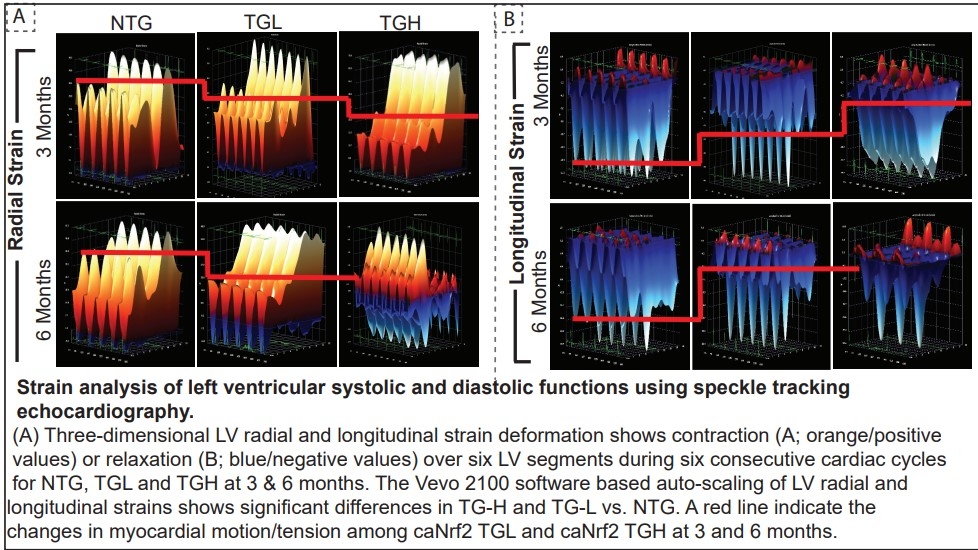
Results: Protein aggregation in TGH/TGL hearts (≥6 months) indicates cRS-induced misfolding. Altered ER transcriptome and subsarcolemmal ER dilation (TEM analysis) suggest ER stress, leading to myocardial structural and functional disintegration. Longitudinal strain showed moderate to severe endocardial deformation in TGL (p>0.01) and TGH (p>0.0001) vs. NTG at 3 months, while severe segmental dyssynchrony was evident in both TGL and TGH at 6 months. Increased global radial strain and decreased global longitudinal strain in TGH at 3 months (p>0.01) suggest the onset of early dyssynchrony. While TGL at 3 months revealed a moderate myocardial segmental deformation. By 6 months, strain differences emerged in TGL vs. NTG (p>0.001) and worsened in TGH (p>0.0001). TEI index, a measure of global cardiac function, was significantly elevated in both caNrf2-TGL and caNrf2-TGH (2 and 4-fold; P>0.0001) compared to NTG mice (normal index: 0.3-0.6) at 6 months, suggesting impaired systolic and diastolic functions in the RS hearts.
Conclusion: We established a strong correlation between non-amyloid proteotoxicity and cardiac dysfunction under chronic reductive stress, challenging the previous belief that antioxidants are always beneficial.
  • Sunny, Sini  ( University of Alabama At Birmingham , Birmingham , Alabama , United States )
  • Namakkal-soorappan, Rajasekaran  ( University of Alabama At Birmingham , Birmingham , Alabama , United States )
  • Masjoan Juncos, Juan  ( University of Alabama At Birmingham , Birmingham , Alabama , United States )
  • Karthikeyan, Santhosh Kumar  ( University of Alabama At Birmingham , Birmingham , Alabama , United States )
  • Bansal, Mohit  ( University of Alabama At Birmingham , Birmingham , Alabama , United States )
  • Subramaniam Tamilarasu, Kumaran  ( University of Alabama At Birmingham , Birmingham , Alabama , United States )
  • Devarajan, Asokan  ( UNIVERSITY CALIFORNIA AT LOS A , Los Angeles , California , United States )
  • Might, Matthew  ( University of Alabama At Birmingham , Birmingham , Alabama , United States )
  • Litovsky, Silvio  ( University of Alabama at Birmingham , Birmingham , Alabama , United States )
  • Pogwizd, Steven  ( University of Alabama At Birmingham , Birmingham , Alabama , United States )
  • Author Disclosures:
    Sini Sunny: DO NOT have relevant financial relationships | Rajasekaran Namakkal-Soorappan: DO NOT have relevant financial relationships | Juan Masjoan Juncos: No Answer | Santhosh Kumar Karthikeyan: No Answer | Mohit Bansal: No Answer | Kumaran Subramaniam Tamilarasu: No Answer | Asokan Devarajan: DO NOT have relevant financial relationships | Matthew Might: No Answer | Silvio Litovsky: No Answer | Steven pogwizd: No Answer
Meeting Info:

Basic Cardiovascular Sciences 2025

2025

Baltimore, Maryland

Session Info:

Poster Session and Reception 1

Wednesday, 07/23/2025 , 04:30PM - 07:00PM

Poster Session and Reception

More abstracts from these authors:
Reductive stress alters high density lipoprotein (HDL) functionality and induces atheroma

Rajkumar Abinayaa, P Kalaiselvi, Challa Anil Kumar, Devarajan Asokan, Franklin John, Nanda Vivek, Namakkal-soorappan Rajasekaran, Sunny Sini

Tandem Mass Tagging (TMT)-based Identification of Proteome Signatures for Ischemia-Reperfusion Injury in Swine

Sunny Sini, Sun Jiacheng, Aniqa Sayed, Walcott Gregory, Zhang Jianyi, Namakkal-soorappan Rajasekaran

You have to be authorized to contact abstract author. Please, Login
Not Available