Impact of chronic reductive stress on myocardial proteome turnover: Insights into proteotoxicity and predictive cardiac remodeling
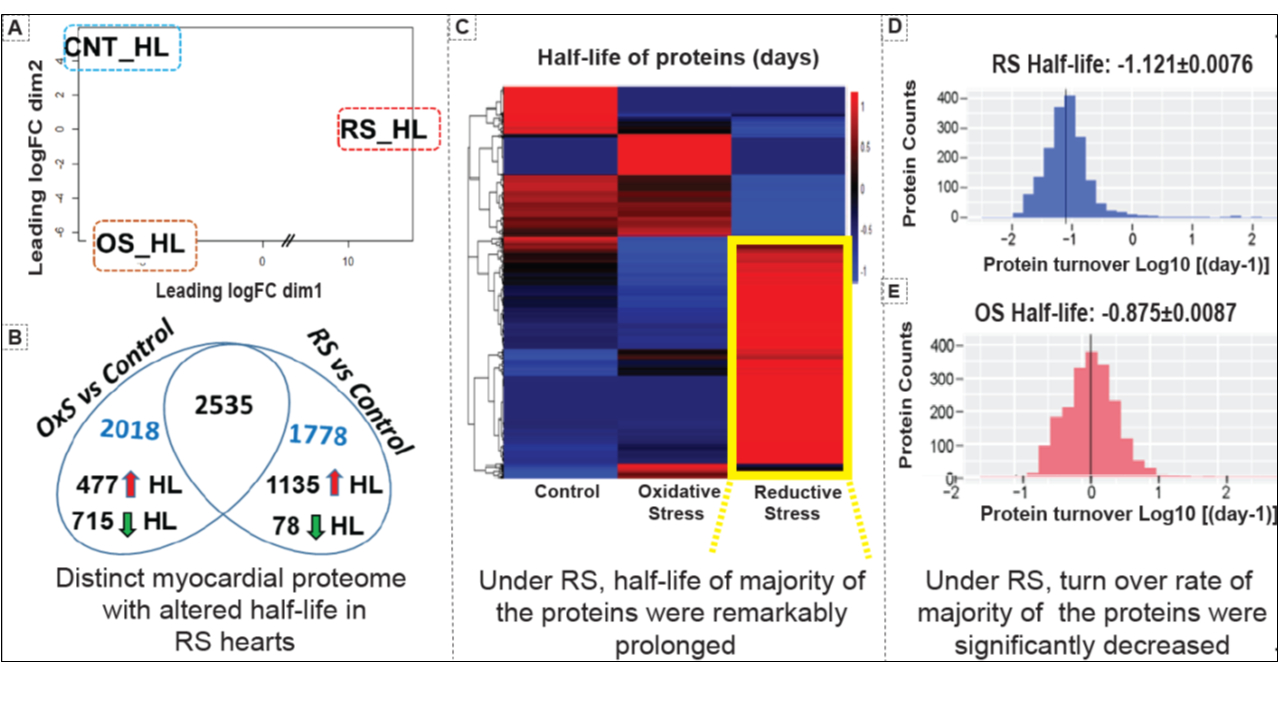
Abstract Body (Do not enter title and authors here): Background: Protein half-life and turnover are crucial for cellular function, especially under basal and stress conditions, often contributing to proteinopathies. While the impact of oxidative stress (OxS) on proteostasis is well-documented, the role of reductive stress, an overabundance of antioxidant status, in proteotoxic cardiac disease remains elusive. Hypothesis: Tested whether chronic reductive stress (cRS) impairs protein turnover and induce proteotoxic cardiac disease. Methods: In transgenic mice expressing constitutively active Nrf2 (caNrf2-TG) and non-transgenic controls (n=6/gp.), we examined the half-life and turnover rates of the myocardial proteome using D2O labeling and mass spectrometry. Results: We observed significant changes in the half-life of over 1,700 proteins, with approximately 1,200 proteins exhibiting increased half-life at 3 months, despite no noticeable defects in cardiac structure and function. Under OxS induced by isoproterenol (ISO), about 700 proteins showed reduced half-life, underscoring distinct regulatory mechanisms in protein turnover between cRS and OxS. Proteins with altered half-lives were involved in key cellular functions, including metabolism, signal transduction, immune response, transport, and cell cycle regulation under cRS, revealing novel targets undetected in an OxS context. Notably, distinct positive adaptive compensatory (59; p<0.05) and maladaptive pathologic (58; p<0.05) responses were observed, resulting in unusual protein stabilization and aggregation, leading to proteotoxic stress under cRS. Comparing transcript levels and protein half-life/turnover (HL/TnO) revealed non-linear metrics for subsets of proteins under cRS. Furthermore, bioinformatic predictions identified potential post-translational modification sites in critical proteins with extended half-lives, correlating with the onset of myocardial remodeling in cRS hearts at 3 months, as indicated by altered Tie index and irregular vector velocities of regional wall motions. Conclusion: Our findings highlight the importance of prolonged protein half-life and reduced turnover, along with unchanged or decreased transcription, as predictive markers for proteotoxic cardiac disease.
Namakkal-soorappan, Rajasekaran
(
Univ. Alabama at Birmingham
, Birmingham , Alabama , United States )
Wang, Ding
(
UCLA SCHOOL OF MEDICINE
, Los Angeles , California , United States )
Ng, Chun
(
UCLA SCHOOL OF MEDICINE
, Los Angeles , California , United States )
Devarajan, Asokan
(
UCLA SCHOOL OF MEDICINE
, Los Angeles , California , United States )
Challa, Anil Kumar
(
Univ. Alabama at Birmingham
, Birmingham , Alabama , United States )
Ping, Peipei
(
UCLA SCHOOL OF MEDICINE
, Los Angeles , California , United States )
Author Disclosures:
Rajasekaran Namakkal-Soorappan:DO NOT have relevant financial relationships
| Ding Wang:DO NOT have relevant financial relationships
| CHUN NG:No Answer
| Asokan Devarajan:No Answer
| Anil Kumar Challa:No Answer
| Peipei Ping:No Answer