
Logo

American Heart Association

  52
  0


Final ID: Thu011

Differential Effects of VEGF-A on Endothelial and Hematopoietic Lineage Specification in 2D Versus 3D Cultures of Embryonic Stem Cells

Abstract Body: Background
The emergence of functional endothelial and hematopoietic lineages from embryonic stem cells (ESCs) is fundamental to vascular and blood development. Vascular endothelial growth factor A (VEGF-A) is considered a pivotal regulator of angiogenesis, influencing endothelial progenitor cell proliferation, migration, and survival. Traditional two-dimensional (2D) culture systems have improved our understanding of early lineage commitment, but they do not fully capture the three-dimensional (3D) microenvironment that more closely mimics in vivo conditions. Recent studies have emphasized the importance of 3D culture platforms in promoting more physiologically relevant differentiation and cell–cell interactions, yet systematic comparisons of 2D versus 3D approaches in VEGF-mediated endothelial and hematopoietic differentiation remain limited.
Methods
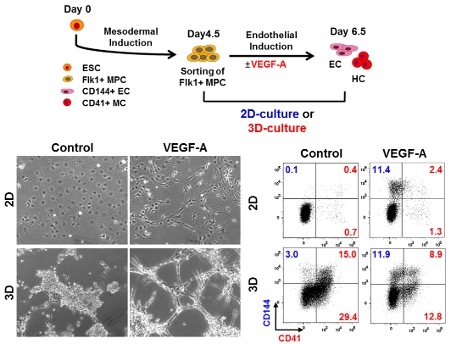
Mouse ESCs underwent a standardized mesoderm induction protocol beginning at day 0. After four days, Flk1+ multipotent progenitors were purified by fluorescence-activated cell sorting (FACS) and then cultured either in 2D adherent plates or within a 3D hydrogel matrix.
Results
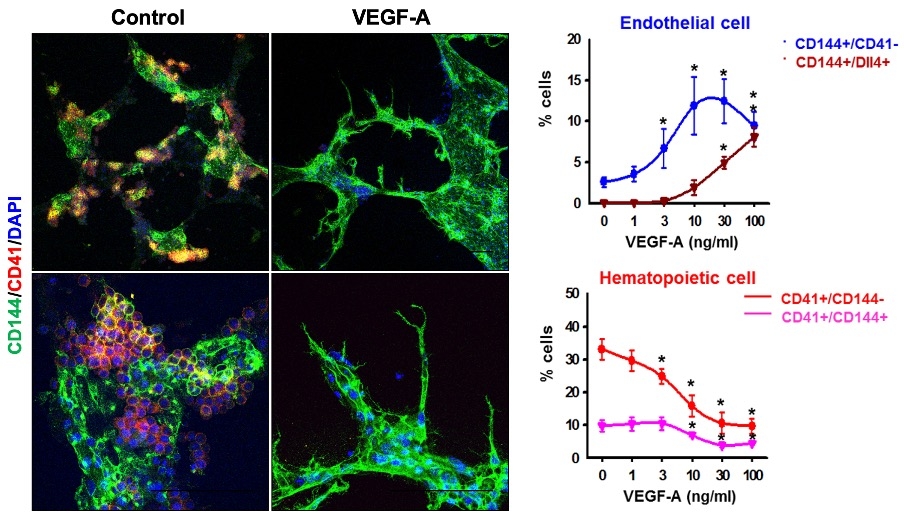
Flow cytometric analyses revealed that VEGF-A supplementation increased the percentage of CD144+ endothelial cells in both 2D and 3D cultures. However, the effect was markedly more pronounced in the 3D system, with a dose-dependent elevation in endothelial markers at VEGF-A concentrations ranging from 1 to 100 ng/mL. Concomitantly, hematopoietic lineage cells (CD41+) declined in the presence of VEGF-A, more substantially in 3D cultures, suggesting a shift in lineage commitment favoring an endothelial phenotype. Immunofluorescence staining confirmed robust CD144 expression and outlined the formation of tubular-like networks in 3D cultures receiving VEGF-A, whereas 2D monolayers displayed flattened endothelial cell morphologies with less pronounced cell–cell connections.
Conclusion
Our findings indicate that 3D culture conditions enhance the pro-endothelial effects of VEGF-A on mouse ESC differentiation relative to conventional 2D systems. The 3D environment appears to mimic aspects of embryonic tissue architecture, allowing for improved cellular interactions and factor gradients that promote endothelial lineage specification. These results advance the understanding of how microenvironmental factors modulate vascular commitment and may provide a foundation for tissue engineering strategies that rely on robust vascularization.
  • Joo, Hyung Joon  ( KOREA UNIVERSITY ANAM HOSPITAL , Seoul , Japan )
  • Kim, Jong-ho  ( KOREA UNIVERSITY ANAM HOSPITAL , Seoul , Japan )
  • Hong, Soon Jun  ( KOREA UNIVERSITY ANAM HOSPITAL , Seoul , Korea (the Republic of) )
  • Author Disclosures:
    Hyung Joon Joo: DO NOT have relevant financial relationships | Jong-Ho Kim: DO NOT have relevant financial relationships | Soon Jun Hong: No Answer
Meeting Info:

Basic Cardiovascular Sciences 2025

2025

Baltimore, Maryland

Session Info:

Poster Session and Reception 2

Thursday, 07/24/2025 , 04:30PM - 07:00PM

Poster Session and Reception

More abstracts on this topic:
More abstracts from these authors:
Deep Learning Model for Identification of Patients with Acute Heart failure using electrocardiogram in Emergency Room

Jung-joon Cha, Moon Jose, Kim Jong-ho, Hong Soon Jun, Yu Cheolwoong, Kim Yong, Kim Eung Ju, Joo Hyung Joon

SDF-1α from adipose derived-stem cell increases angiogenesis in acute myocardial infarction

Joo Hyung Joon, Kim Jong-ho, Hong Soon Jun

You have to be authorized to contact abstract author. Please, Login
Not Available