
Logo

American Heart Association

  62
  0


Final ID: Wed156

Serum Exosomal MicroRNAs in Patients with Heart Failure Are Correlated with Myocardial DNA Damage and Future Reverse Remodeling

Abstract Body: Background: Reliable predictors of treatment response in heart failure have been long awaited. Assessment of myocardial DNA damage has been shown to be able to precisely predict reverse remodeling. Myocardial DNA damage-related serum exosomal microRNAs, if any, may serve as a non-invasive predictor for reverse remodeling in heart failure.
Methods: We screened patients who were diagnosed as heart failure with reduced ejection fraction (HFrEF) regardless of etiologies and cryopreserved their sera. We next performed 1:1 matching for age, sex, etiology, and left ventricular ejection fraction to determine the analysis cohort. In this cohort, for those who underwent endomyocardial biopsy, we assessed myocardial DNA damage using immunostaining of γ-H2A.X, and extracted RNAs from the exosomes isolated from their sera, on which we performed small RNA-sequencing. MicroRNAs whose read frequency were correlated with γ-H2A.X-positive nuclei proportion (%γ-H2A.X), as defined by a Spearman's ρ > 0.4 or < -0.4, were quantified in the entire matched analysis cohort using quantitative reverse transcription polymerase chain reaction (RT-qPCR) for validatation. The expression level of validated microRNAs were then compared between the patients who achieved left ventricular reverse remodeling (LVRR) at 1-year and those who did not.
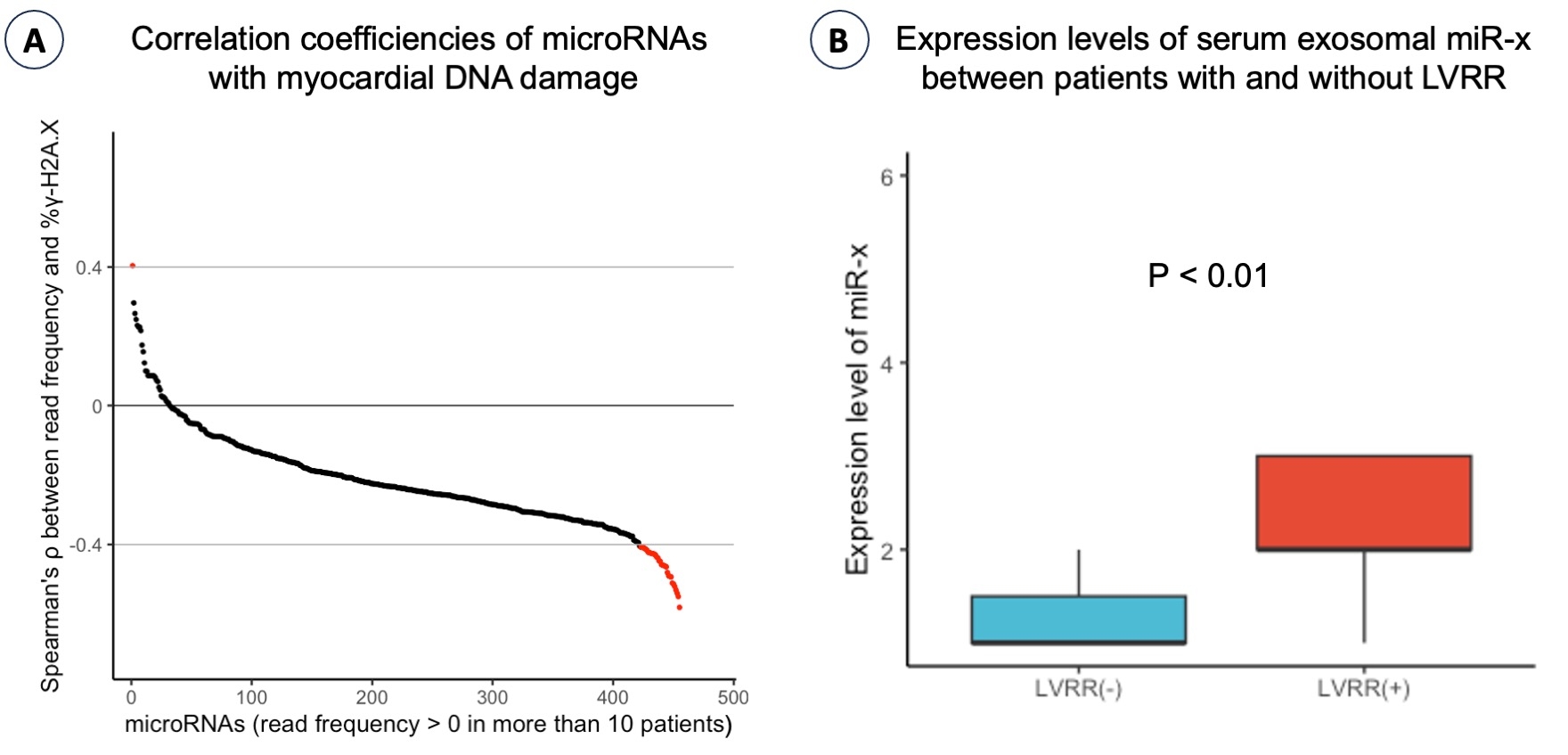
Results: We screened 202 patients with HFrEF, from whom 42 matched pairs (84 patients) were retrieved as the analysis cohort. Among the 23 patietns who underwent biopsy, 12 had 1-year LVRR, and had lower %γ-H2A.X (P = 0.01). Upon analyzing the sequencing data of serum exosomal microRNAs, 33 out of the 2,883 microRNAs had their Spearman's ρ with %γ-H2A.X > 0.4 or < -0.4 (red dots in Figure 1A). Validation using RT-qPCR in the entire matched analysis cohort revealed that miR-x had a remarkable negative correlation with %γ-H2A.X and differed between patients with and without LVRR at 1-year (Figure 1B). Expression level of serum exosomal miR-x was identified as a predominant predictor for 1-year LVRR by receiver operating characteristic analysis.
Conclusions: Measurement of expression levels of serum exosomal microRNAs offers a novel non-invasive approach for prediction of treatment response in HFrEF. Serum exosomal miR-x, negatively correlated with myocardial DNA damage, was indicated as a promising predictor for LVRR. Further investigations focusing on the function of miR-x and its potential as a therapeutic target are ongoing.
  • Dai, Zhehao  ( The University of Tokyo , Tokyo , Japan )
  • Nomura, Seitaro  ( The University of Tokyo , Tokyo , Japan )
  • Ko, Toshiyuki  ( The University of Tokyo , Tokyo , Japan )
  • Komuro, Issei  ( The University of Tokyo , Tokyo , Japan )
  • Author Disclosures:
    Zhehao Dai: DO NOT have relevant financial relationships | Seitaro Nomura: No Answer | Toshiyuki Ko: DO NOT have relevant financial relationships | Issei Komuro: DO NOT have relevant financial relationships
Meeting Info:

Basic Cardiovascular Sciences 2025

2025

Baltimore, Maryland

Session Info:

Poster Session and Reception 1

Wednesday, 07/23/2025 , 04:30PM - 07:00PM

Poster Session and Reception

More abstracts on this topic:
More abstracts from these authors:
LMNA p.Q353R Mutation Causes Dilated Cardiomyopathy through Impaired Vitamin D Signaling

Ito Masamichi, Katoh Manami, Nomura Seitaro, Komuro Issei

End-stage hypertrophic cardiomyopathy is caused by a combination of variants in genes associated with various cardiomyopathies

Hiruma Takashi, Hatano Masaru, Takimoto Eiki, Akazawa Hiroshi, Morita Hiroyuki, Kubo Toru, Kitaoka Hiroaki, Takeda Norihiko, Komuro Issei, Inoue Shunsuke, Dai Zhehao, Nomura Seitaro, Katoh Manami, Ko Toshiyuki, Ishida Junichi, Amiya Eisuke, Takeda Norifumi

You have to be authorized to contact abstract author. Please, Login
Not Available