Semaglutide in HFpEF: Uncoupling Weight Loss to Reveal Additional Therapeutic Benefits
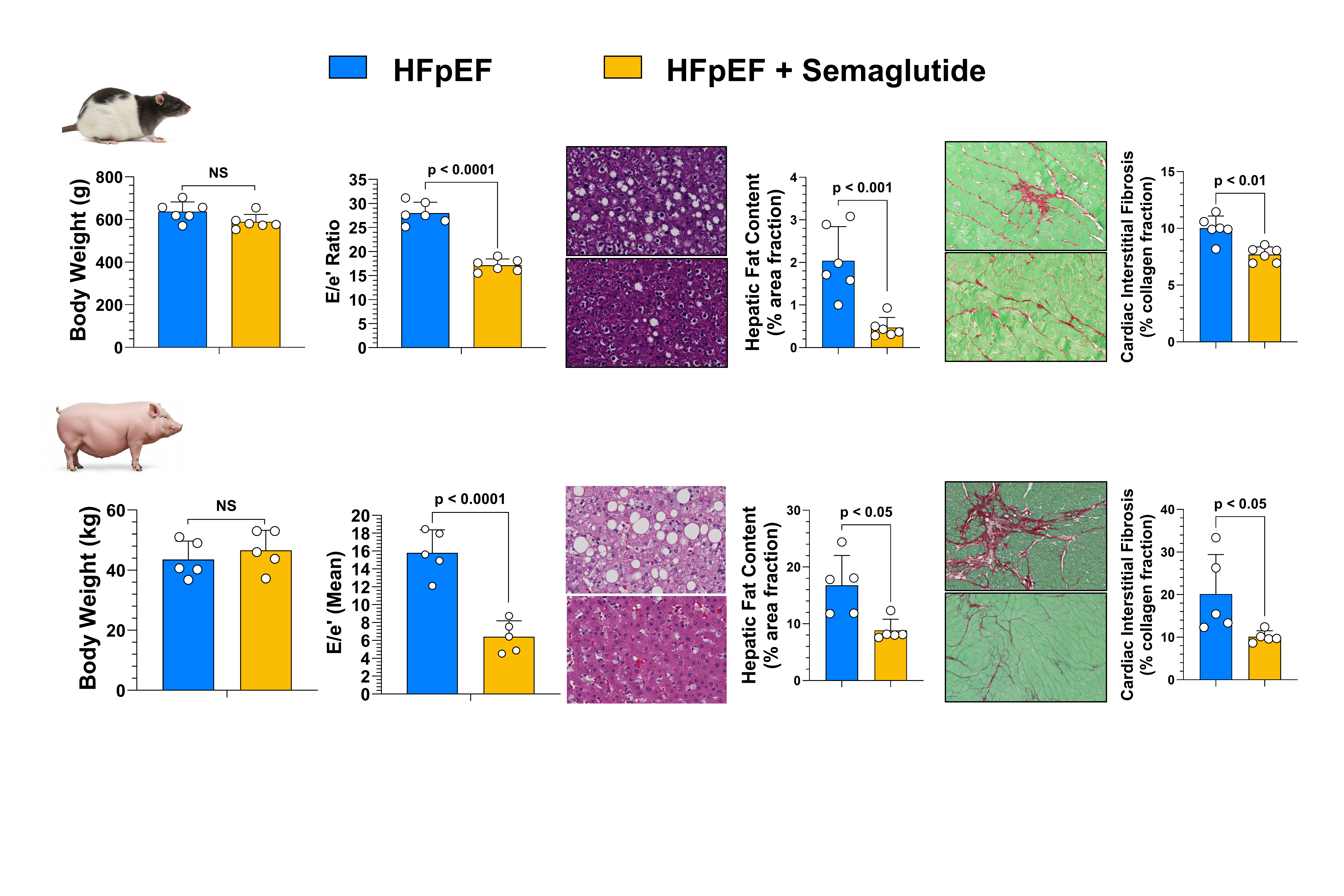
Abstract Body: Background: HFpEF is the most prevalent form of heart failure (HF) for which there are limited treatment options. In recent trials the GLP-1R agonist, semaglutide, improved HFpEF symptoms, exercise capacity, and inflammation though its mechanism of action remains unclear. Although weight loss is considered the primary driver of these benefits, the abundant expression of GLP-1R in the myocardium and vasculature suggest that direct cardiovascular actions may contribute to these benefits. Supporting this, the STEP-HFpEF trial showed early reductions in NT-proBNP with semaglutide, indicating direct effects on HF pathobiology, such as reduced congestion and myocardial stretch, that are independent of weight loss. Hypothesis: Semaglutide exerts beneficial effects in the cardiovascular system to ameliorate HFpEF that are independent upon its anti-obesity actions. Methods: Two preclinical models of HFpEF were investigated. ZSF1 Ob rats with spontaneous HFpEF were treated with vehicle or low-dose semaglutide (30 nmol/kg, SC, b.i.w) for 16 weeks (n=6/group). Göttingen minipigs developed HFpEF following 8 weeks of DOCA implantation and a high-fat diet containing 2% salt. Pigs were then treated with low-dose semaglutide (8 nmol/kg, n=5/group) for 12 weeks and compared to control animals. Assessments included echocardiography, treadmill exercise, invasive hemodynamics, vascular function, cardiac fibrosis, myocardial and hepatic lipid deposition, and electron microscopy. Results: In rats, semaglutide, despite no significant weight loss, improved metabolic profile, exercise capacity, LV diastolic function and reduced LVEDP (28±2 vs. 11±1 mmHg, p<0.0001), endothelium-dependent aortic relaxation, and attenuated cardiac fibrosis. Notably, semaglutide also reduced intramyocardial and hepatic lipid deposition. Similarly, in pigs, semaglutide, without causing weight loss, improved LV diastolic function, attenuated myocardial fibrosis, reduced LVEDP (16±2 vs. 6±2 mmHg, p<0.01) and pulmonary capillary wedge pressure, and attenuated cardiac and hepatic fibrosis. Furthermore, semaglutide improved coronary artery endothelium-dependent relaxation. Conclusion: GLP-1R agonists exert beneficial effects in HFpEF that are, in part, independent of their anti-obesity effects. This suggests a potential therapeutic value for a broad range of HFpEF patients, including lean individuals, patients intolerant of high doses, as well as non-obese patients with other cardiovascular diseases.
Elbatreek, Mahmoud
(
Cedars-Sinai Medical Center
, Los Angeles , California , United States )
Li, Zhen
(
China Pharmaceutical University
, Nanjing , China )
Yu, Xiaoman
(
Cedars-Sinai Medical Center
, Los Angeles , California , United States )
Nevins, Alexandra
(
Cedars-Sinai Medical Center
, Los Angeles , California , United States )
Sharp, Thomas
(
University of South Florida
, Tampa , Florida , United States )
Shah, Sanjiv
(
NORTHWESTERN UNIVERSITY
, Chicago , Illinois , United States )
Goodchild, Traci
(
LSUHSC - NEW ORLEANS
, New Orleans , Louisiana , United States )
Lefer, David
(
Cedars-Sinai Medical Center
, Los Angeles , California , United States )
Author Disclosures:
Mahmoud Elbatreek:DO NOT have relevant financial relationships
| Zhen Li:No Answer
| Xiaoman YU:No Answer
| Alexandra Nevins:DO NOT have relevant financial relationships
| Thomas Sharp:DO NOT have relevant financial relationships
| Sanjiv Shah:No Answer
| Traci Goodchild:DO NOT have relevant financial relationships
| David Lefer:DO NOT have relevant financial relationships