
Logo

American Heart Association

  19
  0


Final ID: Su4092

Low-Dose Semaglutide Attenuates Coronary Artery Pathology and Improves Vascular Function Independent of Weight Loss in a Porcine Model of Cardiometabolic HFpEF

Abstract Body (Do not enter title and authors here): Background: Coronary microvascular dysfunction is a common finding in HFpEF and contributes to diastolic dysfunction, fibrosis, and exercise intolerance. Semaglutide, a GLP-1 receptor agonist (GLP-1RA) approved for obesity and diabetes, has demonstrated promising effects in cardiometabolic HFpEF clinical trials. Accumulating evidence suggests that GLP-1RAs exert direct cardiovascular benefits via activation of heart and vascular GLP-1 receptors.
Hypothesis: Weight loss-independent benefits of semaglutide in HFpEF may involve the improvement of coronary vascular remodeling and function.
Methods: Female Göttingen minipigs developed HFpEF through 8 weeks of DOCA treatment and a high-fat, Western diet containing 2% sodium. Subsequently, pigs (n=5 per group) were randomized to control or low-dose semaglutide (8 nmol/kg, IM, once weekly) for 12 weeks. We performed echocardiography, invasive systemic and LV hemodynamics, coronary histopathology and vascular function testing, fibrosis, and exercise testing.
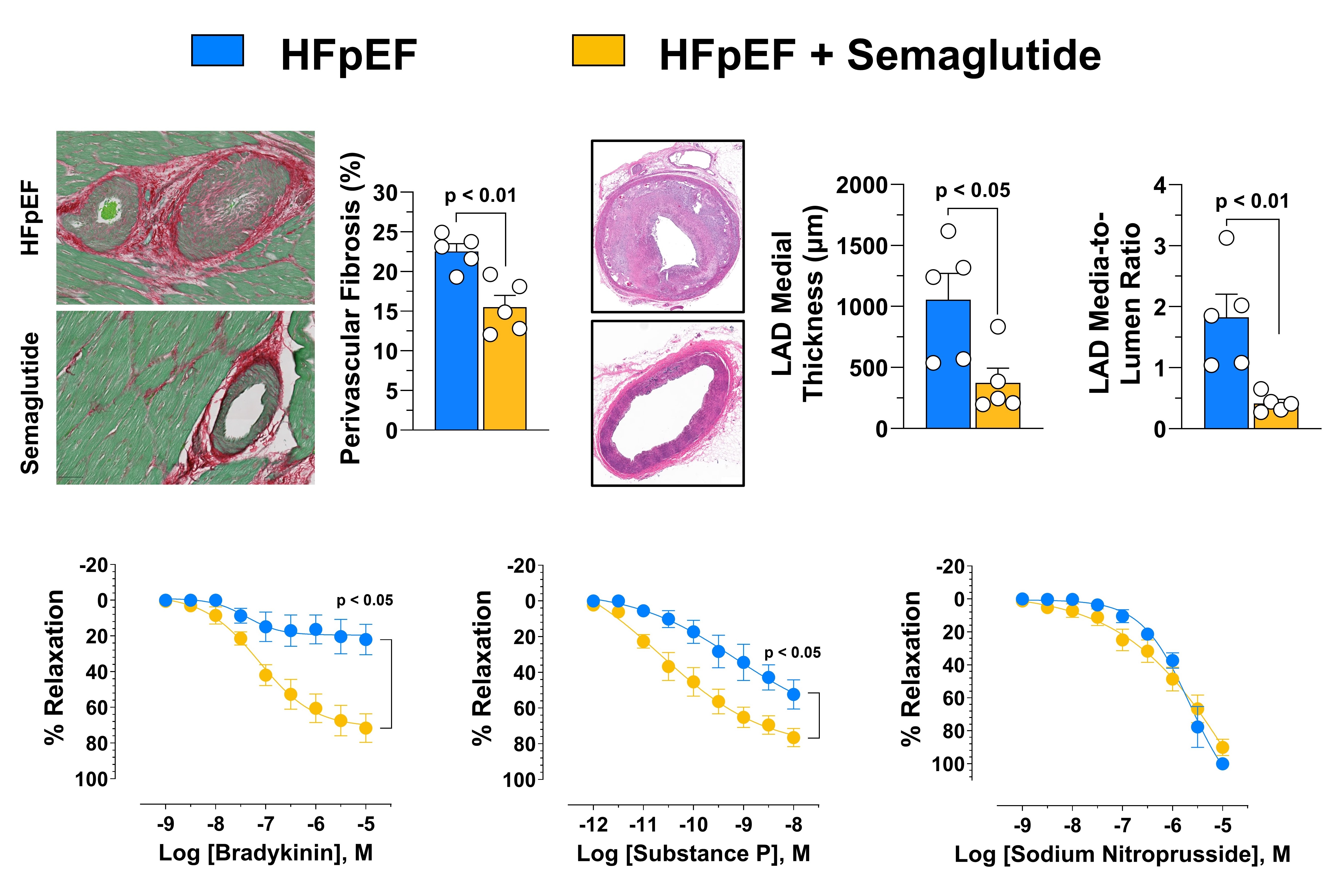
Results: Low-dose semaglutide failed to induce weight loss but improved LV diastolic function, and decreased LVEDP by 62% along with a similar reduction in PCWP. Control pigs exhibited substantial pericardial and epicardial adipose tissue accumulation, particularly surrounding the coronary arteries in conjunction with perivascular fibrosis. Semaglutide treatment significantly reduced pericardial and epicardial adipose tissue and attenuated perivascular fibrosis (p < 0.01). Furthermore, control pigs exhibited profound coronary artery medial thickening and increased media-to-lumen ratio, indicative of pathological coronary artery remodeling which were both significantly reduced by GLP-1 RA therapy. Semaglutide reversed coronary artery calcium deposition and fibrosis compared to control pigs. Consistent with the histological findings, ex vivo studies demonstrated that semaglutide enhanced coronary artery endothelium-dependent relaxation by 72% as compared to control vessels (p < 0.05).
Summary and Conclusion: Low-dose GLP-1 RA therapy reverses coronary artery pathological remodeling in severe cardiometabolic HFpEF. These improvements in coronary vascular function likely result in improved myocardial function, exercise tolerance, and quality of life in HFpEF. Additional studies are required to confirm the direct vascular effects of GLP-1 RA therapy in HFpEF patients. Our data suggest a broader role of GLP-1R agonist therapy in the treatment of cardiovascular diseases.
  • Elbatreek, Mahmoud  ( Cedars-Sinai Medical Center , Los Angeles , California , United States )
  • Li, Zhen  ( China Pharmaceutical University , Nanjing , China )
  • Shah, Sanjiv  ( NORTHWESTERN UNIVERSITY , Chicago , Illinois , United States )
  • Allerton, Timothy  ( Pennington Biomedical Research Cent , Baton Rouge , Louisiana , United States )
  • Yang, Hsin-jung  ( Cedars Sinai Medical Center , Los Angeles , California , United States )
  • Lefer, David  ( Cedars-Sinai Medical Center , Los Angeles , California , United States )
  • Goodchild, Traci  ( Smidt Heart Institute Cedars Sinai , Los Angeles , California , United States )
  • Author Disclosures:
    Mahmoud Elbatreek: DO NOT have relevant financial relationships | Zhen Li: DO NOT have relevant financial relationships | Sanjiv Shah: DO NOT have relevant financial relationships | Timothy Allerton: DO NOT have relevant financial relationships | Hsin-jung Yang: DO NOT have relevant financial relationships | David Lefer: DO NOT have relevant financial relationships | Traci Goodchild: DO NOT have relevant financial relationships
Meeting Info:

Scientific Sessions 2025

2025

New Orleans, Louisiana

Session Info:

Emerging Mechanisms in Heart Disease and Obesity

Sunday, 11/09/2025 , 11:30AM - 12:30PM

Abstract Poster Board Session

More abstracts on this topic:
A DHX38 Spliceosomal Mutation Impairs MYC Signaling, Cardiac Transcriptome Splicing, and Leads to Diastolic Dysfunction

Iwanski Jessika, Sarvagalla Sailu, Methawasin Mei, Van Den Berg Marloes, Churko Jared

4-Hydroxy-2-Nonenal Alters Alternative Polyadenylation to Regulate mRNA Isoform Diversity in the Transition from Human Cardiac Fibroblasts to Myofibroblasts

Natarajan Kartiga, Neupane Rahul, Yalamanchili Hari Krishna, Palaniyandi Suresh, Wagner Eric, Guha Ashrith, Amirthalingam Thandavarayan Rajarajan

More abstracts from these authors:
Empagliflozin Reduces Skeletal Muscle Lipid Accumulation and Augments BCAA Oxidation in Cardiometabolic HFpEF

Allerton Timothy, Li Zhen, Elbatreek Mahmoud, Goodchild Traci, Lefer David

Low-Dose Semaglutide Attenuates Cardiac Lipid Content and Hepatic Steatosis in Cardiometabolic HFpEF: Weight Loss Independent Actions of GLP-1 Receptor Activation

Elbatreek Mahmoud, Li Zhen, Shah Sanjiv, Allerton Timothy, Yang Hsin-jung, Lefer David, Goodchild Traci

You have to be authorized to contact abstract author. Please, Login
Not Available