Long-term follow-up of patients with multivessel coronary artery disease – comparison between Functional, Anatomical, or Medical Only-based Evaluation to Prevent Cardiovascular Events – The FAMOUS Trial
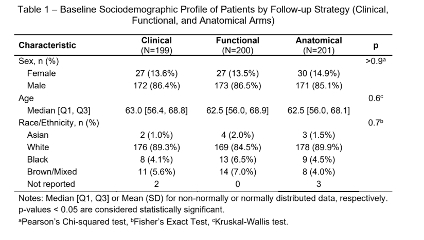
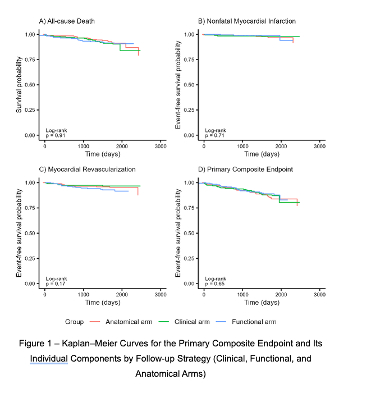
Abstract Body (Do not enter title and authors here): Hypothesis and Purposes: Coronary artery disease (CAD) continues to be a significant cause of mortality and disability worldwide. The optimal strategy of follow-up for patients submitted to coronary artery bypass graft (CABG) surgery is still not established. Study Design and Methods: The FAMOUS trial (NCT03040700) is a prospective, longitudinal, single-center, randomized study specifically designed to compare three different strategies of follow-up of patients with multivessel CAD who have undergone CABG surgery. Sample Size: 600 patients. Population Studied: Patients with multivessel CAD submitted to CABG. Intervention: 600 patients were randomized into one of three follow-up strategies: the clinical group (200 patients) receveid semiannual consultations with cardiologists; the anatomical group (200 patients), underwent coronary computed tomography (CTC) in the 1st, 3rd and 5th year of follow-up, in addition to the semiannual consultations; the functional group (200 patients) underwent a myocardial perfusion study (SPECT) in the 1st, 3rd and 5th year of follow-up, in addition to the semiannual consultations. During the follow-up, additional tests and/or coronary interventions were perfomed as necessary based on the physcian's discretion.Power calculation: The sample size was calculated to detect a difference of twice the rate of events between any groups with 80% power and a 0.05% significance level. 41 composite events were estimated for each group during follow-up, thus totalizing a minimum of 191 patients for each group. Primary outcome: Composite endpoint of death for all causes, non-fatal myocardial infarction and need for additional revascularization. Secondary outcome: Cardiovascular death and hospital admissions due to cardiovascular events. Outcomes: Demographic characteristics were similar between the three groups (Figure 1). The primary outcome occurred in 34, 30 and 34 patients in clinical, functional and anatomical groups, respectively (p=0.65). Mortality was similiar across three groups (29, 21 and 21, respectively; p=0.91). Revascularization procedures occured similarly (6, 13 and 9; respectively; p=0,88). Figure 1 shows Kaplan-Meier curves for the primary composite endpoint and its components. Secondary outcomes are under review and will be presented soon.
Gowdak, Luis Henrique
(
University of Sao Paulo
, Sao Paulo , Brazil )
Bianchi, Leonardo
(
University of Sao Paulo
, Sao Paulo , Brazil )
Sousa, Luhanda
(
University of Sao Paulo
, Sao Paulo , Brazil )
Pereira, Alexandre
(
University of Sao Paulo
, Sao Paulo , Brazil )
Soares Junior, Jose
(
University of Sao Paulo
, Sao Paulo , Brazil )
Rochitte, Carlos
(
INCOR UNIV.SAOPAULO HCOR HEART HOSP
, Sao Paulo , Brazil )
Dallan, Luis Alberto Oliveira
(
University of Sao Paulo
, Sao Paulo , Brazil )
Lisboa, Luiz Augusto
(
University of Sao Paulo
, Sao Paulo , Brazil )
Cesar, Luiz Antonio
(
University of Sao Paulo
, Sao Paulo , Brazil )
Krieger, Jose
(
Univ Sao Paulo Med Sch
, Sao Paulo Sp , Brazil )
Author Disclosures:
Luis Henrique Gowdak:No Answer
| Jose Krieger:DO NOT have relevant financial relationships
| Leonardo Bianchi:DO NOT have relevant financial relationships
| Luhanda Sousa:DO NOT have relevant financial relationships
| Alexandre Pereira:No Answer
| Jose Soares Junior:No Answer
| Carlos Rochitte:DO have relevant financial relationships
;
Consultant:Canon Medical Systems:Past (completed)
; Research Funding (PI or named investigator):Cleerly:Active (exists now)
; Research Funding (PI or named investigator):Novartis:Active (exists now)
; Speaker:GE Healthcare:Past (completed)
| Luis Alberto Oliveira Dallan:No Answer
| Luiz Augusto Lisboa:DO NOT have relevant financial relationships
| Luiz Antonio Cesar:No Answer