Efficacy and Safety of Obicetrapib in Dyslipidemia or Atherosclerotic Cardiovascular Disease: A Systematic Review and Meta-Analysis
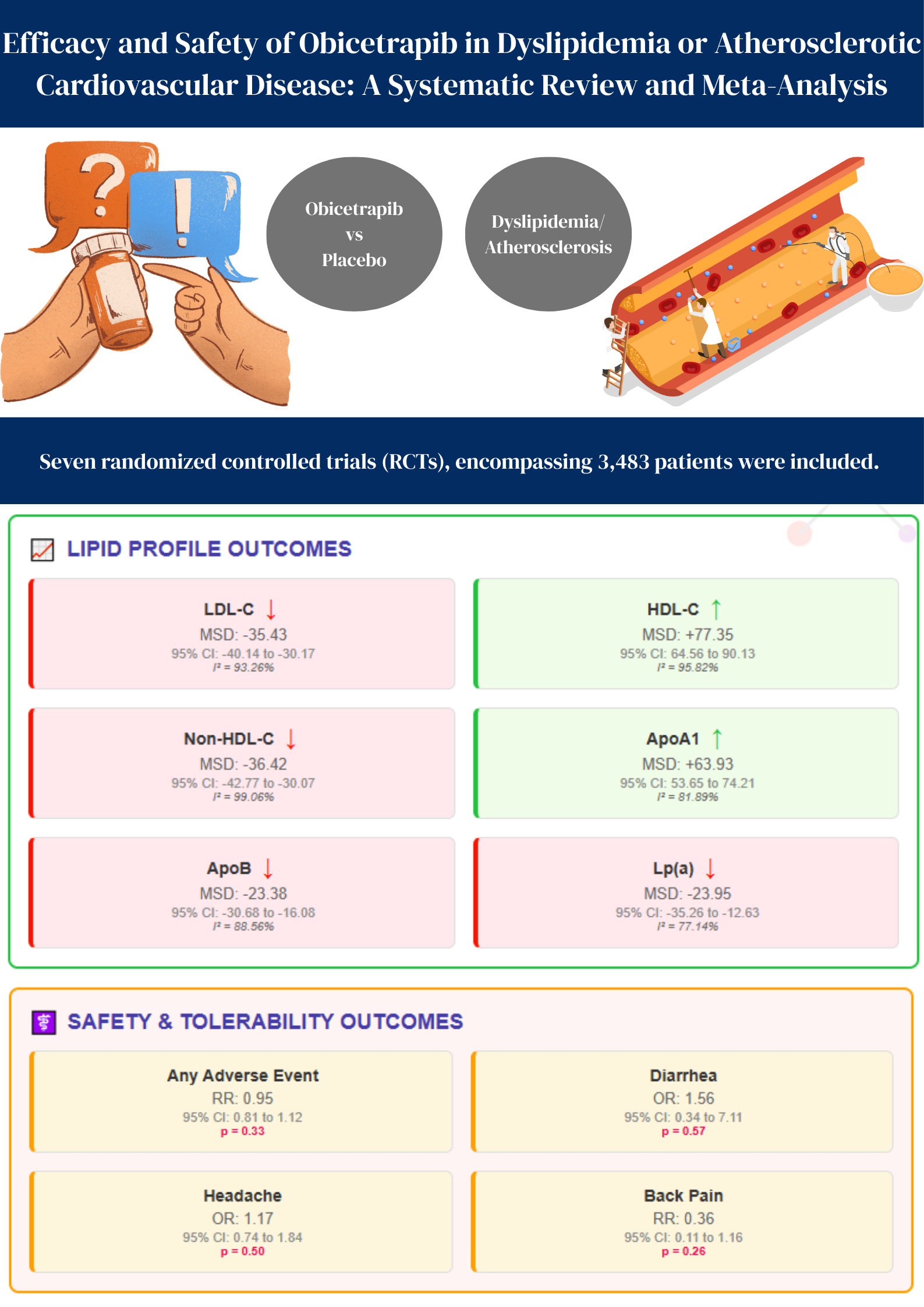
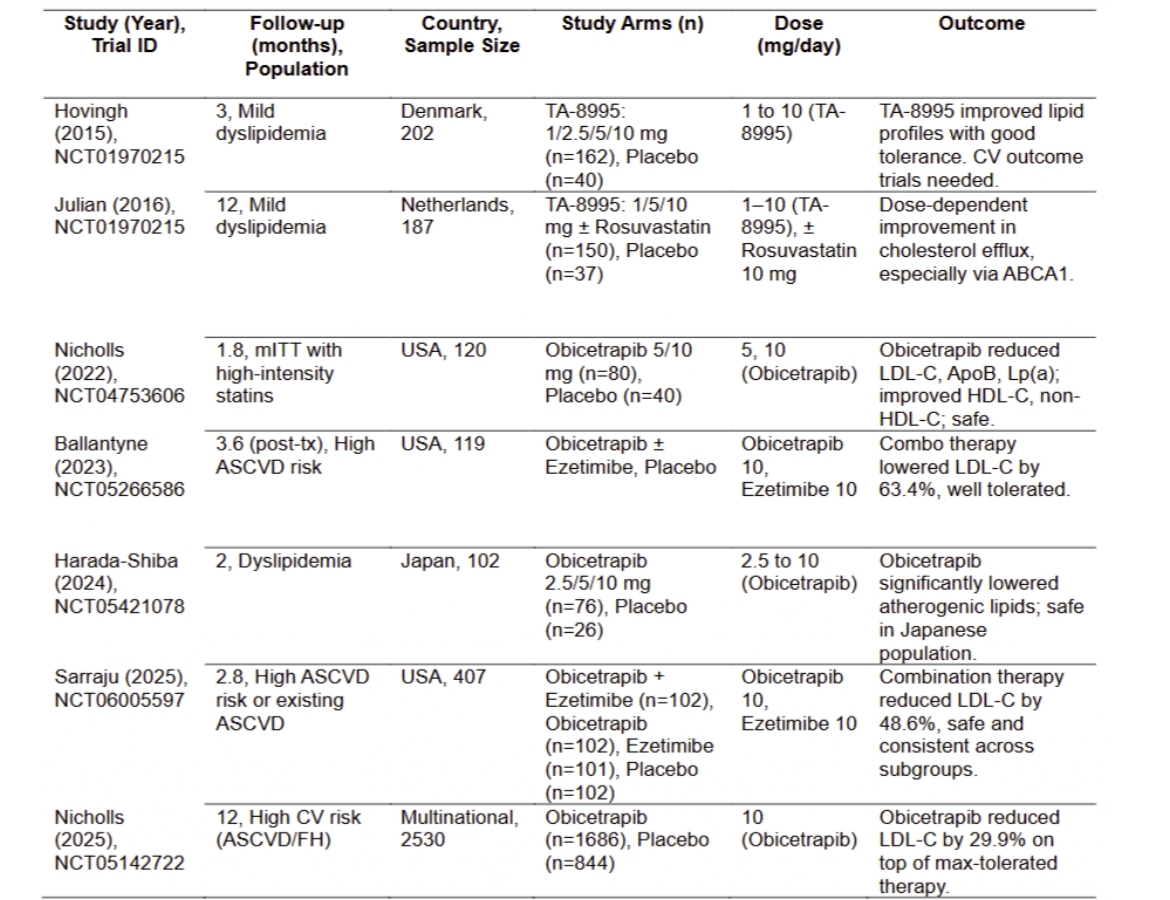
Abstract Body (Do not enter title and authors here): Background: Obicetrapib is a next-generation cholesteryl ester transfer protein (CETP) inhibitor. It has emerged as a promising agent for improving lipid parameters and potentially reducing risk of atherosclerotic cardiovascular disease (ASCVD). Methods: A systematic search of databases, including PubMed, Scopus, Embase, Web of Science, Clinical Trials, and Cochrane Library, was conducted to identify relevant randomized controlled trials (RCTs). Outcomes included the assessment of LDL-C reduction, changes in ApoB, non-HDL-C, HDL-C, triglycerides, Lp(a), MACE, as well as the safety and tolerability profile of Obicetrapib in patients with dyslipidemia or ASCVD. Standardized mean differences (SMD) with 95% confidence intervals (CI) were pooled using random-effects. Results: Seven RCTs encompassing 3483 patients were included. Obicetrapib significantly improved lipid parameters. It reduced LDL-C (MSD: –35.43; 95% CI: –40.14 to –30.17; I2 = 93.26%), non-HDL-C (MSD: –36.42; 95% CI: –42.77 to –30.07; I2 = 99.06%), ApoB (MSD: –23.38; 95% CI: –30.68 to –16.08; I2 = 88.56%), and Lp(a) (MSD: –23.95; 95% CI: –35.26 to –12.63; I2 = 77.14%). Obicetrapib also led to a reduction in TG levels (MSD: –0.12; 95% CI: –0.19 to –0.05; I2 = 0.00%). In contrast, favorable increases were observed in HDL-C (MSD: 77.35; 95% CI: 64.56 to 90.13; I2 = 95.82%) and ApoA1 (MSD: 63.93; 95% CI: 53.65 to 74.21; I2 = 81.89%). Despite high heterogeneity, these results support Obicetrapib’s effectiveness in improving atherogenic lipid markers. Obicetrapib demonstrated a safety profile comparable to placebo. The overall risk of any adverse event was slightly reduced in the Obicetrapib group compared to placebo, but the 95% CI included 1, (RR: 0.96; 95% CI: 0.76 to 1.21; I2 = 66.3%; p = 0.01). Specific adverse events such as diarrhea (OR: 1.56; 95% CI: 0.34 to 7.11; I2 = 5.16%; p = 0.57), headache (OR: 1.17; 95% CI: 0.74 to 1.84; I2 = 0.00%; p = 0.50), and back pain (RR: 0.36; 95% CI: 0.11 to 1.16; I2 = 18.3%; p = 0.26) were also not significantly different between groups. Overall, Obicetrapib appears well-tolerated without increased adverse events. Conclusion: Obicetrapib significantly improved lipid parameters, notably reducing LDL-C, non-HDL-C, ApoB, Lp(a), and triglycerides, while increasing HDL-C and ApoA1, with a favorable and comparable safety profile.
Hemida, Mohamed Fawzi
(
Alexandria Faculty of Medicine
, Alexandria , Egypt )
Hammad, Noha
(
Port-Said Faculty of Medicine
, Port-Said , Egypt )
Ibrahim, Alyaa
(
Alexandria Faculty of Medicine
, Alexandria , Egypt )
Bahnasy, Ahmed
(
Mayo Clinic
, Rochester , Minnesota , United States )
Ishtiaq, Saniya
(
Rawalpindi Medical University
, Rawalpindi , Pakistan )
Shahriar, Zahin
(
Dhaka Medical College Hospital
, Dhaka , Bangladesh )
Hassan Mohamed, Abdelrhman
(
Faculty of Medicine Luxor
, Luxor , Egypt )
Islam, M Rafiqul
(
Shaheed Suhrawardy Medical College
, Dhaka , Bangladesh )
Younas, Muhammad
(
Gomal medical college Dera Ismail k
, Dera Ismail khan , Pakistan )
Ali, Muhammad Faizan
(
Jinnah Postgraduate Medical Center
, Karachi , Pakistan )
Author Disclosures:
Mohamed Fawzi Hemida:DO NOT have relevant financial relationships
| Muhammad Raza Sarfraz:DO NOT have relevant financial relationships
| Muhammad Faizan Ali:DO NOT have relevant financial relationships
| Noha Hammad:DO NOT have relevant financial relationships
| Alyaa Ibrahim:DO NOT have relevant financial relationships
| Ahmed Bahnasy:DO NOT have relevant financial relationships
| Saniya Ishtiaq:DO NOT have relevant financial relationships
| Zahin Shahriar:DO NOT have relevant financial relationships
| Abdelrhman Hassan Mohamed:DO NOT have relevant financial relationships
| M Rafiqul Islam:DO NOT have relevant financial relationships
| Muhammad Younas:DO NOT have relevant financial relationships
Hemida Mohamed Fawzi, Ali Muhammad Faizan, Alkasabrah Omar, Ibrahim Alyaa, Shahriar Zahin, Patel Krish, Abdelkhalek Ahmad, Islam M Rafiqul, Rathi Diya, Hussein Mirna, Sarfraz Muhammad Raza
Hemida Mohamed Fawzi, Ali Muhammad Faizan, Ahmed Phd Raheel, Ibrahim Alyaa, Islam M Rafiqul, Patel Krish, Abdelkhalek Ahmad, Ahmad Aamer, Rathi Diya, Sarfraz Muhammad Raza, Hammad Noha
4373660_File000000.jpg
4373660_File000001.jpg
You have to be authorized to contact abstract author. Please, Login