Trends and Disparities in Aortic Dissection Mortality in the United States: A Retrospective Analysis
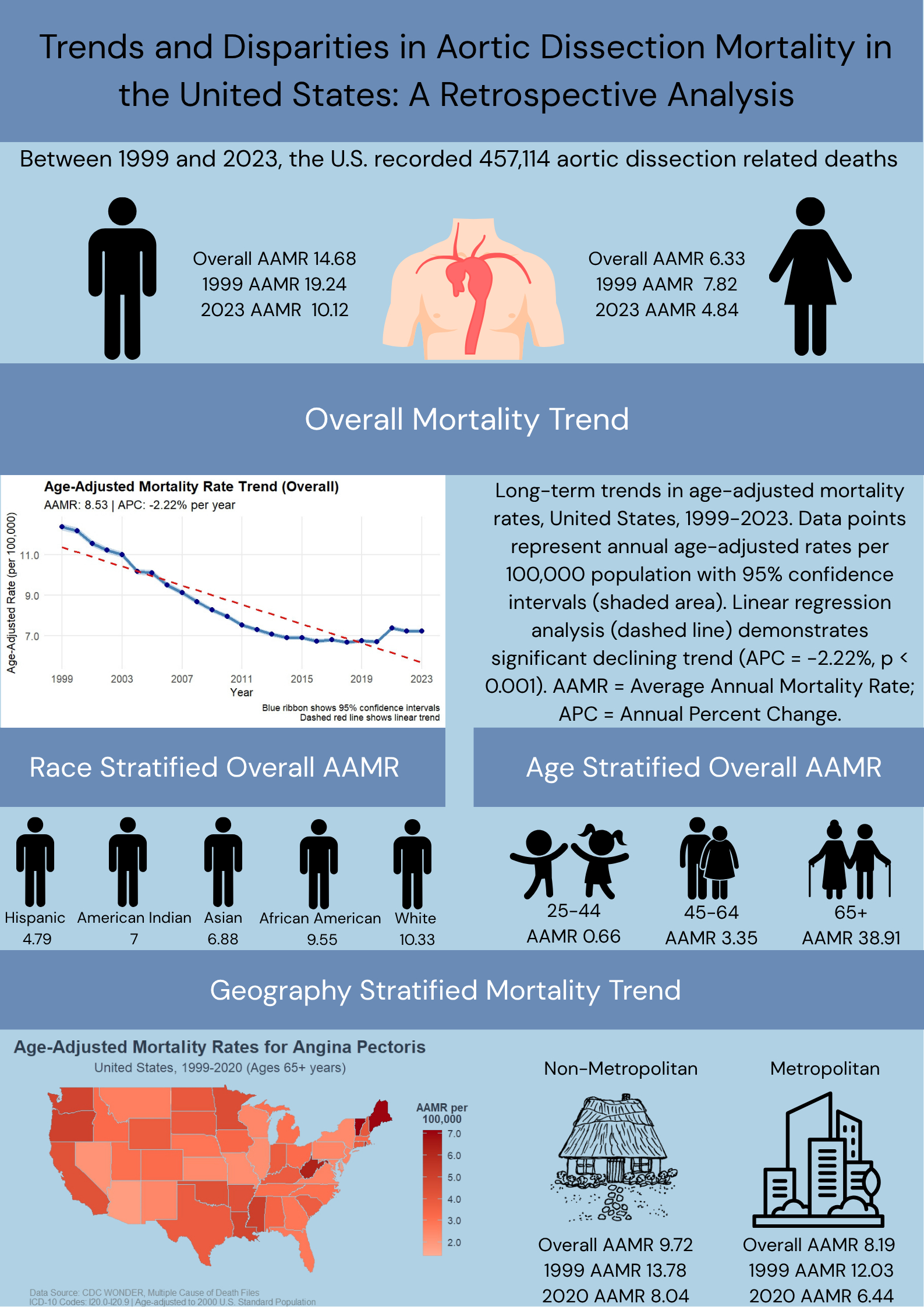
Abstract Body (Do not enter title and authors here): Background: Aortic dissection (AD) is a potentially life-threatening cardiovascular condition associated with significant morbidity, and mortality in adults aged >25 years. We assessed trends in AD-related mortality in the United States from 1999 to 2023 among adults to determine differences by sex, race, urbanization, and census region using CDC WONDER data. Objective: We hypothesize that there are disparities in mortalities due to AD among adults in the United States of America (USA) based on age, gender, race, and census region. Methods: We analyzed adults aged >25 years death certificates from the CDC-WONDER database with AD (ICD-10 code: I71) from 1999-2023. Age-adjusted mortality rates (AAMR) per 100,000 population were stratified by gender, race, census region, and year. Join-Point analysis was performed to estimate annual percent change (APC) and average annual percent change (AAPC) in mortality trends. Results: Between 1999 and 2023, AD caused 457,114 deaths in adults aged >25 years. The AAMR first decreased from 12.37 in 1999 to 7.06 in 2013 (APC: -4.13, 95% CI: -4.45 to –3.91), further decreased to 6.66 in 2018 (APC: -1.09; 95% CI: -3.32 to 0.19) and finally increased to 7.22 in 2023 (APC: 2.00; 95% CI: 1.07-3.97 ) with an overall AAPC (-2.25; 95% CI: -2.38 to –2.10). From 1999 to 2023, AAMR for males (19.24-10.12) was higher than that of females (7.82-4.84). From 1999 to 2023, Non-Hispanic (NH) White displayed the highest AAMR (12.99-7.67), followed by NH Black or African American (10.7-8.4), NH American Indian or Alaska Native (8.31-5.69), NH Asian or Pacific Islander (8.86-4.9), and Hispanic or Latino (5.91-3.67). West region showed highest AAPC (-1.98), followed by Midwest (-2.28), South (-2.30), and Northeast (-2.48). Adults aged 65 and older had the highest overall AAMR at 38.91, compared to 3.35 in the 45–64 age group and 0.66 in the 25–44 age group. Rural areas exhibited higher overall AAMR (9.72) than urban areas (8.19). Conclusion: AD-related mortality has increased, with highest rates among males, White individuals, and those in Midwestern and rural U.S., requiring targeted, equitable public health strategies.
Hemida, Mohamed Fawzi
(
Alexandria Faculty of Medicine
, Alexandria , Egypt )
Ibrahim, Alyaa
(
Alexandria Faculty of Medicine
, Alexandria , Egypt )
Shahriar, Zahin
(
Dhaka Medical College Hospital
, Dhaka , Bangladesh )
Patel, Krish
(
C. U. Shah Medical College
, Surendranagar , India )
Abdelkhalek, Ahmad
(
RFU- Northwestern McHenry Hospital
, McHenry , Illinois , United States )
Islam, M Rafiqul
(
Shaheed Suhrawardy Medical College
, Dhaka , Bangladesh )
Rathi, Diya
(
Dow University of Health Sciences
, Karachi , Pakistan )
Hussein, Mirna
(
Alexandria Faculty of Medicine
, Alexandria , Egypt )
Ali, Muhammad Faizan
(
Jinnah Postgraduate Medical Center
, Karachi , Pakistan )
Alkasabrah, Omar
(
Landmark Medical Center
, Woonsocket , Rhode Island , United States )
Author Disclosures:
Mohamed Fawzi Hemida:DO NOT have relevant financial relationships
| Muhammad Faizan Ali:DO NOT have relevant financial relationships
| Omar Alkasabrah:DO NOT have relevant financial relationships
| Alyaa Ibrahim:DO NOT have relevant financial relationships
| Zahin Shahriar:DO NOT have relevant financial relationships
| Krish Patel:DO NOT have relevant financial relationships
| Ahmad Abdelkhalek:DO NOT have relevant financial relationships
| M Rafiqul Islam:DO NOT have relevant financial relationships
| Diya Rathi:DO NOT have relevant financial relationships
| Mirna Hussein:DO NOT have relevant financial relationships
| Muhammad Raza Sarfraz:DO NOT have relevant financial relationships
Hemida Mohamed Fawzi, Ali Muhammad Faizan, Wasir Amanpreet, Alkasabrah Omar, Ibrahim Alyaa, Patel Krish, Abdelkhalek Ahmad, Islam M Rafiqul, Shahriar Zahin, Rathi Diya, Hussein Mirna, Sarfraz Muhammad Raza
Hemida Mohamed Fawzi, Ali Muhammad Faizan, Ahmed Phd Raheel, Ibrahim Alyaa, Islam M Rafiqul, Patel Krish, Abdelkhalek Ahmad, Ahmad Aamer, Rathi Diya, Sarfraz Muhammad Raza, Hammad Noha
4362684_File000000.jpg
You have to be authorized to contact abstract author. Please, Login