
Logo

American Heart Association

  18
  0


Final ID: Su3024

Demographic Inequities in Catheter Ablation Among SVT Hospitalizations: An Analysis of the Nationwide Inpatient Sample Database

Abstract Body (Do not enter title and authors here): Background:
Catheter ablation is a guideline-directed therapy for symptomatic supraventricular tachycardia (SVT), yet disparities in its utilization across patient populations remain inadequately characterized.
Objective:
To evaluate demographic and hospital-level factors associated with catheter ablation among hospitalized patients with SVT in the United States.
Methods:
We analyzed adult hospitalizations with a diagnosis of SVT (ICD-10-CM I47.1) from the National Inpatient Sample (NIS) for the years 2016 through 2020. Catheter ablation was identified using ICD-10-PCS procedure codes. Survey-weighted logistic regression was used to assess associations between demographic characteristics and the odds of receiving ablation. Age was evaluated both as a continuous and categorical variable. Analyses accounted for the complex survey design of the NIS.
Results:
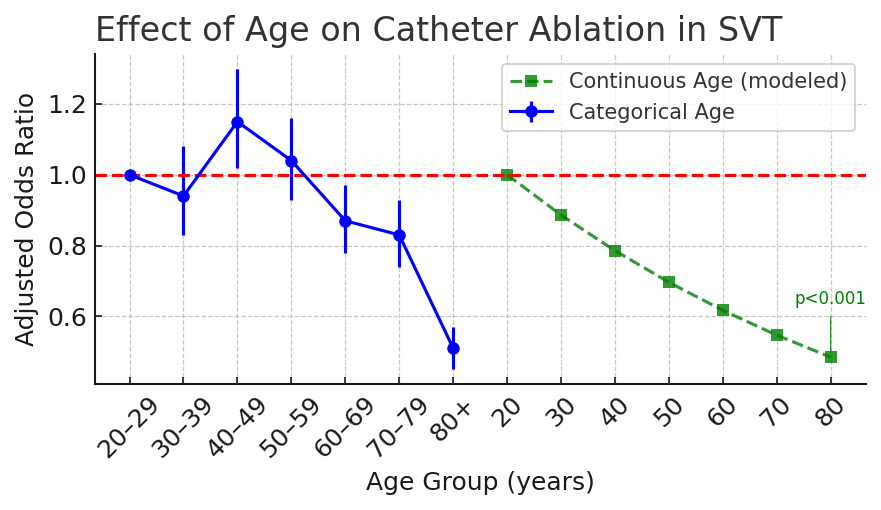
Among approximately 1.87 million weighted hospitalizations for SVT, only 4.1% underwent catheter ablation. Female patients comprised 52.5% of the SVT cohort but had 16.0% lower odds of receiving ablation compared to males (adjusted OR [aOR] 0.84; p<0.001). Black patients had 9.1% lower odds of ablation compared to White patients (aOR 0.91; p=0.002), while Hispanic and Other race groups had 18.1% (aOR 1.18; p<0.001) and 24.6% (aOR 1.25; p=0.003) higher odds, respectively. Insurance status also impacted access: patients with private insurance had 34.2% higher odds of ablation compared to Medicare recipients (aOR 1.34; p<0.001), whereas those with Medicaid had 9.7% lower odds (aOR 0.90; p=0.010). Increasing age was inversely associated with ablation use, with a 1.2% decrease in odds per year of age (aOR 0.99; 95% CI 0.987–0.989; p<0.001). Compared to patients aged 20–29, those aged 40–49 had 15.4% higher odds (aOR 1.15; p=0.018), while patients aged 60–69, 70–79, and ≥80 had 12.8%, 17.5%, and 49.1% lower odds, respectively (all p<0.05; Figure 1). Patients treated at urban teaching hospitals had 316% higher odds of ablation compared to those at rural hospitals (aOR 4.16; p<0.001).
Conclusion:
Significant disparities exist in the use of catheter ablation for SVT. Female sex, older age, Black race, and Medicaid coverage were associated with lower odds of ablation, while private insurance and care in urban teaching hospitals were associated with higher odds. These findings underscore the need for targeted efforts to address inequities in access to evidence-based electrophysiologic care.
  • Elganainy, Mohamed  ( East Carolina University , Greenville , North Carolina , United States )
  • Abdulfattah, Ammar  ( SUNY Downstate Medical Center , Brooklyn , New York , United States )
  • Alkoutami, Sami  ( East Carolina University , Greenville , North Carolina , United States )
  • Sarfraz, Shiza  ( East Carolina University , Greenville , North Carolina , United States )
  • Elsayed, Omar  ( HCA LewisGale Medical center , Salem , Virginia , United States )
  • Khalil, Fatma  ( Alexandria School of Medicine , Alexandria Egypt , Egypt )
  • Alenezi, Fawaz  ( Duke University Health System , Durham , North Carolina , United States )
  • Author Disclosures:
    Mohamed Elganainy: DO NOT have relevant financial relationships | Ammar Abdulfattah: DO NOT have relevant financial relationships | Sami Alkoutami: DO NOT have relevant financial relationships | Shiza Sarfraz: DO NOT have relevant financial relationships | Omar Elsayed: DO NOT have relevant financial relationships | Fatma Khalil: DO NOT have relevant financial relationships | Fawaz Alenezi: DO NOT have relevant financial relationships
Meeting Info:

Scientific Sessions 2025

2025

New Orleans, Louisiana

Session Info:

Population Science and Arrhythmia Trends

Sunday, 11/09/2025 , 03:15PM - 04:15PM

Abstract Poster Board Session

More abstracts on this topic:
Atrial Fibrillation Wave Vectors Determined by Artificial-Intelligence Indicate Clinical Phenotypes

Anbazhakan Suhaas, Abad Juan Ricardo Carlos, Ruiperez-campillo Samuel, Rodrigo Miguel, Narayan Sanjiv

Association between Glucagon-like peptide-1 receptor agonists and risk of Arrhythmias: A Contemporary Real-World Analysis

Jaiswal Vikash, Hanif Muhammad, Goyal Aman, Yasmin Juveria, Deb Novonil, Mashkoor Yusra, Rajak Kripa, Mattumpuram Jishanth, Weinberg Andrew

More abstracts from these authors:
I'm Ready for My Close-Up: Multimodality Imaging of the Right Heart

Alenezi Fawaz, Mukherjee Monica, Hahn Rebecca

Gender Disparities in ECMO Utilization and Outcomes in Cardiogenic Shock: Insights from the Nationwide Inpatient Sample

Elganainy Mohamed, Alkoutami Sami, Hammami Ahmed Sami, Sarfraz Shiza, Abdulfattah Ammar, Elsayed Omar, Fazlioglu Senad, Khalil Fatma, Puicea Raluca Diana

You have to be authorized to contact abstract author. Please, Login
Not Available