
Logo

American Heart Association

  17
  0


Final ID: MP1809

Gender Disparities in ECMO Utilization and Outcomes in Cardiogenic Shock: Insights from the Nationwide Inpatient Sample

Abstract Body (Do not enter title and authors here): Background:
Despite advances in extracorporeal membrane oxygenation (ECMO) for cardiogenic shock (CS), little is known about gender-based differences in its utilization and clinical outcomes. We aimed to assess whether gender influences ECMO use and outcomes in CS using Nationwide Inpatient Sample (NIS) Database.
Methods:
We conducted a retrospective cohort study using the Nationwide Inpatient Sample (NIS, 2016–2020), identifying adults (≥18 years) hospitalized with cardiogenic shock. ECMO use was identified using ICD-10-PCS codes. Survey-weighted logistic and linear regression models were used to assess gender differences in ECMO utilization, in-hospital mortality, length of stay (LOS), hospitalization costs, and major complications. Models adjusted for demographics, comorbidities (Elixhauser index), and hospital characteristics.
Results:
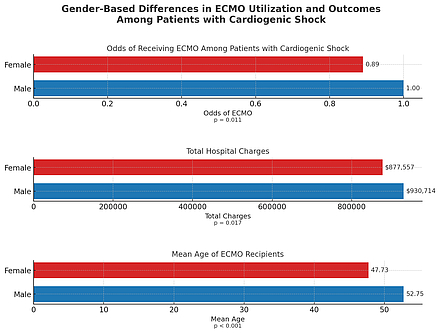
Among 13,005 patients receiving ECMO for CS, only 33.9% were female. Female patients were significantly less likely to receive ECMO (adjusted OR 0.89; 95% CI 0.82–0.97; p = 0.011). Female ECMO recipients were younger than males (mean age 47.7 vs. 52.8 years; p < 0.001). There was no significant difference in in-hospital mortality by gender (aOR 1.12; 95% CI 0.92–1.35; p = 0.258). Length of stay was similar between genders (23.6 days), with a non-significant trend toward shorter LOS in females (β = –2.25; p = 0.071). Adjusted total hospital charges were significantly lower in females (β = –$95,269; p = 0.017) (Figure 1).
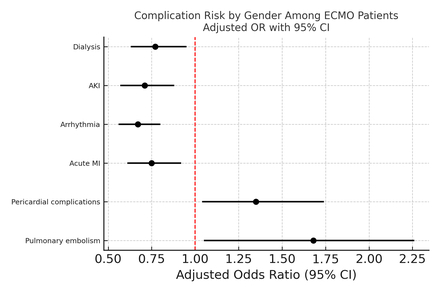
Notably, complication rates varied by gender. Females had significantly lower adjusted odds of requiring dialysis (aOR 0.77; 95% CI 0.63–0.95; p = 0.013), developing acute kidney injury (aOR 0.71; 95% CI 0.57–0.88; p = 0.002), arrhythmias (aOR 0.67; 95% CI 0.56–0.80; p < 0.001), and acute myocardial infarction (aOR 0.75; 95% CI 0.61–0.92; p = 0.007). However, female patients had higher adjusted odds of developing pericardial complications (aOR 1.35; 95% CI 1.04–1.74; p = 0.022) and pulmonary embolism (aOR 1.68; 95% CI 1.25–2.26; p = 0.001) (Figure 2).
Conclusions:
Women were less likely to receive ECMO for cardiogenic shock and tended to be younger at the time of receiving it. While in-hospital mortality and length of stay did not differ by gender, females had significantly lower hospital charges and distinct complication patterns. These findings highlight potential gender-based disparities in ECMO utilization and underscore the need for further investigation to ensure equitable access and outcomes.
  • Elganainy, Mohamed  ( East Carolina University , Greenville , North Carolina , United States )
  • Alkoutami, Sami  ( East Carolina University , Greenville , North Carolina , United States )
  • Hammami, Ahmed Sami  ( East Carolina University , Greenville , North Carolina , United States )
  • Sarfraz, Shiza  ( ECU Health medical center , Greenville , North Carolina , United States )
  • Abdulfattah, Ammar  ( SUNY Downstate Medical Center , Brooklyn , New York , United States )
  • Elsayed, Omar  ( HCA LewisGale Medical center , Salem , Virginia , United States )
  • Fazlioglu, Senad  ( East Carolina University , Greenville , North Carolina , United States )
  • Khalil, Fatma  ( Alexandria School of Medicine , Alexandria , Egypt )
  • Puicea, Raluca Diana  ( East Carolina University , Greenville , North Carolina , United States )
  • Author Disclosures:
    Mohamed Elganainy: DO NOT have relevant financial relationships | Sami Alkoutami: DO NOT have relevant financial relationships | Ahmed Sami Hammami: No Answer | Shiza Sarfraz: DO NOT have relevant financial relationships | Ammar Abdulfattah: DO NOT have relevant financial relationships | Omar Elsayed: DO NOT have relevant financial relationships | Senad Fazlioglu: DO NOT have relevant financial relationships | Fatma Khalil: DO NOT have relevant financial relationships | Raluca Diana Puicea: No Answer
Meeting Info:

Scientific Sessions 2025

2025

New Orleans, Louisiana

Session Info:

It's Shocking: Cardiogenic Shock Research

Sunday, 11/09/2025 , 11:50AM - 01:05PM

Moderated Digital Poster Session

More abstracts on this topic:
A Machine Learning Algorithm to Detect Pediatric Supraventricular Tachycardia Risk from Baseline ECGs

Arezoumand Amirhossein, Danala Gopichandh, Masnadi Khiabani Parisa, Ebert David, Behere Shashank

Acute Stroke Characteristics, Treatment and Outcomes in Children on Mechanical Circulatory Support

Cheronis Chrisoula, Jackson Karla, Mayne Elizabeth, Teeyagura Prathyusha, Lee Sarah

More abstracts from these authors:
Demographic Inequities in Catheter Ablation Among SVT Hospitalizations: An Analysis of the Nationwide Inpatient Sample Database

Elganainy Mohamed, Abdulfattah Ammar, Alkoutami Sami, Sarfraz Shiza, Elsayed Omar, Khalil Fatma, Alenezi Fawaz

Cardiac Catheterization in Kidney Transplant Patients Presenting with Non-ST Segment Elevation Myocardial Infarction: A Five-year Nationwide Analysis

Al Akeel Mohannad, Eldawud Daoud, Jha Mayank, Harikrishna Arya, Jain Hritvik, Abdulfattah Ammar, Alamro Yazan, Patel Jeetendra

You have to be authorized to contact abstract author. Please, Login
Not Available