Logo

American Heart Association

  22
  0


Final ID: MP2538

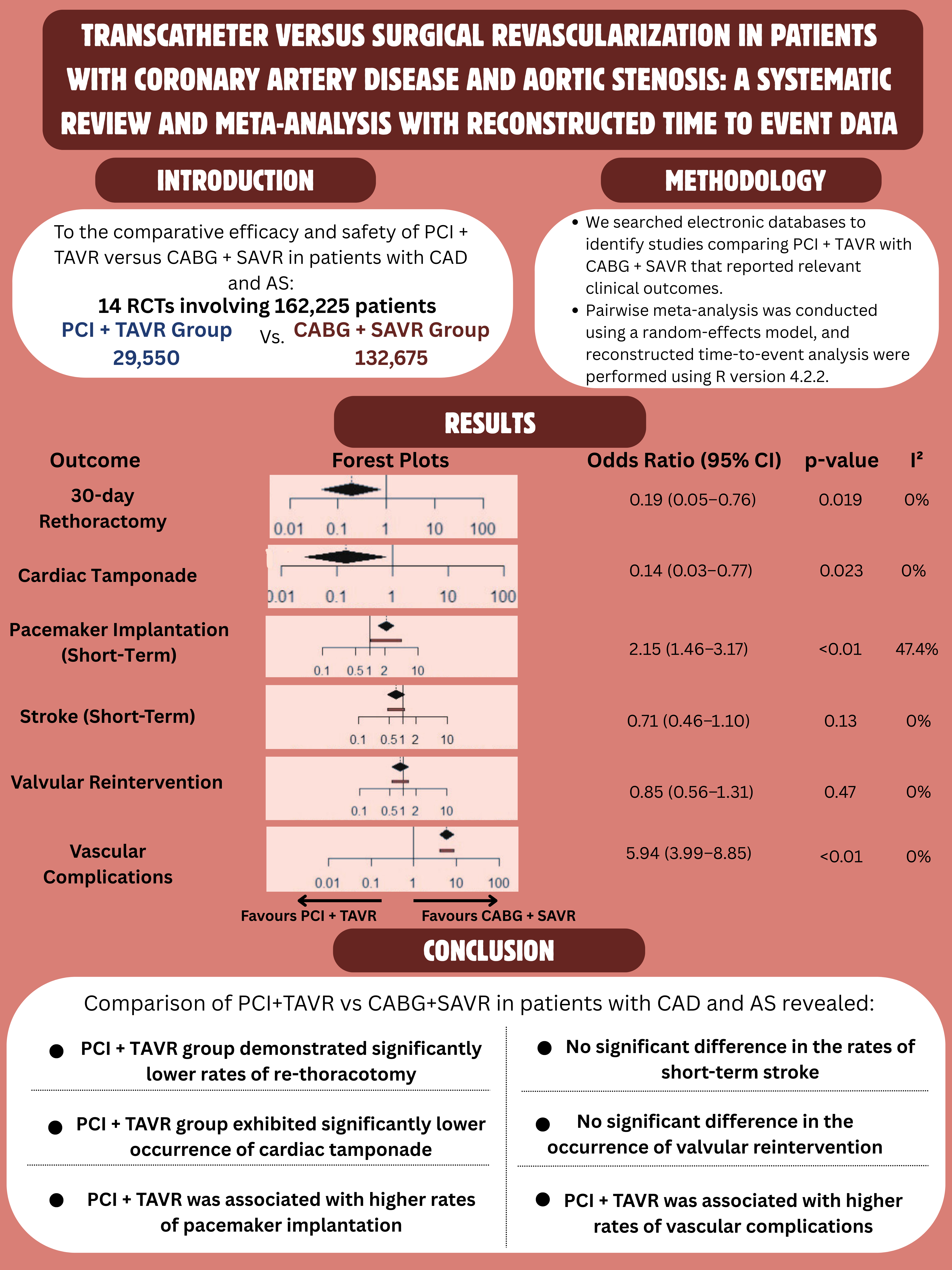
Transcatheter Versus Surgical Revascularization in Patients with Coronary Artery Disease and Aortic Stenosis: A Systematic Review and Meta-Analysis with Reconstructed Time to Event Data

Abstract Body (Do not enter title and authors here): Background
In patients with coexisting coronary artery disease (CAD) and aortic stenosis (AS), the comparative time-dependent event rates for percutaneous coronary intervention (PCI) with transcatheter aortic valve replacement (TAVR) versus coronary arteries bypass grafting (CABG) with surgical aortic valve replacement (SAVR) remain poorly characterized.
Research Question
What is the comparative efficacy and safety of PCI + TAVR versus CABG + SAVR in patients with CAD and AS, considering both short- and long-term clinical outcomes?
Methods
We searched electronic databases to identify studies comparing PCI + TAVR with CABG + SAVR that reported relevant clinical outcomes. Pairwise meta-analysis was conducted using a random-effects model, and reconstructed time-to-event analysis were performed using R version 4.2.2.
Results
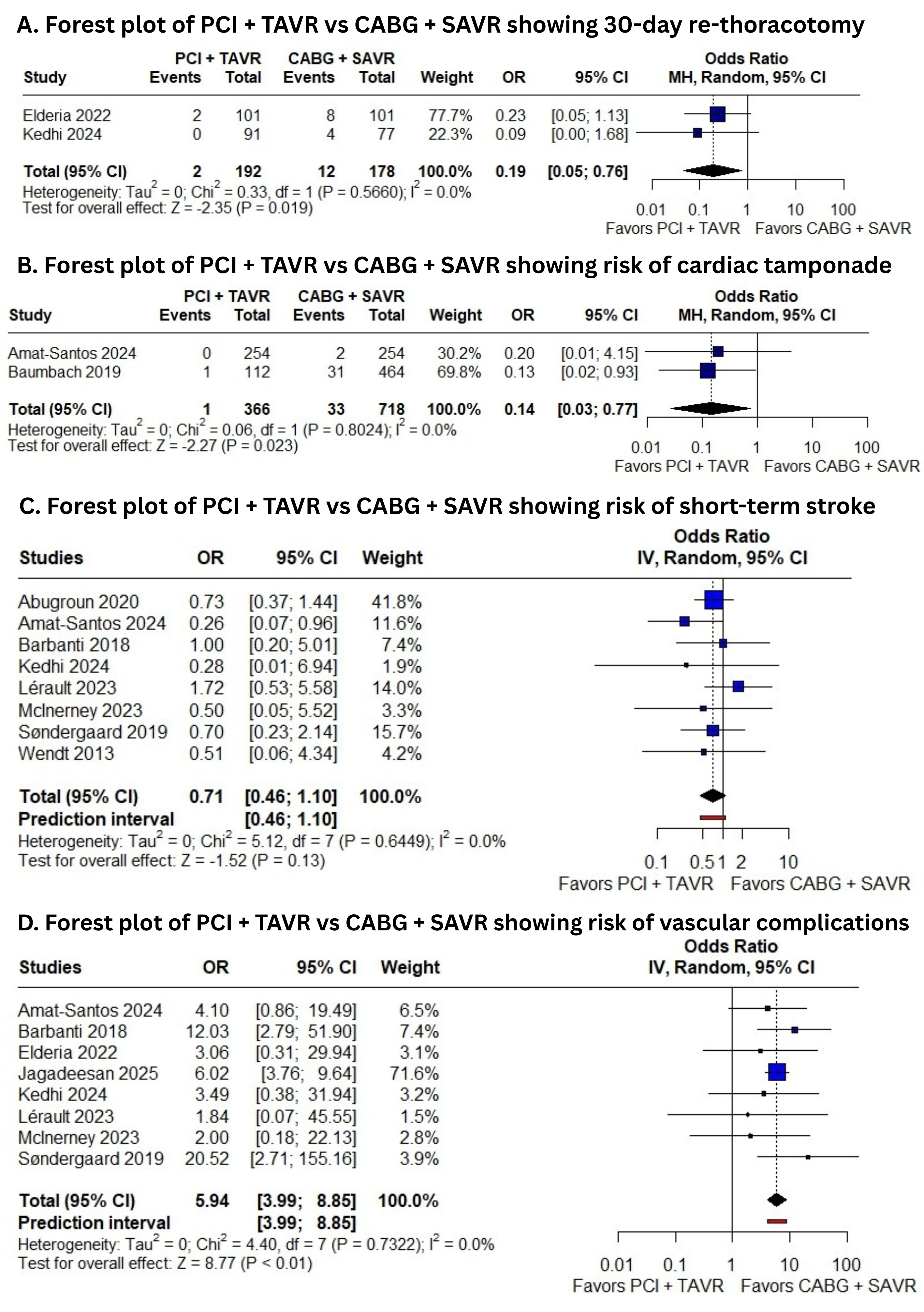
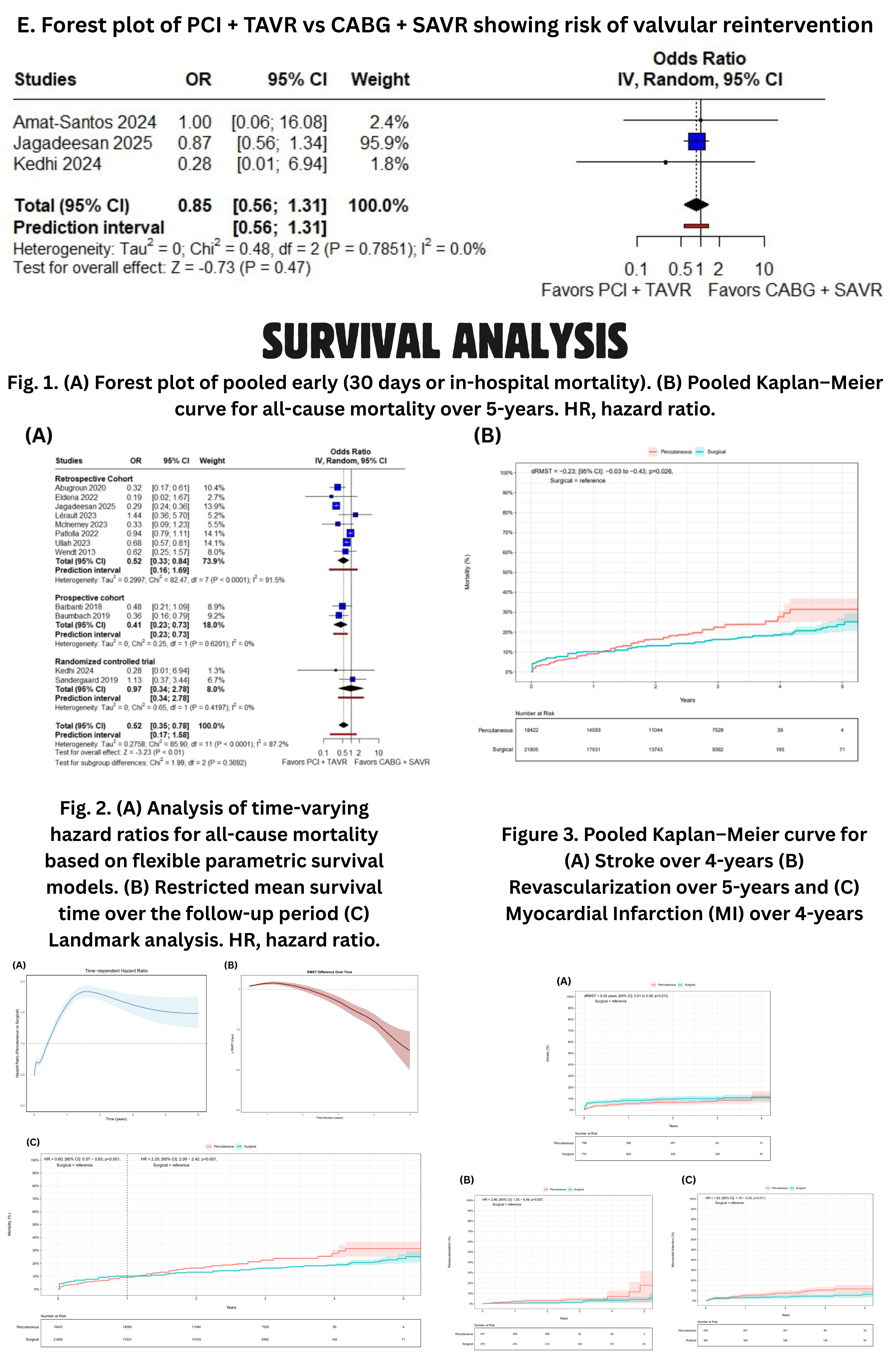
We included 14 studies comprising a total of 162,225 patients. Compared to CABG + SAVR, the PCI + TAVR group demonstrated significantly lower rates of early mortality (OR 0.52; 95% CI 0.35–0.78), re-thoracotomy (OR 0.19; 95% CI 0.05--0.76), atrial fibrillation (OR 0.16; 95% CI 0.09–0.28), acute kidney injury (OR 0.29; 95% CI 0.18–0.47), major bleeding (OR 0.51; 95% CI 0.28–0.94), and cardiac tamponade (OR 0.14; 95% CI 0.03–0.77). However, PCI + TAVR was associated with higher rates of pacemaker implantation (OR 2.15; 95% CI 1.46–3.17) and vascular complications (OR 5.94; 95% CI 3.99–8.85). There were no significant differences between the two strategies in the rates of stroke (OR 0.71; 95% CI 0.46–1.10), MI (OR 0.53; 95% CI 0.22–1.27), or valvular reintervention (OR 0.85; 95% CI 0.56–1.31). Reconstructed time-to-event analysis revealed that PCI + TAVR significantly reduced all-cause mortality at 1 year (p < 0.001), but was associated with increased mortality beyond 1 year (p < 0.001). MI (p = 0.01) and repeat revascularization (p = 0.007) were significantly higher in the percutaneous arm, although, percutaneous group had a longer stroke-free survival time (p = 0.015).
Conclusions
Our meta-analysis suggests that the percutaneous approach offers better short-term outcomes, whereas the surgical approach provides superior long-term benefits.
  • Iqbal, Asad  ( Bacha Khan Medical College , Mardan , Pakistan )
  • Waleed, Salem  ( Alexandria faculty of medicine , Alexandria , Egypt )
  • Ahmad, Ashfaq  ( Gomal Medical College , D.I Khan , Pakistan )
  • Binashikhbubkr, Noof K.  ( Hadhramout University , Hadhramout , Yemen )
  • Ahmad, Husnain  ( Shalamar Medical and Dental College , Lahore , Pakistan )
  • Ahmad, Maaz  ( Bacha Khan Medical College , Mardan , Pakistan )
  • Eltawansy, Sherif  ( Jersey Shore UMC , Monroe , New Jersey , United States )
  • Fernandes Oliveira Amador, Wellgner  ( UFCG , Cajazeiras , Brazil )
  • Ahmed, Ashraf  ( Yale University School of Medicine, Bridgeport Hospital , New Haven , Connecticut , United States )
  • Lajczak, Pawel  ( Medical University of Silesia , Zabrze , Poland )
  • Consoli, Leo  ( Federal University of Bahia - UFBA , Salvador , Brazil )
  • Ali, Muhammad Faizan  ( Jinnah Postgraduate Medical Center , Karachi , Pakistan )
  • Ahmed, Manahil  ( Jinnah Sindh Medical University , Karachi , Pakistan )
  • Mannan, Abdul  ( Rawalpindi Institute of Cardiology , Rawalpindi , Pakistan )
  • Rathi, Diya  ( Dow university of health sciences. , Karachi , Pakistan )
  • Author Disclosures:
    Asad Iqbal: No Answer | Salem Waleed: DO NOT have relevant financial relationships | ashfaq ahmad: No Answer | Noof K. Binashikhbubkr: No Answer | Husnain Ahmad: DO NOT have relevant financial relationships | Maaz Ahmad: DO NOT have relevant financial relationships | Sherif Eltawansy: DO NOT have relevant financial relationships | Wellgner Fernandes Oliveira Amador: DO NOT have relevant financial relationships | Ashraf Ahmed: No Answer | Pawel Lajczak: DO NOT have relevant financial relationships | Leo Consoli: DO NOT have relevant financial relationships | Muhammad Faizan Ali: DO NOT have relevant financial relationships | Manahil Ahmed: DO NOT have relevant financial relationships | Abdul Mannan: No Answer | Diya Rathi: DO NOT have relevant financial relationships
Meeting Info:

Scientific Sessions 2025

2025

New Orleans, Louisiana

Session Info:

Innovations in Aortic Valve Intervention: Surgery, TAVR, and What’s Next 2

Monday, 11/10/2025 , 10:45AM - 11:35AM

Moderated Digital Poster Session

More abstracts on this topic:
Activin Signaling Inhibition Enhances Cardiac Functional Recovery After Aortic Debanding

Singh Anand, Guseh James Sawalla, Xiao Chunyang, Babbs Keith, Seehra Jasbir, Li Haobo, Rosenzweig Anthony

Application and Outcomes of Coronary Atherectomy in Patients with Acute Coronary Syndrome: A Report from the Nationwide J-PCI Registry

Aikawa Tadao, Minamino Tohru, Mori Yuichiro, Kohsaka Shun, Matsue Yuya, Kuno Toshiki, Yamaji Kyohei, Ozaki Dai, Tokano Takashi, Kozuma Ken

More abstracts from these authors:
Cerebral Embolic Protection in TAVI: Does It Improve Outcomes? A Comprehensive Meta-Analysis and Trial Sequential Analysis

Ali Muhammad Faizan, Abdul Rehman Khawaja, Hemida Mohamed Fawzi, Ahmed Ashraf, Younas Muhammad, Ahmad Husnain, Eltawansy Sherif, Abdul Malik Mohammad Hamza Bin, Mehdi Hassan

Cardiovascular Outcomes of Oral Incretin-Based Therapies in Type 2 Diabetes: A Systematic Review and Meta-Analysis of 62,821 Patients

Ali Muhammad Faizan, Tariq Ammarah, Arshad Muhammad Usman, Binashikhbubkr Noof K., Alam Umama, Eltawansy Sherif, Abdul Malik Mohammad Hamza Bin, Iqbal Asad, Hemida Mohamed Fawzi, Ahmed Ashraf, Naseer Faisal, Shazly Omar, Ahmad Husnain, Shafi Nimra, Mohammed Omer Farooq

You have to be authorized to contact abstract author. Please, Login
Not Available