Logo

American Heart Association

  23
  0


Final ID: MP16

Cerebral Embolic Protection in TAVI: Does It Improve Outcomes? A Comprehensive Meta-Analysis and Trial Sequential Analysis

Abstract Body (Do not enter title and authors here): Background: Previous evidence from randomized controlled trials (RCTs) on cerebral embolic protection (CEP) during transcatheter aortic valve implantation (TAVI) has been inconclusive. The recent PROTECT TAVI trial, the largest RCT to date, offers new data to reassess outcomes. We conducted a comprehensive meta-analysis with trial sequential analysis (TSA) to provide an up-to-date evaluation of the clinical impact of CEP in TAVI patients.
Research question: Does the use of CEP improve clinical outcomes, including all-cause mortality and stroke, in patients undergoing TAVI who are at increased risk for these adverse events?
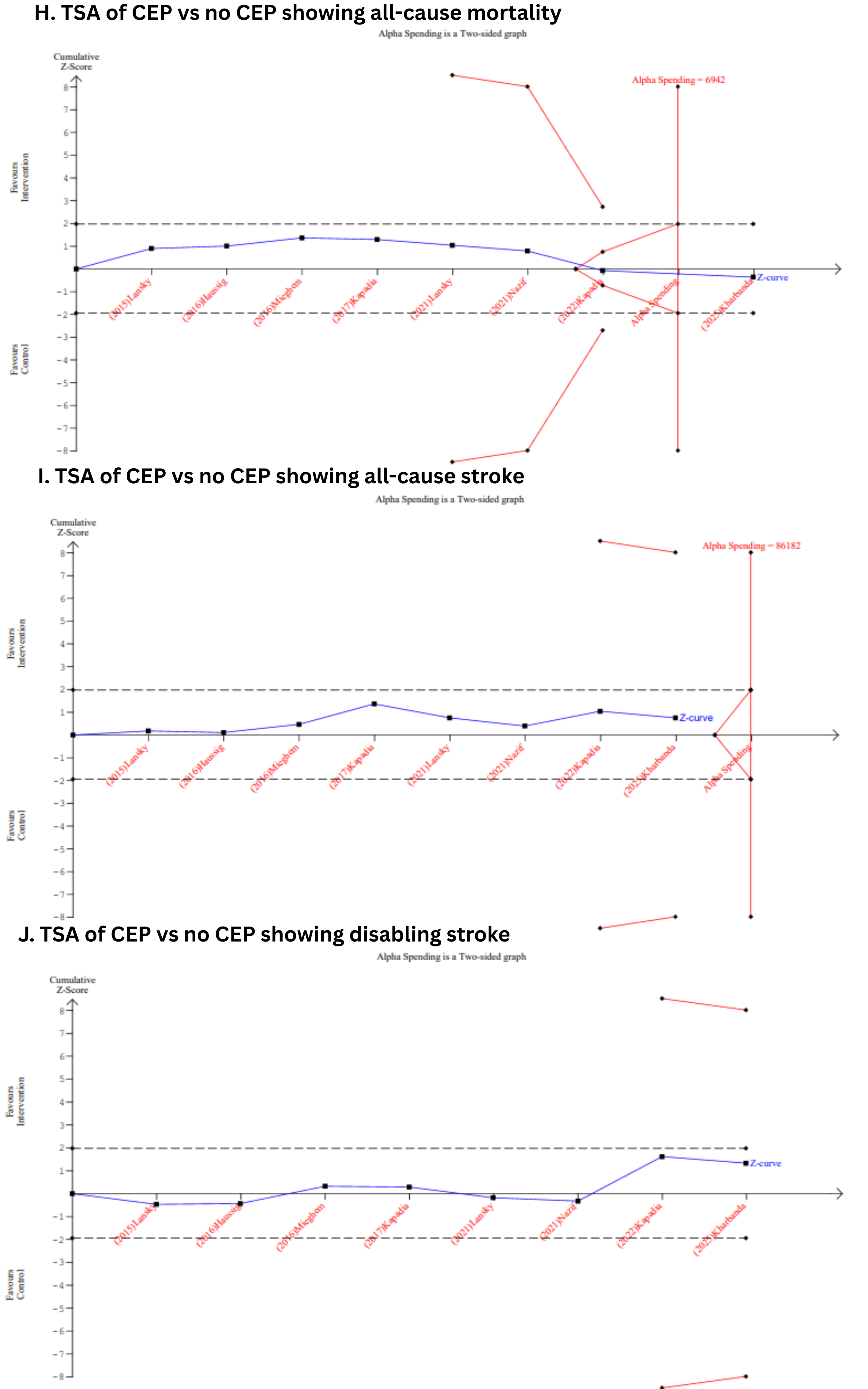
Methods: A comprehensive search of databases was conducted to identify RCTs. Pairwise meta-analyses were performed using a random-effects model. Moreover, TSA was employed to calculate the required information size and construct monitoring boundaries for statistical significance and futility, assuming a two-sided alpha of 5% and 90% power. All statistical analyses were carried out using R software.
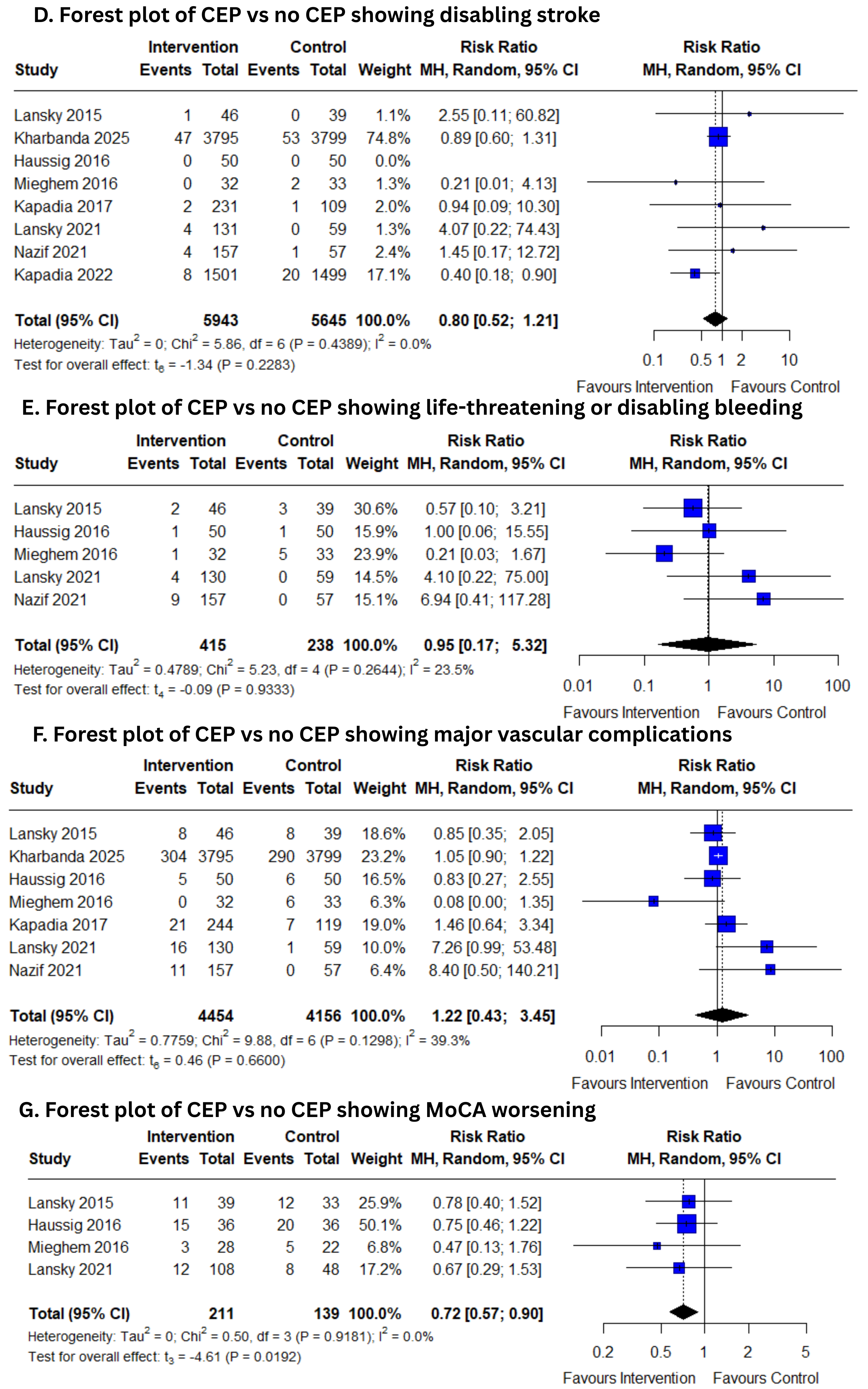
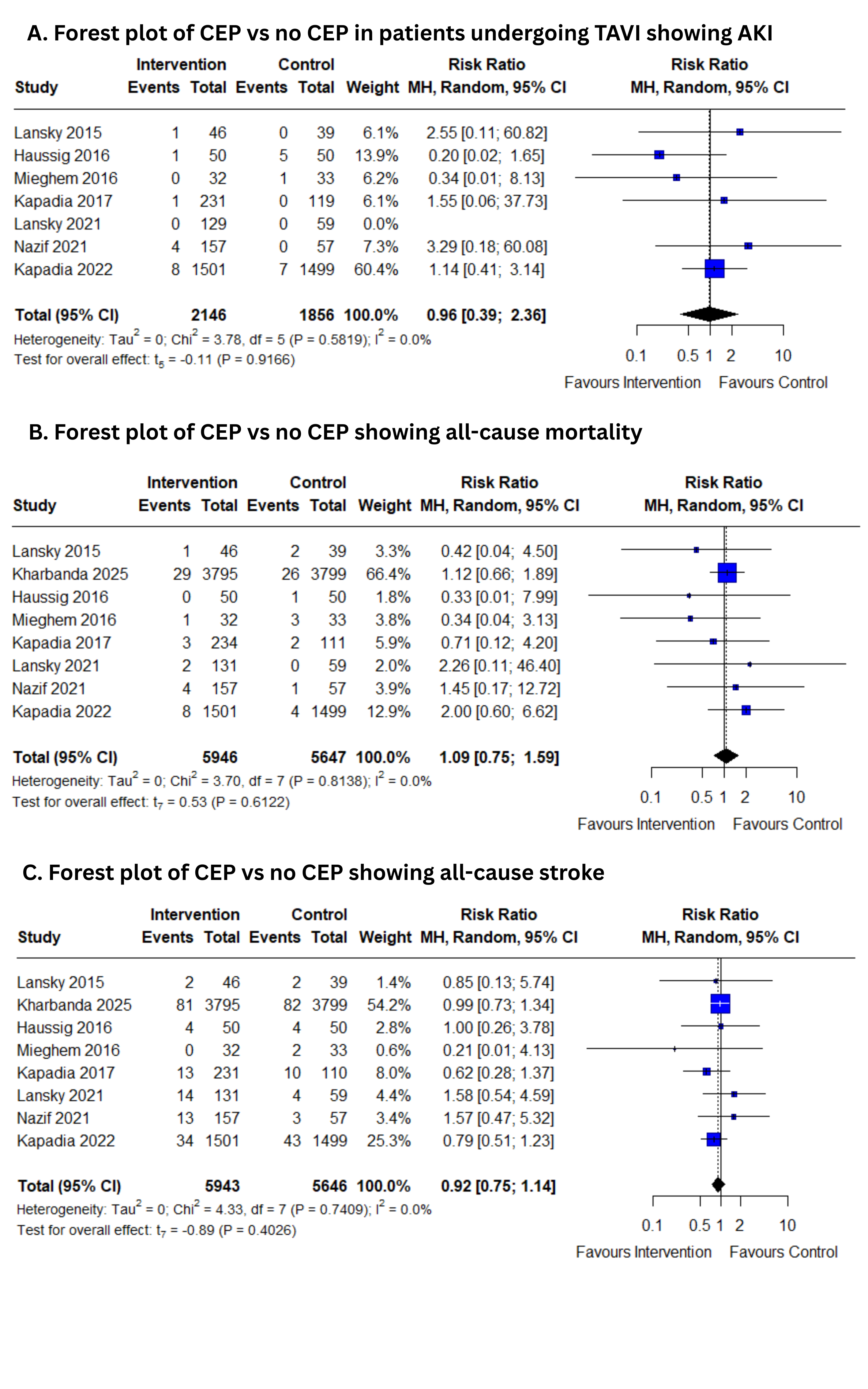
Results: Eight RCTs encompassing a total of 11,666 patients were included, of whom 5,986 received CEP devices and 5,680 did not. Pairwise meta-analysis demonstrated no significant differences between two groups in terms of all-cause mortality (RR: 1.09; 95% CI: 0.75–1.56), all stroke (RR: 0.92; 95% CI: 0.75–1.14), disabling stroke (RR: 0.80; 95% CI: 0.52–1.21), life-threatening or disabling bleeding (RR: 0.95; 95% CI: 0.17–5.32), major vascular complications (RR: 1.22; 95% CI: 0.43–3.45), worsening of the NIHSS score (RR: 1.21; 95% CI: 0.70–2.10), presence of ischemic brain lesions (RR: 1.00; 95% CI: 0.93–1.07), and acute kidney injury (RR: 0.96; 95% CI: 0.39–2.36). However, use of CEP was associated with a statistically significant reduction in the risk of worsening Montreal Cognitive Assessment (MoCA) scores (RR: 0.72; 95% CI: 0.57–0.90; P = 0.01). TSA showed that the cumulative evidence for all stroke, and disabling stroke did not reach the required information size, indicating insufficient evidence to confirm a statistically significant benefit of CEP in reducing these outcomes. However, futility boundary was reached for all-cause mortality.
Conclusion: While CEP did not significantly impact major clinical outcomes, it was associated with improved cognitive preservation. TSA indicated that evidence for reducing all stroke, and disabling stroke remains inconclusive due to insufficient information size. Further high-quality RCTs are warranted.
  • Ali, Muhammad Faizan  ( Jinnah Postgraduate Medical Center , Karachi , Pakistan )
  • Abdul Rehman, Khawaja  ( CMH Lahore Medical College , Lahore , Pakistan )
  • Hemida, Mohamed Fawzi  ( Alexandria Faculty of Medicine , Alexandria , Egypt )
  • Ahmed, Ashraf  ( Department of Medicine, Yale University School of Medicine, Bridgeport Hospital , Connecticut , Connecticut , United States )
  • Younas, Muhammad  ( Gomal medical college Dera Ismail k , Dera Ismail khan , Pakistan )
  • Ahmad, Husnain  ( Shalamar Medical and Dental College , Lahore , Pakistan )
  • Eltawansy, Sherif  ( Jersey Shore UMC , Monroe , New Jersey , United States )
  • Abdul Malik, Mohammad Hamza Bin  ( Nassau University Medical Center , East Meadow , New York , United States )
  • Mehdi, Hassan  ( Jinnah Postgraduate Medical Center , Karachi , Pakistan )
  • Author Disclosures:
    Muhammad Faizan Ali: DO NOT have relevant financial relationships | Khawaja Abdul Rehman: DO NOT have relevant financial relationships | Mohamed Fawzi Hemida: DO NOT have relevant financial relationships | Ashraf Ahmed: No Answer | Muhammad Younas: DO NOT have relevant financial relationships | Husnain Ahmad: DO NOT have relevant financial relationships | Sherif Eltawansy: DO NOT have relevant financial relationships | Mohammad Hamza Bin Abdul Malik: DO NOT have relevant financial relationships | hassan mehdi: DO NOT have relevant financial relationships
Meeting Info:

Scientific Sessions 2025

2025

New Orleans, Louisiana

Session Info:

Intersecting Pathways: Cardiac Health, Therapies, and Stroke Prevention Gaps

Saturday, 11/08/2025 , 12:15PM - 01:30PM

Moderated Digital Poster Session

More abstracts on this topic:
ACUTE ISCHEMIC STROKE IN YOUNG CANNABIS USERS: A NATIONWIDE ANALYSIS

Joseph Varughese Vivek, Anil Peethambar Gowri, Jayaraj Ranjini Nived, Mummadisetty Anvitha

A multifaceted family intervention for blood pressure management in rural China: an open label, parallel group, cluster randomized trial (Healthy Family Program)

Jiang Chao, Dong Jianzeng, Cai Jun, Anderson Craig, Du Xin, Tang Yangyang, Han Rong, Song Yanna, Wang Chi, Lin Xiaolei, Yi Yang, Rodgers Anthony, Ma Changsheng

More abstracts from these authors:
A Quarter Century of Cardiovascular Risk: National Mortality Trends in Hypertension and Arrhythmias Among U.S. Adults Aged 55 and Older

Ahmad Husnain, Khan Muhammad, Sharif Aleena, Hossain Mohammad, Eltawansy Sherif, Faizan Muhammad, Ali Muhammad Faizan, Ahmed Ashraf, Abdul Malik Mohammad Hamza Bin, Pahwani Ritesh, Patel Rahul, Mehdi Hassan

Cardiovascular Outcomes of Oral Incretin-Based Therapies in Type 2 Diabetes: A Systematic Review and Meta-Analysis of 62,821 Patients

Ali Muhammad Faizan, Tariq Ammarah, Arshad Muhammad Usman, Binashikhbubkr Noof K., Alam Umama, Eltawansy Sherif, Abdul Malik Mohammad Hamza Bin, Iqbal Asad, Hemida Mohamed Fawzi, Ahmed Ashraf, Naseer Faisal, Shazly Omar, Ahmad Husnain, Shafi Nimra, Mohammed Omer Farooq

You have to be authorized to contact abstract author. Please, Login
Not Available