
Logo

American Heart Association

  18
  0


Final ID: Mo3102

Aortic Tortuosity Predicts Conduction Disturbances After TAVR via Aortic Angle and Membranous Septum Length: A Structural Equation Modeling Approach

Abstract Body (Do not enter title and authors here): Background:
Transcatheter aortic valve replacement (TAVR) has broadened treatment options for elderly patients with severe aortic valve stenosis (AVS), including those with challenging vascular anatomy such as increased aortic tortuosity. We previously demonstrated that a higher aortic tortuosity index (ATI), defined as the ratio of aortic length (from the sinotubular junction to the terminal aorta) to body height measured by 3D-computed tomography, was associated with complete atrioventricular block (CAVB). However, the anatomical mechanisms linking ATI to conduction disturbances (CD) requiring pacemaker implantation (PMI) remain unclear.
Purpose:
To investigate whether anatomical variations—specifically, aortic angle and membranous septum (MS) length—mediate the association between ATI and CD requiring PMI after TAVR.
Methods:
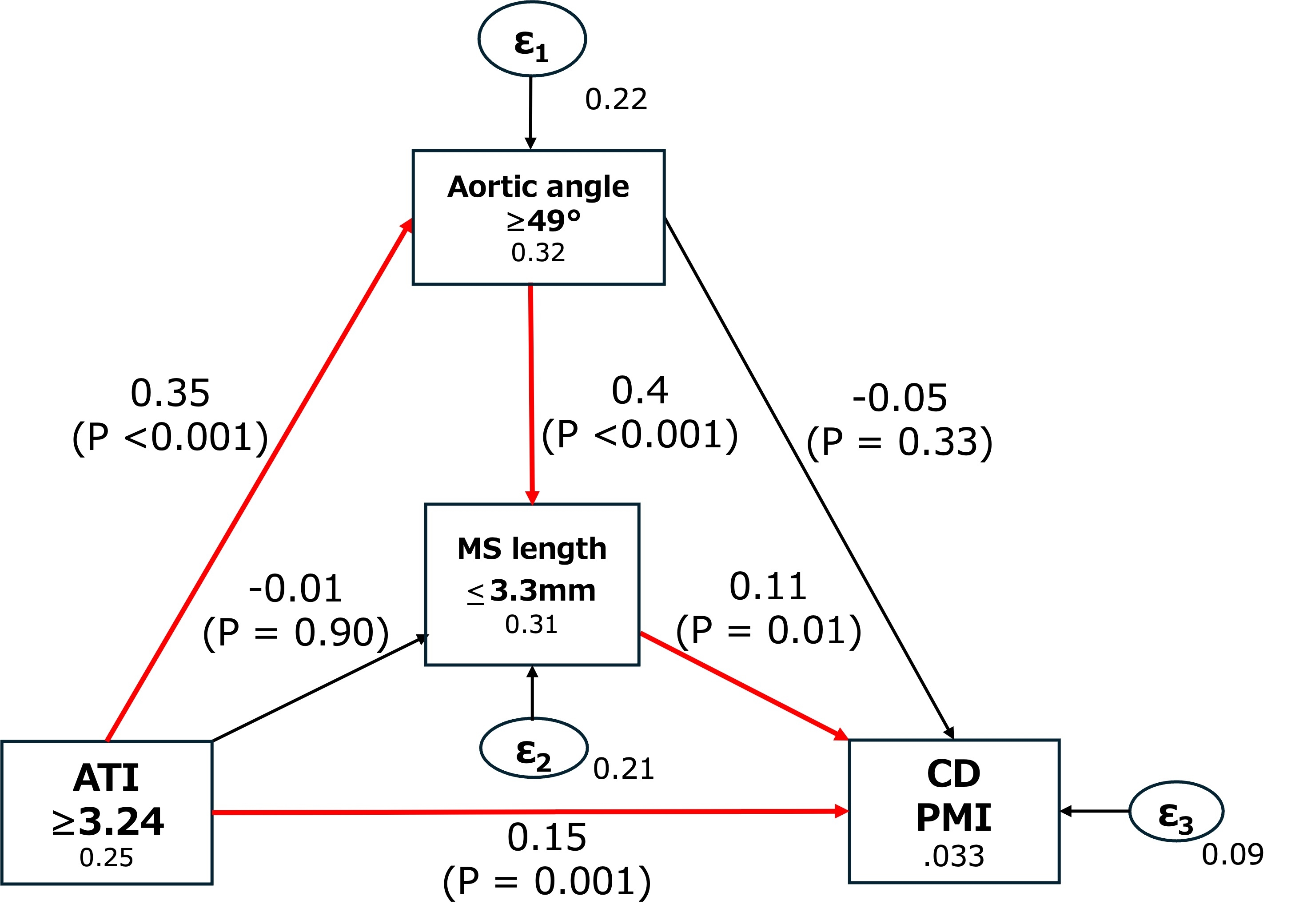
We analyzed 198 consecutive patients with severe AVS who underwent TAVR. ATI, aortic angle, and MS length were quantified using pre-procedural 3D-CT imaging. CD requiring PMI within 30 days post-TAVR was observed in 20 patients (10.2%). Patients were stratified by median ATI (3.24), aortic angle (49°), and MS length (3.3 mm). Structural equation modeling (SEM) was applied to evaluate both direct and indirect effects of ATI on CD through aortic angle and MS length.
Results:
Patients with higher ATI (>3.24) had a significantly greater incidence of CD requiring PMI than those with lower ATI (18.2% vs. 3.0%, p = 0.001). SEM demonstrated a significant direct effect of higher ATI on CD (path coefficient = 0.26, p < 0.01), along with a significant indirect effect mediated by aortic angle and MS length (path coefficient = 0.15, p < 0.05).
Conclusion:
Higher ATI is associated with increased risk of CD requiring PMI after TAVR, and this relationship is mediated by steeper aortic angle and shorter MS length. Aortic tortuosity may reflect age-related anatomical remodeling that predisposes patients to conduction injury during TAVR.
  • Nakamura, Takamitsu  ( UNIVERSITY OF YAMANASHI , Chuo , Japan )
  • Horikoshi, Takeo  ( UNIVERSITY OF YAMANASHI , Chuo , Japan )
  • Eguchi, Miu  ( University of Yamanashi , Yamanashi-ken Chuo-shi , Japan )
  • Kobayashi, Tsuyoshi  ( University of Yamanashi , Yamanashi-ken Chuo-shi , Japan )
  • Uematsu, Manabu  ( Yamanashi University , Chuo , Japan )
  • Yoshizaki, Toru  ( University of Yamanashi , Yamanashi-ken Chuo-shi , Japan )
  • Sato, Akira  ( University of Yamanashi , Yamanashi-ken Chuo-shi , Japan )
  • Author Disclosures:
    Takamitsu Nakamura: DO NOT have relevant financial relationships | Takeo Horikoshi: DO NOT have relevant financial relationships | Miu Eguchi: DO NOT have relevant financial relationships | Tsuyoshi Kobayashi: No Answer | Manabu Uematsu: DO NOT have relevant financial relationships | Toru Yoshizaki: DO NOT have relevant financial relationships | Akira Sato: DO NOT have relevant financial relationships
Meeting Info:

Scientific Sessions 2025

2025

New Orleans, Louisiana

Session Info:

Aortic Valve Under Pressure: Mechanisms, Models, and Molecular Insights

Monday, 11/10/2025 , 10:30AM - 11:30AM

Abstract Poster Board Session

More abstracts on this topic:
More abstracts from these authors:
Paclitaxel distribution assessment after drug-coated balloon treatment in the superficial femoral artery: SNOW grade

Horikoshi Takeo, Nakamura Takamitsu, Takei Toshiki, Eguchi Miu, Yoshizaki Toru, Kobayashi Tsuyoshi, Sato Akira

Unveiling Phenotypic Heterogeneity in Coronary Spastic Angina through Multidimensional Risk Profiling: The FUJI-SPASM Study

Nakamura Takamitsu, Horikoshi Takeo, Uematsu Manabu, Deyama Juntaro, Kobayashi Tsuyoshi, Yoshizaki Toru, Eguchi Miu, Sato Akira

You have to be authorized to contact abstract author. Please, Login
Not Available