
Logo

American Heart Association

  43
  0


Final ID: MP1316

Inverse Association Between Educational Attainment and Cardiovascular Mortality: A Nationwide Investigation from the United States in 2022

Abstract Body (Do not enter title and authors here): Background:
Educational attainment is a key social determinant of health. However, the extent to which cardiovascular mortality rates differ by education level in the contemporary U.S. population remains underexplored.
Methods:
We used the CDC WONDER database to obtain the number of cardiovascular deaths in 2022, defined by ICD-10 codes I00–I99 as the underlying cause of death. Population estimates were obtained from the U.S. Census Bureau, stratified by 10-year age groups (≥25 years). Age-adjusted mortality rates (AAMRs) were calculated using the direct method and the 2000 U.S. standard population across eight levels of educational attainment, from ≤8th grade to doctoral or professional degrees. Trends across education levels were evaluated using inverse-variance–weighted linear regression in the total U.S. population and among males and females.
Results:
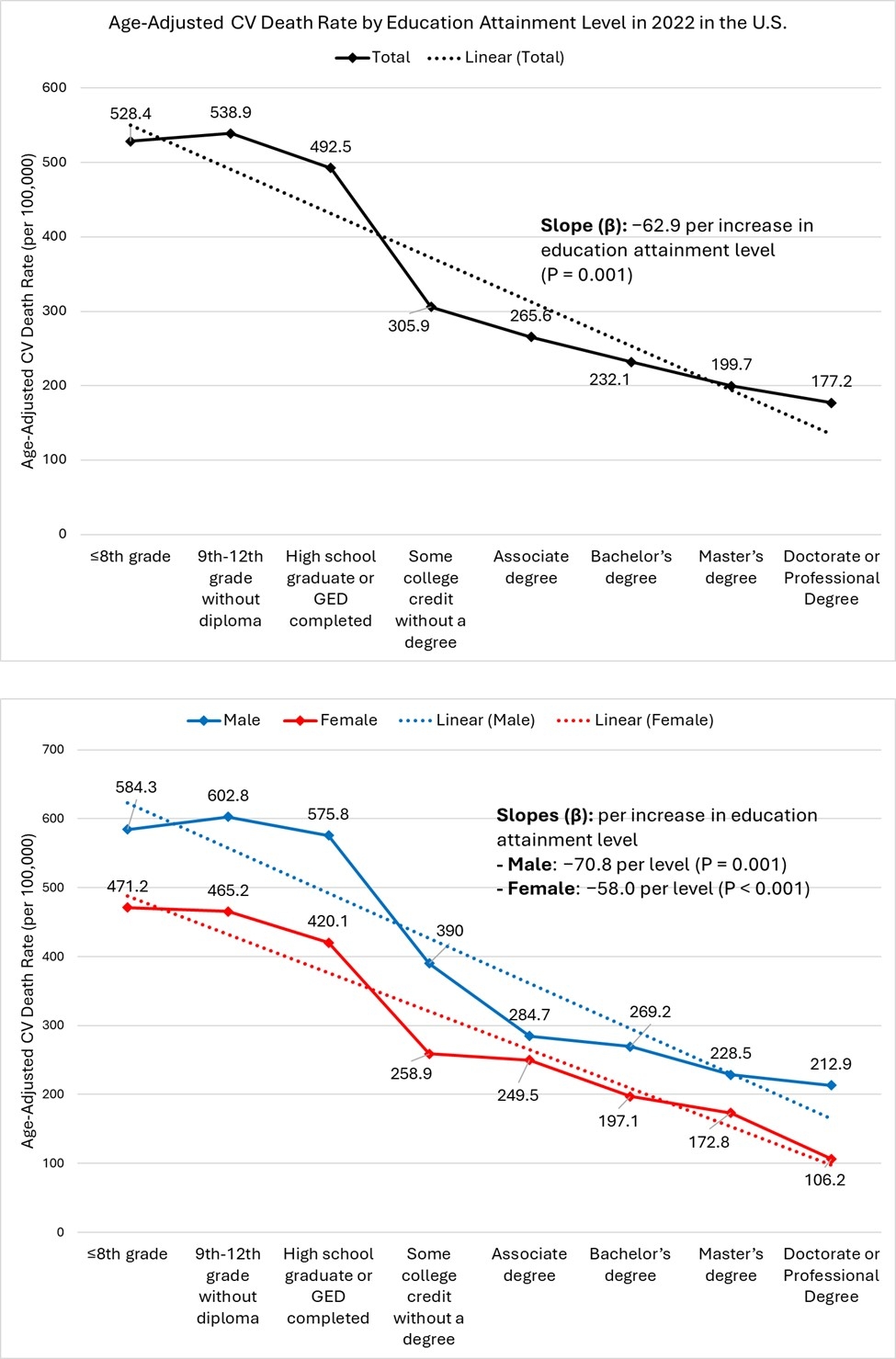
In 2022, a total of 914,922 cardiovascular deaths occurred in the United States. AAMRs declined progressively with increasing education. Among the overall population, the AAMR decreased from 528.4 per 100,000 in individuals with ≤8th grade education to 177.2 per 100,000 among those with doctoral degrees. Each one-level increase in educational attainment was associated with a 62.9-unit decrease in AAMR (β = −62.9; P = 0.001). Similar inverse trends were observed among males (β = −70.8; P = 0.001) and females (β = −58.0; P < 0.001). Males consistently exhibited higher AAMRs than females at each level of education, although the sex disparity narrowed with higher educational attainment.
Conclusions:
Higher educational attainment is associated with lower cardiovascular mortality in the United States, with consistent inverse gradients observed among both sexes. Further studies are needed to evaluate the association between education level and the management of cardiovascular risk factors, and to adjust for other potential confounders that may influence this relationship.
  • Rashedi, Sina  ( Brigham and Women's Hospital , Boston , Massachusetts , United States )
  • Alilou, Sanam  ( NYU Langone Health , Boston , Massachusetts , United States )
  • Author Disclosures:
    SINA RASHEDI: DO NOT have relevant financial relationships | Sanam Alilou: DO NOT have relevant financial relationships
Meeting Info:

Scientific Sessions 2025

2025

New Orleans, Louisiana

More abstracts on this topic:
A New Biomarker of Aging Derived From Electrocardiogram Improves Risk Prediction of Incident Myocardial Infarction and Stroke.

Wilsgaard Tom, Rosamond Wayne, Schirmer Henrik, Lindekleiv Haakon, Attia Zachi, Lopez-jimenez Francisco, Leon David, Iakunchykova Olena

Burden of Non-Rheumatic Valvular Heart Disease in High-income Asia Pacific from 1990-2019: A Benchmarking analysis

Shaikh Salomi, Amin Vishrant, Desai Hardik, Sharma Kamal, Shandilya Ashwinikumar, Patel Khushbu, Waqas Muhammad, Syed Saif, Lakkimsetti Mohit, Bhalodia Paritaben, Islam Hamza, Patel Juhi

You have to be authorized to contact abstract author. Please, Login
Not Available