
Logo

American Heart Association

  16
  0


Final ID: MP1558

Optimal GDMT Use According to Frailty Status Following Diagnosis of HFrEF Among Medicare Fee for Service Beneficiaries

Abstract Body (Do not enter title and authors here): Background: Frailty and HF often co-exist identifying a population at increased risk for CV events. While perceived frailty may be a potential driver of clinical inertia, conventional HF therapy may reduce worsening HF and hospitalization which can lead to progressive frailty. Few contemporary data exist examining longitudinal patterns of GDMT use according to frailty status.
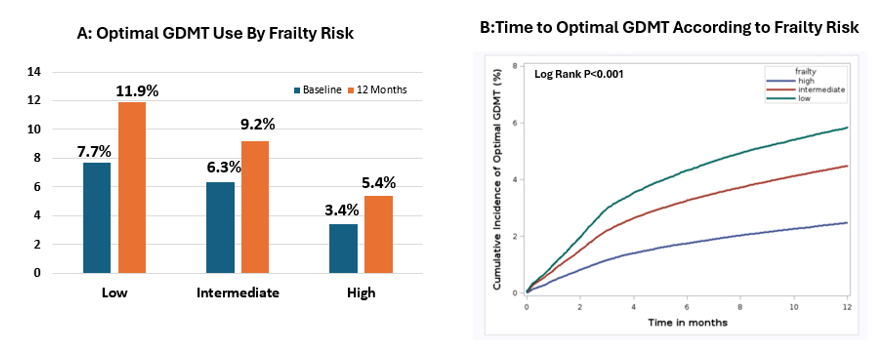
Methods: In this retrospective nationwide cohort study, we identified 548, 841 patients with a new diagnosis of HFrEF in a 100% Medicare Fee for service sample with available data for Part D medication use between January 2016 to December 2023. Frailty was assessed using the Hospital Frailty Risk Score (HFRS) derived from ICD-10 codes and patients were categorized as low (HFRS<5), intermediate (HFRS 5-15) and high (HFRS>15) frailty risk. Optimal quadruple GDMT was defined as ≥ 50% of the target daily dose of beta blocker and ACEi/ARB or any dose of ARNI, MRA or SGLT2i. Time to optimal GDMT use according HFRS category was assessed using cumulative incidence curves.
Results: Among 548, 841 patients with a new diagnosis of HFrEF, the mean age was 77 ± 11 years, 48% were women and the median HFRS was 77. 123,798(23%), 239,669 (44%) and 185,374 (34%) of patients were categorized as low, intermediate and high frailty risk, respectively. Compared to patients in the lowest frailty risk category, patients in the intermediate (HR 1.38; 95%CI: 1.35-1.41) and high risk(HR1.95; 95%CI: 1.90-2.00) categories experienced greater risk of mortality. The proportional use of optimal GDMT was lowest among patients with the highest levels of frailty at baseline (low: 7.7%; intermediate: 6.3%, high: 3.4%; P<0.0001) and remained suboptimal at 12 months (low: 11.9%; intermediate: 9.2%, high: 5.4%; P<0.0001); Figure 1. Among patient not on optimal GDMT at baseline, patients with the highest frailty risk had a significantly lower probability of achieving optimal GDMT in follow up(P<0.001); Figure 1. Achievement of optimal GDMT in follow up was associated with a substantially lower risk of subsequent 1 year mortality (HR 0.50; 95%CI: 0.47-0.52) independent of frailty burden (P<0.0001).
Conclusion: In this nationwide cohort of newly diagnosed HFrEF, approximately 1 in 3 patients had high frailty risk. Such patients experienced worse outcomes and both the lowest proportional use and greatest time to optimal GDMT in follow up highlighting significant implementation gaps in this high-risk population.
  • Chatur, Safia  ( Brigham and Women`s Hospital/Harvard , Boston , Massachusetts , United States )
  • Mentias, Amgad  ( Cleveland Clinic , Cleveland , Ohio , United States )
  • Keshvani, Neil  ( University of Texas Southwestern , Dallas , Texas , United States )
  • Ibrahim, Rashedat  ( UT Southwestern Medical Center , Dallas , Texas , United States )
  • Thibodeau, Jennifer  ( UT Southwestern , Dallas , Texas , United States )
  • Januzzi, James  ( Masachusetts General Hospital , Boston , Massachusetts , United States )
  • Vaduganathan, Muthiah  ( Brigham and Womens Hospital , Boston , Massachusetts , United States )
  • Pandey, Ambarish  ( UT Southwestern Medical Center , Dallas , Texas , United States )
  • Author Disclosures:
    Safia Chatur: DO NOT have relevant financial relationships | Amgad Mentias: DO NOT have relevant financial relationships | Neil Keshvani: DO have relevant financial relationships ; Consultant:Science37:Active (exists now) ; Consultant:Idorsia Pharmaceuticals:Past (completed) ; Consultant:Tricog Health, Inc:Past (completed) | Rashedat Ibrahim: DO NOT have relevant financial relationships | Jennifer Thibodeau: DO NOT have relevant financial relationships | James Januzzi: No Answer | Muthiah Vaduganathan: DO have relevant financial relationships ; Consultant:American Regent, Amgen, AstraZeneca, Bayer AG, Baxter Healthcare, Bristol Myers Squibb, Boehringer Ingelheim, Chiesi, Cytokinetics, Esperion, Fresenius Medical Care, Idorsia Pharmaceuticals, Lexicon Pharmaceuticals, Merck, Milestone Pharmaceuticals, Novartis, Novo Nordisk, Pharmacosmos, Relypsa, Roche Diagnostics, Sanofi and Tricog Health:Active (exists now) ; Research Funding (PI or named investigator):Amgen, AstraZeneca, Boehringer Ingelheim, Galmed, Novartis, Bayer AG, Occlutech, Pharmacosmos, and Impulse Dynamics:Active (exists now) | Ambarish Pandey: DO have relevant financial relationships ; Consultant:Tricog:Active (exists now) ; Consultant:Sarfez Therapeutics, Edwards Lifesciences, Merck, Bayer, Anumana, Alleviant, Pfizer, Abbott, Axon Therapies, Kilele Health, Acorai, Kardigan, Novartis, Idorsia Pharma, and Science37:Active (exists now) ; Consultant:Rivus:Active (exists now) ; Consultant:iRhythm:Active (exists now) ; Researcher:SQ innovations:Active (exists now) ; Research Funding (PI or named investigator):SC Pharma:Active (exists now) ; Consultant:Astra Zeneca:Active (exists now) ; Research Funding (PI or named investigator):Ultromics:Active (exists now) ; Research Funding (PI or named investigator):Roche:Active (exists now) ; Consultant:Ultromics:Active (exists now) ; Consultant:Roche:Active (exists now) ; Consultant:Lilly:Active (exists now) ; Consultant:Bayer:Active (exists now) ; Consultant:Novo Nordisk:Active (exists now)
Meeting Info:

Scientific Sessions 2025

2025

New Orleans, Louisiana

Session Info:

Heart Failure, Unfiltered: Disparities, Devices, and the Diverse Faces of Risk

Sunday, 11/09/2025 , 03:15PM - 04:15PM

Moderated Digital Poster Session

More abstracts from these authors:
Epidemiology of Disease State Transitions Among Patients with New-Onset Heart Failure with Preserved Ejection Fraction

Keshvani Neil, Rabiei Shireen, Tao Kayla, Shimoni Or, Pandey Ambarish

Adverse Social Determinants of Health in a Low-Income Population Hospitalized with Heart Failure

Rizvi Syed Kazim, Lokesh Nidhish, Dhruve Ritika, Miller James, Keshvani Neil, Pandey Ambarish

You have to be authorized to contact abstract author. Please, Login
Not Available