
Epidemiology of Disease State Transitions Among Patients with New-Onset Heart Failure with Preserved Ejection Fraction
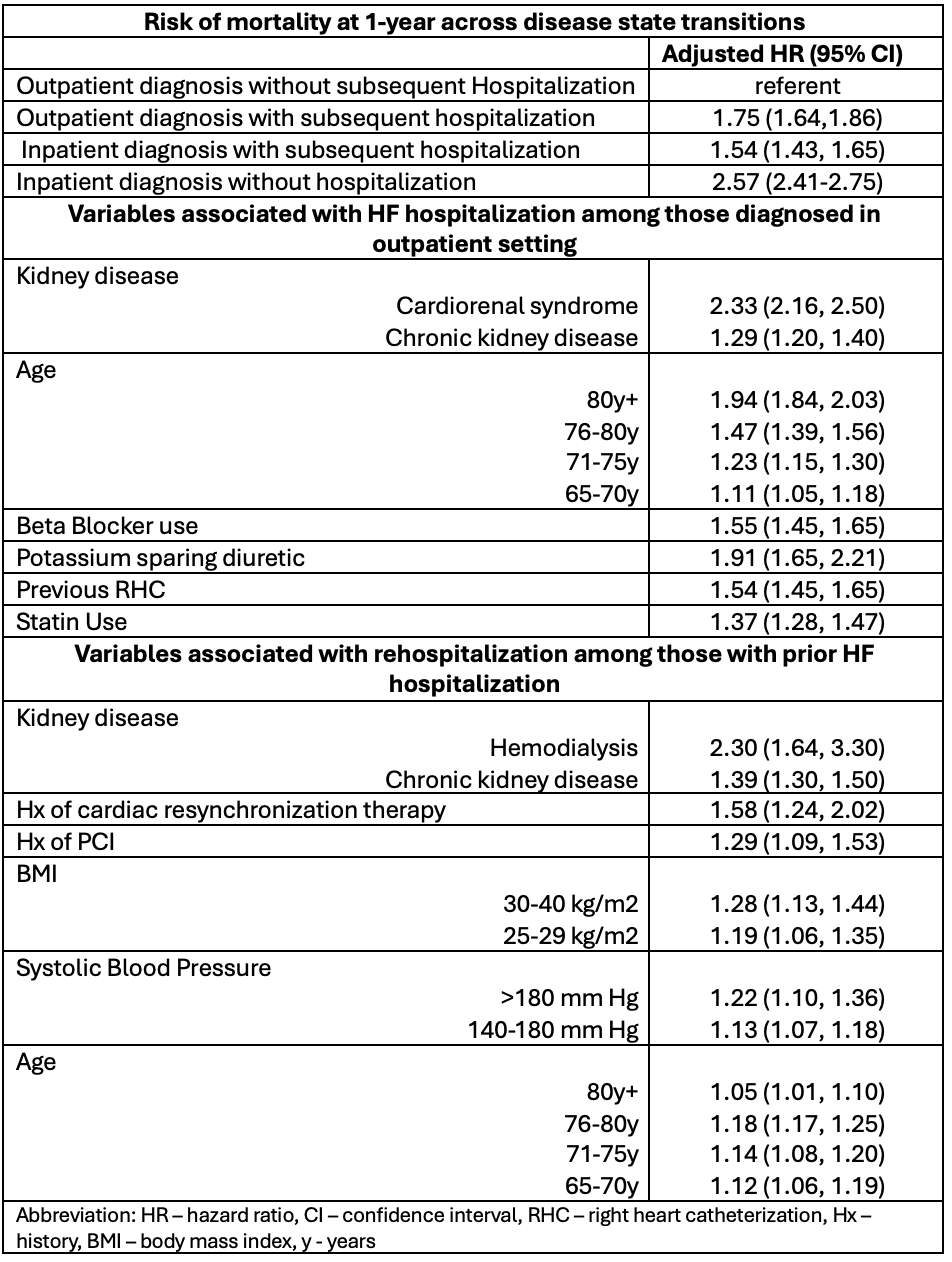
Abstract Body (Do not enter title and authors here): Introduction: The presentation of new-onset HFpEF varies among older adults, from progressive exercise intolerance in outpatients to acute HF hospitalization (HFH). The natural history of HFpEF based on its clinical presentation at the time of diagnosis (outpatient vs. HFH) is not well-characterized. Methods: Patients with new-onset HFpEF were identified in the Optum database from 2016-2022. Patients were grouped into 4 strata based on their clinical presentation at time of diagnosis (outpatient vs. HFH) and subsequent transition in disease state (subsequent HFH, yes vs. no). The predictors of progression in disease state (outpatient to first HFH to repeat HFH) and risk of mortality associated with each disease state transition were assessed using adjusted Cox models. Results: 99,370 patients (age 73.5y, 11.2% Black) were included, of which 38.6% were outpatient-diagnosed and 41.4% following an HFH. Patients with HFH-based HFpEF diagnosis (vs. outpatient) were younger, had lower burden of comorbidities, and had earlier follow-up with PCP or HF cardiologist following diagnosis (12 [IQR 4-59] vs.15 [4-72] days; p <0.001). 42.6% of outpatient-diagnosed HFpEF progressed to a subsequent HFH event, while 55.3% with HFH-based HFpEF diagnosis had a subsequent HFH (median time to event: 363 days[IQR 106-790] vs. 162 [IQR 34-505]days, p<0.001). In adjusted analyses, patients with outpatient diagnosis without subsequent HFH had the highest 12-month survival (88%), followed by inpatient-diagnosed patients with HFH (82%). Patients with HFH-based HFpEF diagnosis without subsequent HFH had the lowest 12-month survival (74%,Table). Significant predictors of HFH in the outpatient-diagnosed group included older age, worse kidney disease, and prior right heart cath. Significant predictors of rehospitalization included older age, higher blood pressure, obesity, worse kidney disease, and prior PCI (Table). Conclusion: 1/3rd of patients with HFpEF are outpatient-diagnosed, of which 42% progress to have an HFH within 1 year of diagnosis. Progressive disease state transitions from an outpatient setting to HFH is more common among older patients with a higher burden of comorbidities and is associated with a higher risk of mortality.
Keshvani, Neil
( University of Texas Southwestern
, Dallas
, Texas
, United States
)
Rabiei, Shireen
( Edwards Lifesciences
, Irvine
, California
, United States
)
Tao, Kayla
( Edwards Lifesciences
, Irvine
, California
, United States
)
Shimoni, Or
( Edwards Lifesciences
, Irvine
, California
, United States
)
Pandey, Ambarish
( University of Texas Southwestern
, Dallas
, Texas
, United States
)
Author Disclosures:
Neil Keshvani:DO have relevant financial relationships
;
Consultant:Tricog Health:Past (completed)
; Consultant:Heart Sciences:Past (completed)
| Shireen Rabiei:No Answer
| Kayla Tao:No Answer
| Or Shimoni:No Answer
| Ambarish Pandey:DO have relevant financial relationships
;
Consultant:Tricog:Active (exists now)
; Consultant:Lilly:Active (exists now)
; Consultant:Edwards Lifesciences:Active (exists now)
; Consultant:Semler:Active (exists now)
; Consultant:Science37:Active (exists now)
; Research Funding (PI or named investigator):SCPharma:Active (exists now)
; Advisor:Medtronic:Active (exists now)
; Advisor:Axon:Active (exists now)
; Advisor:Bayer:Active (exists now)
; Research Funding (PI or named investigator):Ultromics:Active (exists now)
; Consultant:Novo Nordisk:Active (exists now)
; Consultant:Roche:Active (exists now)