Burden of Anemia Due to Hypertensive CKD from 1990-2021: A Growing Global Crisis Extending from Low-Income Regions to the United States
Abstract Body (Do not enter title and authors here): Background:Chronic kidney disease(CKD) is a growing global health challenge, with hypertension being a leading cause of renal dysfunction across populations. A major yet underrecognized complication of hypertensive CKD (HTN-CKD) is anemia, which not only worsens renal outcomes but also amplifies cardiovascular risk through mechanisms like left ventricular hypertrophy and myocardial strain. Understanding its burden is critical, as anemia in this setting accelerates disease progression and contributes significantly to cardiovascular morbidity and mortality.
Method:We estimated the global and regional burden of anemia attributable to HTN-CKD in 204 countries and its terriotories from 1990-2021 using standardized Global Burden of Disease Study 2021. Estimates of prevalence and years lived with disability(YLDs) were generated using DisMod-MR 2.1, a Bayesian meta-regression tool that integrates data from population-based surveys, cohort studies, hospital records, and vital registration systems. Age-standardized rates were calculated to facilitate comparisons across time and regions, and annualized percentage changes(APCs) were computed using log-linear regression.
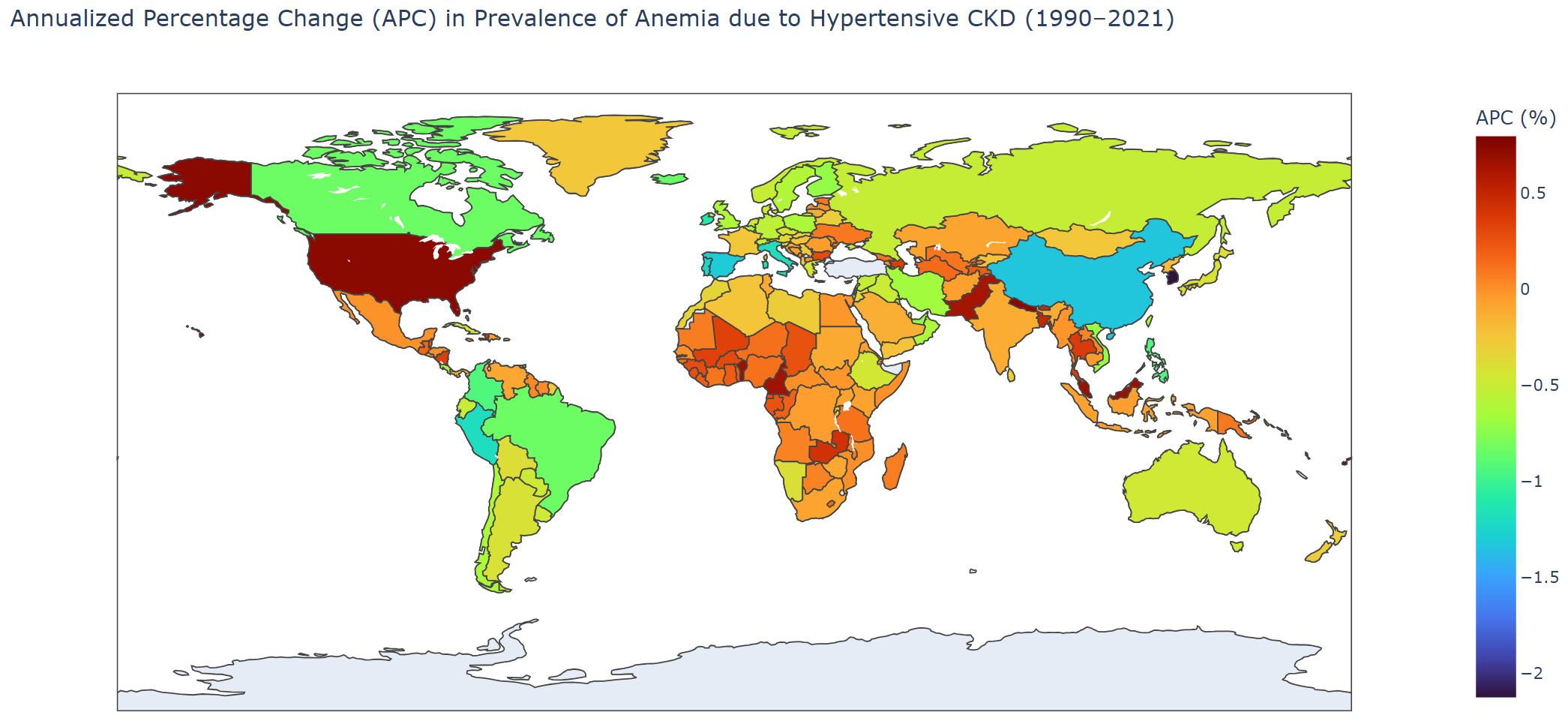
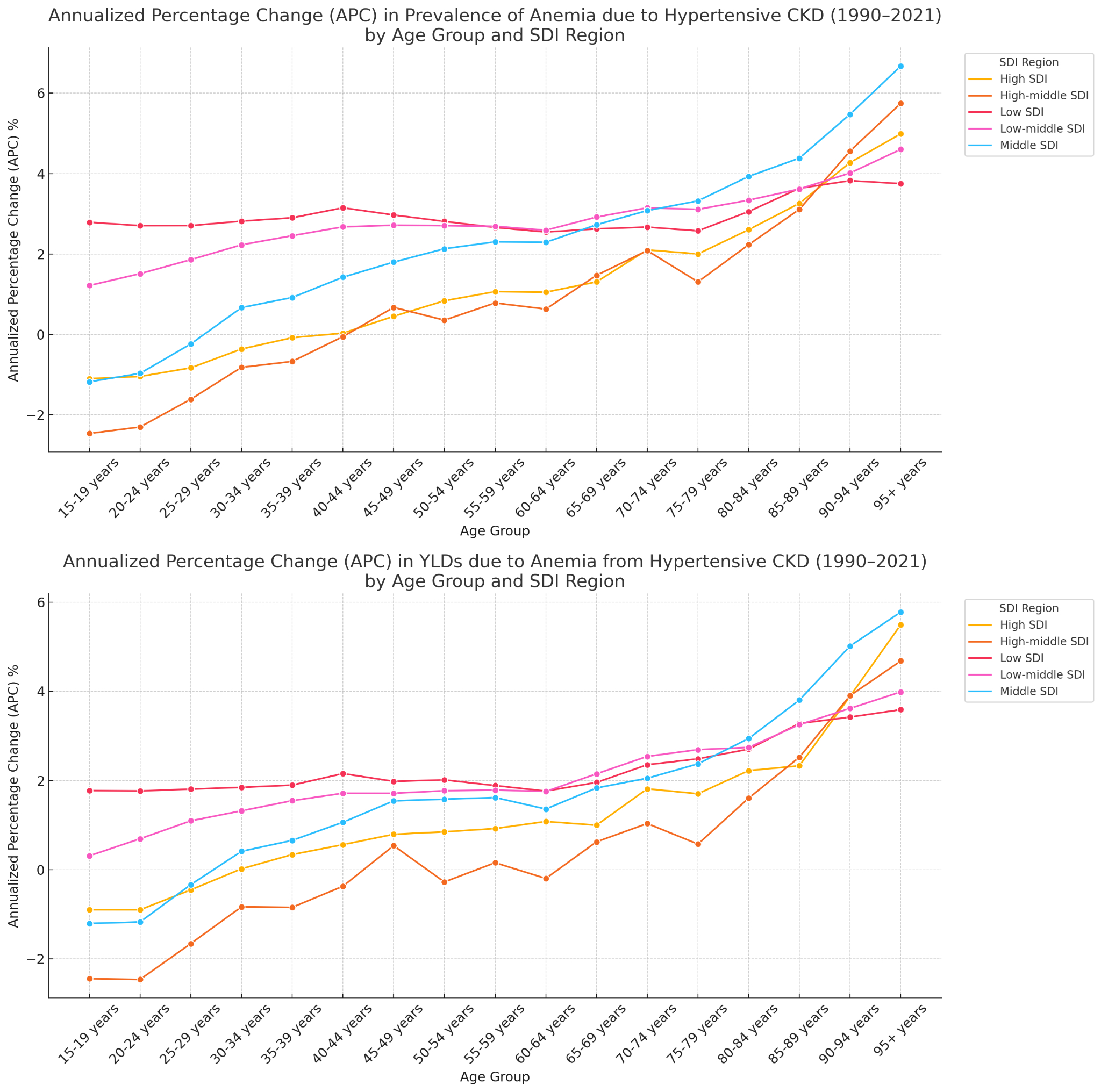
Results:Between 1990 and 2021, the global prevalence of anemia attributable to HTN-CKD more than doubled, rising from 2.6 million(95% UI: 2.4–2.9 million) to 5.6 million(5.2–6.1 million), with an APC of +2.46%. Correspondingly, YLDs increased from 74,819 (49,512–106,554) to 138,672 (92,028–198,889), reflecting an APC of +2.01%. The highest regional increase in prevalence was observed in South Asia (APC: +3.16%), followed by Latin America and the Caribbean (+2.94%), Sub-Saharan Africa (+2.80%), and North Africa and the Middle East (+2.71%). The greatest rise in age-standardized prevalence rate was seen in Fiji (APC: +0.80%), followed by the United States (APC: +0.74%), signaling a growing concern even in high-resource settings like the USA. Among adults aged 70 years and above in middle and low-middle SDI regions, both prevalence and YLDs showed annualized increases exceeding 2%, whereas younger age groups in high SDI regions exhibited stable or declining trends.
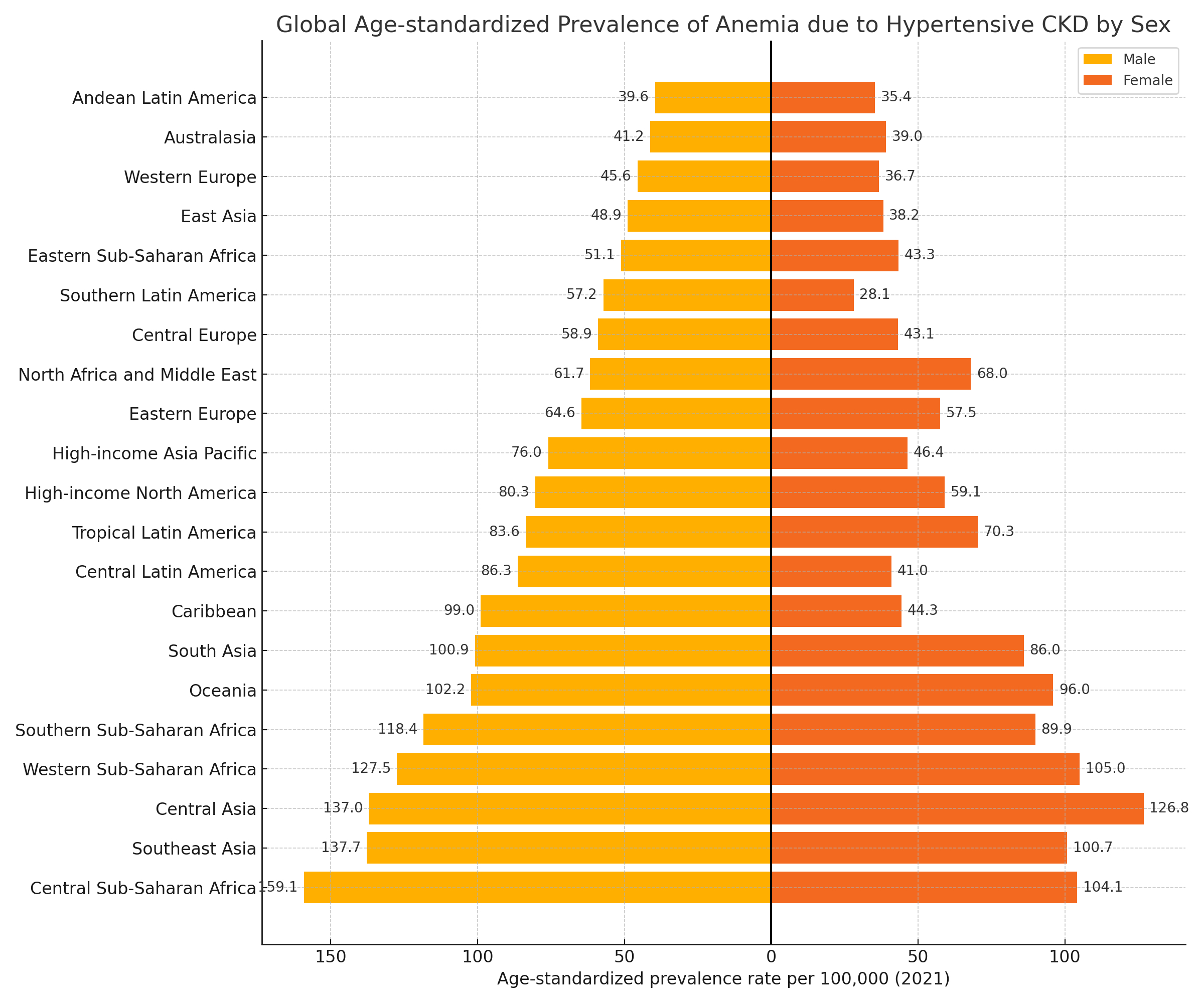
Conclusion:The global burden of anemia due to HTN-CKD has escalated, with the sharpest increases concentrated in low- and middle-income regions where hypertension detection and management remain suboptimal. The burden is especially pronounced among older adults and men, accentuating widening disparities by age, sex, and socioeconomic status.
Patel, Jeel
(
Gujarat Adani Institute of Med. Sci
, Bhuj , India )
Varagantiwar, Vaidheesh
(
Internal medicine,Rajiv Gandhi institute of medical sciences, Adilabad,504001, India
, Adilabad , India )
Kothawala, Azra
(
MedStar Health
, Baltimore , Maryland , United States )
Tummala, Thanmayee
(
Bhaskar Medical College, yenkapally, Hyderabad, Telangana, India - 500075
, Hyderabad , India )
Koushik, Sai
(
Internal medicine, clinikk hub, banglore, karnataka, india-560097
, Banglore , India )
Parisapogu, Anusha
(
University of Connecticut
, Hartford , Connecticut , United States )
Sami, Shahzad Ahmed
(
Internal medicine, DCH regional medical center/university of Alabama, Tuscaloosa, AL, 35401
, Tuscaloosa , Alabama , United States )
Patel, Ridham
(
Internal Medicine, Corpus Christi Medical Center, Corpus Christi, Texas, USA, 78411
, Austin , Texas , United States )
Kochhar, Gunjan
(
university of oklahoma health sciences center
, Oklahoma City , Oklahoma , United States )
Author Disclosures:
Jeel Patel:DO NOT have relevant financial relationships
| Gunjan Kochhar:DO NOT have relevant financial relationships
| Vaidheesh Varagantiwar:No Answer
| Azra Kothawala:DO NOT have relevant financial relationships
| Thanmayee Tummala:No Answer
| sai koushik:DO NOT have relevant financial relationships
| Anusha Parisapogu:DO NOT have relevant financial relationships
| SHAHZAD AHMED SAMI:No Answer
| Ridham Patel:DO NOT have relevant financial relationships
| Hardik Dineshbhai Desai:DO NOT have relevant financial relationships