Three-Decade National and Subnational Trends in the Burden of Heart Failure Attributable to Chronic Kidney Disease in the United States, 1990–2021
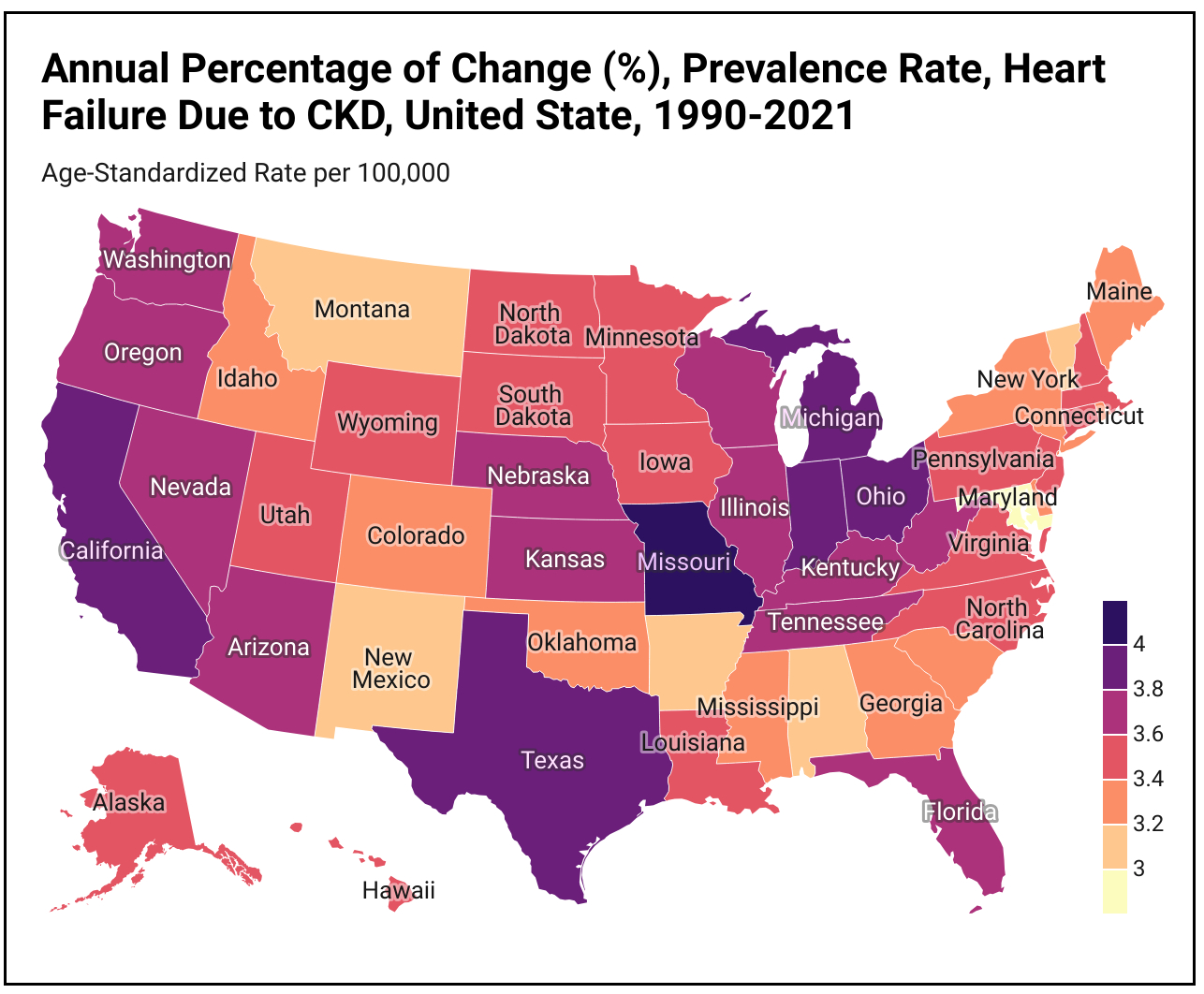
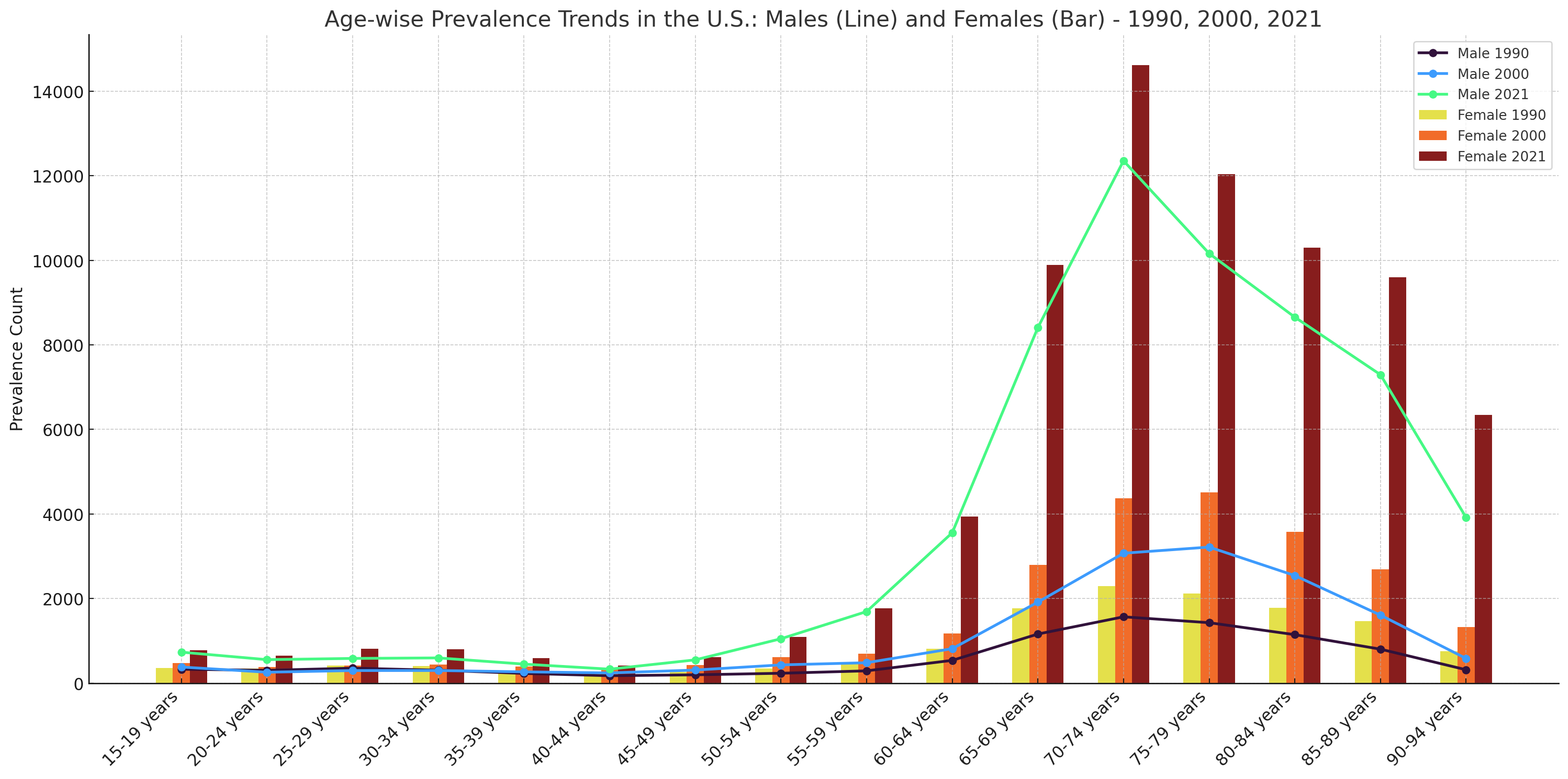
Abstract Body (Do not enter title and authors here): Background: Chronic kidney disease (CKD) significantly amplifies the risk and complexity of heart failure (HF), yet national and state-level trends of HF burden attributable to CKD remain poorly characterized. With rising CKD prevalence and widening health disparities, a comprehensive assessment of geographic and temporal patterns is essential to inform targeted prevention and policy efforts in the U.S. Methods: We analyzed the burden of HF attributable to CKD in the United States from 1990 to 2021 using the Global Burden of Disease Study 2021 framework. Prevalence and years lived with disability (YLDs) were estimated by applying standardized case definitions and disability weights. Age-standardized prevalence rates and annualized percentage changes (APC) were calculated at national, state, and regional levels. Subnational comparisons and age-sex stratified analyses were performed to identify demographic and geographic trends. Results: Between 1990 and 2021, the total number of prevalent HF cases due to CKD rose from 26,681 (95% UI: 20,454–34,584) to 145,197 (106,346–197,734), reflecting a 444% increase. Similarly, YLDs increased from 3,425 (2,128–5,141) to 18,320 (11,119–28,692), marking a 435% rise. Subnationally, all states reported increases in prevalence, with the highest APC in Nevada (8.11%), Arizona (6.98%), Alaska (6.66%), and Texas (6.57%). Slower growth was observed in Rhode Island (4.37%) and the District of Columbia (3.48%). Regionally, the Western U.S. exhibited the highest APC at 6.40%, followed by the South (5.32%), Midwest (5.25%), and Northeast (5.05%). In 2021, the highest age-specific prevalence rate was noted among adults aged 55+ years at 128.12 (89.79–181.33) per 100,000, compared to 9.43 (6.35–13.74) in <20 years and 6.02 (4.30–8.19) in 20–54 years. By gender, the APC in age-standardized prevalence was slightly higher in males (3.57%) than in females (3.47%). Conclusion: In 2021, the United States contributed 7.49% of the global prevalence of HF attributable to CKD. Western and Southern states, as well as older adults, experienced disproportionately higher increases. These findings highlight the urgent need for regionally tailored interventions and integrated cardiovascular–renal care strategies to mitigate the growing disease burden.
Sanapala, Deepika
(
Katuri medical college
, Krishna , India )
Rayudu, Uma Shailendri
(
Gitam institute of medical sciences and research
, Visakhapatnam , India )
Patel, Ridham
(
Internal Medicine, Corpus Christi Medical Center, Corpus Christi, Texas, USA, 78411
, Austin , Texas , United States )
Sami, Shahzad Ahmed
(
Internal medicine, DCH regional medical center/university of Alabama, Tuscaloosa, AL, 35401
, Tuscaloosa , Alabama , United States )
Parisapogu, Anusha
(
University of connecticut, Hartford
, Hartford , Connecticut , United States )
Varagantiwar, Vaidheesh
(
Internal medicine,Rajiv Gandhi institute of medical sciences, Adilabad,504001, India
, Adilabad , India )
Imtiaz, Hassaan
(
Mclaren Bay Region
, Saginaw , Michigan , United States )
Kochhar, Gunjan
(
university of oklahoma health sciences center
, Oklahoma City , Oklahoma , United States )
Koushik, Sai
(
Internal medicine, clinikk hub, banglore, karnataka, india-560097
, Banglore , India )
deepika sanapala:DO NOT have relevant financial relationships
| sai koushik:DO NOT have relevant financial relationships
| Hardik Dineshbhai Desai:DO NOT have relevant financial relationships
| Uma Shailendri Rayudu:DO NOT have relevant financial relationships
| Aditya Ahuja:DO NOT have relevant financial relationships
| Ridham Patel:DO NOT have relevant financial relationships
| SHAHZAD AHMED SAMI:No Answer
| Anusha Parisapogu:DO NOT have relevant financial relationships
| Vaidheesh Varagantiwar:No Answer
| Hassaan Imtiaz:DO NOT have relevant financial relationships
| Gunjan Kochhar:DO NOT have relevant financial relationships