
Logo

American Heart Association

  14
  0


Final ID: Sa4031

Familial Clustering of Mital Valve Prolapse and Mitral Valve Regurgitation

Abstract Body (Do not enter title and authors here): Introduction: Studies have found significant familial clustering of mitral valve prolapse (MVP) and mitral valve regurgitation (MVR) in parent-child and sibling studies. However, genetic screening in MVP/MVR patients without syndromic presentation or in their family members is not recommended. Here we extend the familial clustering evidence beyond nuclear families and examine characteristics of MVP/MVR patients from high-risk MVP/MVR pedigrees.
Methods: Transesophageal echocardiograms (ECHO) of patients seen at Intermountain Health from June 2006 to June 2024 were evaluated. Reported severity of MVP/MVR was used to categorize patients as severe, moderate, or mild (mild had to be reported on 2 or more ECHO). Patient characteristics were compared based on MVP/MVR ECHO severity. The Intermountain Genealogy Registry (IGR), a genealogy linked to Intermountain patients, was used to identify MVP/MVR cases from pedigrees. We compared MVP/MVR cases in pedigrees with high rates of MVP/MVR (relative rate >5 times general patient population) to MVP/MVR cases in pedigrees with low rates of MVP/MVR. Finally, the IGR was used for large pedigree (≥3 generations) familial clustering analyses, based on genealogy familial index (GIF), which is the average kinship co-efficient for all case pairs.
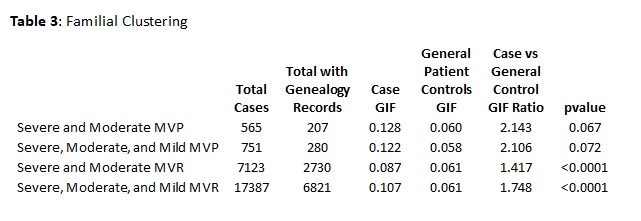
Results: A total of 751 MVP and 17,387 MVR patients were identified from 163,267 ECHOs. Those with severe MVP/MVR disease tended to male and have fewer comorbidities (Table 1). However, only males were significantly more likely to come from high-risk MVP/MVR pedigrees compared to low-risk MVP/MVR pedigrees (Table 2). MVP case pairs from large pedigrees had double the average relatedness (GIF ratio=2.1; Table 3), and while not significant, there was a trend toward different when compared to general patient pairs (p=0.07). However, the MVR case pairs from larger pedigrees did have a significant increase in relatedness (GIF ratio=1.4-1.7) compared to general patient pairs (p<0.0001).
Conclusions: There was no distinguishing patient characteristic, except for male sex, that indicated that an MVP/MVR patient was from a high-risk MVP/MVR pedigree. However, there was a trend toward significant familial clustering in large MVP pedigrees and a significant increase in relatedness for MVR. Examination of ECHO-specific parameters might help determine which ones are associated with MVP/MVR patients most likely from high-risk pedigrees and whose family members might be at higher risk.
  • Knight, Stacey  ( INTERMOUNTAIN HEALTH CARE , Salt Lake City , Utah , United States )
  • Whisenant, Brian  ( Intermountain Medical Center , Salt Lake Cty , Utah , United States )
  • Bair, Tami  ( Intermountain Medical Center , Salt Lake Cty , Utah , United States )
  • Knowlton, Kirk  ( Intermountain Medical Center , Salt Lake Cty , Utah , United States )
  • Anderson, Jeffrey  ( INTERMOUNTAIN MEDICAL CENTER , Murray , Utah , United States )
  • Mckellar, Stephen  ( INTERMOUNTAIN MEDICAL CENTER , Salt Lake City , Utah , United States )
  • May, Heidi  ( INTERMOUNTAIN MEDICAL CENTER , Salt Lake City , Utah , United States )
  • Author Disclosures:
    Stacey Knight: DO NOT have relevant financial relationships | Brian Whisenant: DO have relevant financial relationships ; Consultant:Abbott:Active (exists now) ; Consultant:Edwards:Active (exists now) | Tami Bair: DO NOT have relevant financial relationships | Kirk Knowlton: DO have relevant financial relationships ; Research Funding (PI or named investigator):novartis:Active (exists now) | Jeffrey Anderson: DO NOT have relevant financial relationships | Stephen McKellar: DO NOT have relevant financial relationships | Heidi May: DO NOT have relevant financial relationships
Meeting Info:

Scientific Sessions 2025

2025

New Orleans, Louisiana

Session Info:

Genomic Insights into Cardiac Valve and Aortic Disease

Saturday, 11/08/2025 , 10:30AM - 11:30AM

Abstract Poster Board Session

More abstracts on this topic:
9p21.3 variants drive coronary calcification by suppressing statherin expression

Soheili Fariborz, Almontashiri Naif, Heydarikhorneh Niloufar, Vilmundarson Ragnar, Chen Hsiao-huei, Stewart Alexandre

Adverse Cardiovascular Outcomes in the Postpartum Period Associated with Upbringing-Related Social Determinants of Health

Tolu-akinnawo Oluwaremilekun, Anuforo Anderson, Ezekwueme Francis, Ogunniyi Kayode, Awoyemi Toluwalase

You have to be authorized to contact abstract author. Please, Login
Not Available