
Logo

American Heart Association

  17
  0


Final ID: MP1422

The Risk of Pancreatitis and Adverse Cardiovascular Events in Patients with Type 2 Diabetes and/or Overweight/Obesity with and without Hypertriglyceridemia when Prescribed GLP1RA: A Propensity Score-Matched Analysis

Abstract Body (Do not enter title and authors here): Introduction: Concern for an increased risk of pancreatitis in patients prescribed glucagon-like peptide-1 receptor agonists (GLP1RAs) persists despite the lack of firm causality. Clinicians may therefore be hesitant to prescribe this treatment in patients at higher risk of pancreatitis, such as those with hypertriglyceridemia (HTG). Conversely, GLP-1RAs can positively affect triglyceride (TG) homeostasis and lead to lower plasma TG. This study evaluated whether GLP1RAs were associated with an increased risk of pancreatitis and major adverse cardiovascular events (MACE) in patients with and without HTG.
Methods: We queried the Intermountain Health electronic medical records for patients ≥18 years old from January 2006 to April 2025 with Type 2 diabetes (T2D) and/or body mass index (BMI) ≥27 either on GLP1RA at baseline or never on GLP1RA with measured TG. Propensity score (PS) matching with a greedy nearest neighbor algorithm was used to pair the groups. Using the PS matched pairs, Cox-proportional hazard regressions (unadjusted and adjusted) were used to examine the risk of follow-up pancreatitis and MACE.
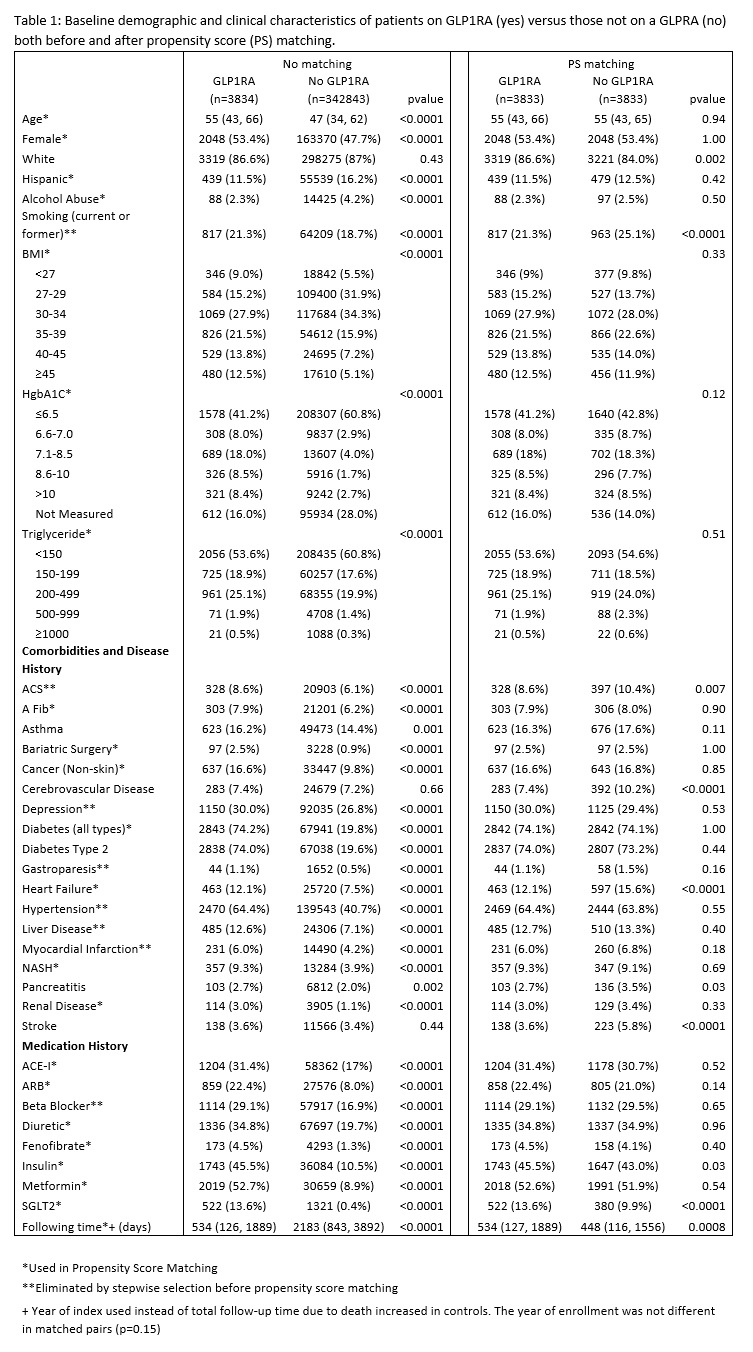
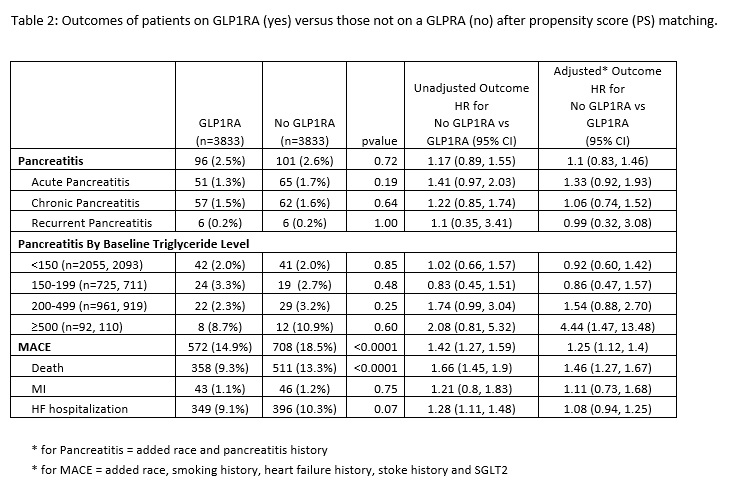
Results: Of the 346,677 patients, 3834 (1.1%) patients were prescribed GPL1RA (342,843 (98.9%) without GLP1RA). Those on a GLP1RA were older, more likely to be non-Hispanic, have lower rates of alcohol abuse and higher BMI, Hgb A1C, and TG, and tended to have more comorbidities and medication use (Table 1). The PS matching resulted in a well-matched cohort of 3833 pairs (Table 1). The rate of pancreatitis was similar in those on GLP1RA compared to those not (2.5% vs 2.6%, p=0.72) (Table 2). The risk of pancreatitis was further examined by baseline TG levels. For patients with severe TG levels (≥500 mg/dL), those on a GLP1RA had a non-significant decrease in pancreatitis (8.7% vs 10.9%, p=0.60); however, after adjustment for prior pancreatitis history the hazard ratio (HR) for pancreatitis was over 4 times greater for those not on GLP1RA vs those on a GLP1RA. MACE events on GLP1RA were also lower (14.9% vs 18.5%, p<0.0001) with MACE HR of 1.25 when not on GLP1RA (Table 2).
Conclusions: These results support findings of prior studies that did not identify an increased risk of pancreatitis in patients prescribed a GLP1RA. Additionally, there was not an increased risk of pancreatitis in patients with HTG, including those with TG ≥ 500 mg/dL. Based on this analysis, prescribers may feel more confident about prescribing GLP1RAs to patients with HTG.
  • Iverson, Leslie  ( Intermountain Health , Murray , Utah , United States )
  • Knight, Stacey  ( INTERMOUNTAIN HEALTH CARE , Salt Lake City , Utah , United States )
  • May, Heidi  ( INTERMOUNTAIN MEDICAL CENTER , Salt Lake City , Utah , United States )
  • Le, Viet  ( INTERMOUNTAIN , Murray , Utah , United States )
  • Bair, Tami  ( Intermountain Medical Center , Salt Lake Cty , Utah , United States )
  • Knowlton, Kirk  ( Intermountain Medical Center , Salt Lake Cty , Utah , United States )
  • Anderson, Jeffrey  ( INTERMOUNTAIN MEDICAL CENTER , Murray , Utah , United States )
  • Author Disclosures:
    Leslie Iverson: DO NOT have relevant financial relationships | Stacey Knight: DO NOT have relevant financial relationships | Heidi May: DO NOT have relevant financial relationships | Viet Le: DO have relevant financial relationships ; Researcher:Janssen/J&J:Active (exists now) ; Advisor:Pfizer:Active (exists now) ; Advisor:Amgen:Active (exists now) ; Advisor:Bayer:Active (exists now) ; Advisor:Novartis:Active (exists now) ; Advisor:Idorsia:Active (exists now) ; Advisor:Lexicon:Active (exists now) ; Research Funding (PI or named investigator):Kardia:Active (exists now) | Tami Bair: DO NOT have relevant financial relationships | Kirk Knowlton: DO have relevant financial relationships ; Research Funding (PI or named investigator):novartis:Active (exists now) | Jeffrey Anderson: DO NOT have relevant financial relationships
Meeting Info:

Scientific Sessions 2025

2025

New Orleans, Louisiana

Session Info:
More abstracts on this topic:
Fatty Liver, Big Heart Risk: Prevalent Cardiovascular Risk among Young Children with Subclinical and Clinical Hepatic Steatosis

Ramirez Tovar Ana, Khanna Geetika, Knight-scott Jack, Alazraki Adina, Bai Shasha, Vos Miriam, Welsh Jean, Sanchez Torres Cristian, Gillespie Scott, Aguayo Liliana, Huneault Helaina, Yaranga Claudia, Desantos Karla, Carapia-chaparro Christina, James Brittany

Adipose tissue extracellular vesicles mediate pro-arrhythmic changes in atrial cardiomyocytes

Limpitikul Worawan, Garcia Contreras Marta, Betti Michael, Sheng Quanhu, Xiao Ling, Chatterjee Emeli, Gamazon Eric, Shah Ravi, Das Saumya

More abstracts from these authors:
Baseline Severity of Coronary Artery Calcium Among Patients Enrolled in the CorCal Trial Compared to those Enrolled in the MESA Study

Muhlestein Joseph, May Heidi, Winslow Tyler, Knight Stacey, Le Viet, Iverson Leslie, Bair Tami, Knowlton Kirk, Anderson Jeffrey

Lipoprotein (a) [Lp(a)] levels are not associated with MACE outcomes in patients with suspected CAD referred for Cardiac PET/CT stress tests in an integrated health system

Le Viet, Knight Stacey, Muhlestein Joseph, May Heidi, Iverson Leslie, Bair Tami, Knowlton Kirk, Anderson Jeffrey

You have to be authorized to contact abstract author. Please, Login
Not Available