Logo

American Heart Association

  109
  0


Final ID: MDP1573

Long-term Effect of Screening for Coronary Artery Disease Using CT Angiography on Mortality and Cardiac Events in High-risk Patients with Diabetes: the FACTOR-64 Follow-up Study

Abstract Body (Do not enter title and authors here): Background: The FACTOR-64 study was a randomized controlled trial designed to assess whether routine screening for CAD by coronary computed tomography angiography (CCTA) in high-risk patients with diabetes followed by CCTA-directed therapy would reduce the risk of death and nonfatal coronary outcomes. Results at four years showed a lower revascularization rate (3.1% (14) vs. 8.9% (40), p<0.005) among the control group. But there was also a non-significant trend toward a lower incidence of all-cause mortality and nonfatal MI (hazard ratio, 0.82 [95% CI, 0.49-1.32]; p=0.38). Whether screening CCTA might have a more significant effect on the outcomes of patients after longer follow-up is unknown.
Methods: The FACTOR-64 study randomized 900 patients (age = 61.5 years, males = 52%, Type 2 DM = 88%, DM duration = 13 years) with type 1 or type 2 diabetes for at least 3 to 5 years without CAD symptoms to screening with CCTA (n = 452) or standard national guidelines-based optimal diabetes care (n = 448). Standard primary prevention medical therapy or aggressive secondary prevention therapy with invasive coronary angiography was recommended based on CCTA findings. Enrollment occurred between July 2007 and May 2013, and follow-up extended to May 2024.
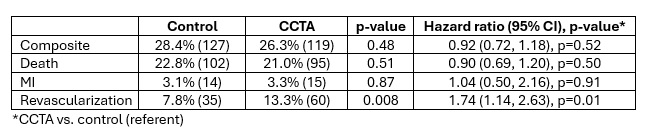
Results: The mean follow-up time was 12.7±3.2 (CCTA=12.8±3.1; control=12.6±3.3, p=0.47) years. During longer-term follow-up after the initial four years, essentially the same numbers of further revascularizations (20 vs. 21) occurred in the CCTA group vs. the control group, thus continuing a significantly higher rate of revascularization among those receiving CCTA (Table). However, the composite and individual outcomes of all-cause mortality and nonfatal MI did not differ between the CCTA and control groups.
Conclusion: Among asymptomatic patients with type 1 or type 2 diabetes followed for over twelve years, the use of CCTA to screen for CAD did not significantly affect the rates of all-cause mortality or nonfatal MI. This was despite an overall significantly increased use of revascularization among those receiving CCTA. These definitive findings do not support CCTA screening in this population.
  • Muhlestein, Joseph  ( INTERMOUNTAIN MEDICAL CTR , Murray , Utah , United States )
  • May, Heidi  ( INTERMOUNTAIN MEDICAL CENTER , Salt Lake City , Utah , United States )
  • Knight, Stacey  ( INTERMOUNTAIN MEDICAL CENTER , Salt Lake City , Utah , United States )
  • Le, Viet  ( INTERMOUNTAIN MEDICAL CENTER , Salt Lake City , Utah , United States )
  • Bair, Tami  ( INTERMOUNTAIN MEDICAL CENTER , Salt Lake City , Utah , United States )
  • Anderson, Jeffrey  ( INTERMOUNTAIN MEDICAL CENTER , Salt Lake City , Utah , United States )
  • Knowlton, Kirk  ( INTERMOUNTAIN MEDICAL CENTER , Salt Lake City , Utah , United States )
  • Author Disclosures:
    Joseph Muhlestein: DO NOT have relevant financial relationships | Heidi May: DO NOT have relevant financial relationships | Stacey Knight: DO NOT have relevant financial relationships | Viet Le: DO have relevant financial relationships ; Consultant:Novartis:Active (exists now) ; Consultant:Pfizer:Active (exists now) ; Consultant:Amgen:Active (exists now) ; Researcher:Janssen:Active (exists now) | Tami Bair: DO NOT have relevant financial relationships | Jeffrey Anderson: DO NOT have relevant financial relationships | Kirk Knowlton: DO NOT have relevant financial relationships
Meeting Info:

Scientific Sessions 2024

2024

Chicago, Illinois

Session Info:

Prediction in Cardiometabolic Disease

Monday, 11/18/2024 , 12:50PM - 02:15PM

Moderated Digital Poster Session

More abstracts on this topic:
A Multi-centre, Randomized, Controlled Study of External CounterPulsation for Patients with Recent Atherosclerotic Stroke (SPA)

Xiong Li, Chen Xiangyan, Leung Howan, Zhu Lixia, Leung Thomas, Wong Lawrence

Artificial Intelligence-Enabled Electrocardiography For The Prediction of Future Type 2 Diabetes Mellitus

Pastika Libor, Peters Nicholas, Kramer Daniel, Waks Jonathan, Sau Arunashis, Ng Fu Siong, Patlatzoglou Konstantinos, Sieliwonczyk Ewa, Barker Joseph, Zeidaabadi Boroumand, Mcgurk Kathryn, Khan Sadia, Mandic Danilo, Ware James

More abstracts from these authors:
Lipoprotein (a) [Lp(a)] levels are not associated with MACE outcomes in patients with suspected CAD referred for Cardiac PET/CT stress tests in an integrated health system

Le Viet, Knight Stacey, Muhlestein Joseph, May Heidi, Iverson Leslie, Bair Tami, Knowlton Kirk, Anderson Jeffrey

Baseline Severity of Coronary Artery Calcium Among Patients Enrolled in the CorCal Trial Compared to those Enrolled in the MESA Study

Muhlestein Joseph, May Heidi, Winslow Tyler, Knight Stacey, Le Viet, Iverson Leslie, Bair Tami, Knowlton Kirk, Anderson Jeffrey

You have to be authorized to contact abstract author. Please, Login
Not Available