Logo

American Heart Association

  70
  0


Final ID: Mo2028

Ambulatory QT Interval Prolongation and Reduced T-Amplitude Help Identify Veterans with Heart Disease

Abstract Body (Do not enter title and authors here): Introduction: Several ECG parameters accessible via ambulatory Holter recordings may help risk-stratify coronary heart disease (CHD) risk, but their clinical use is mostly limited to arrhythmia detection. Candidate ECG-based measures for CHD include autonomic markers like heart rate variability (HRV) and cardiac repolarization measures involving the T wave and QT interval. We explored several potential ECG digital biomarkers for CHD classification in a cohort of veteran twins to help inform future research on real-time CHD risk assessment with ambulatory ECG monitoring.
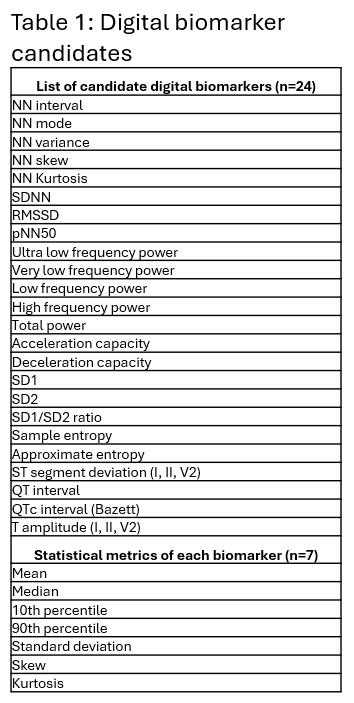
Methods: We collected ambulatory Holter data (1,000 Hz, 3 channels) for one week from veteran twins recruited from the Vietnam Era Twins Registry. We assessed CHD if they described either previous MI, CABG, cardiac arrest/ICD shock, or PCI during a clinical history conducted by a trained clinician. We used the Physionet Cardiovascular Signal Toolbox to derive several ECG features from sliding 5-minute windows (table 1). For each ECG feature, we calculated several different statistical summary measures. This resulted in 164 total features. We performed logistic regression with forward selection and corrected for multiple comparisons with Bonferroni correction. We also tested the performance of the newly discovered ECG markers within twin CHD discordant pairs to control for family-level confounding. Lastly, we controlled for traditional CHD risk factors using multivariable models.
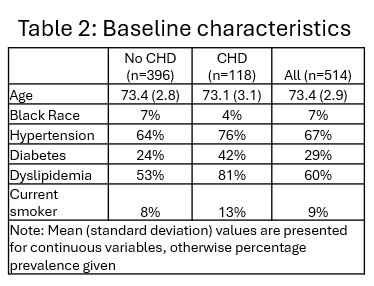
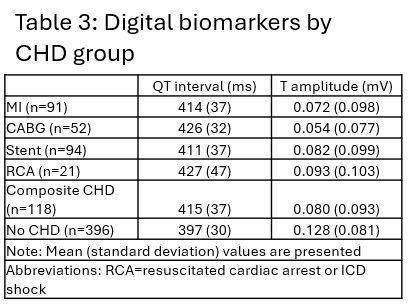
Results: We studied 514 men with mean (SD) age 73.4 (2.9) years; 7% were Black, and 23% had a history of CHD (table 2). The mean QT interval and T amplitude in lead I were the most strongly associated with CHD (p<0.0001 for both), and none of the other markers met criteria for statistical significance. The ECG-CHD relationships were similar within 33 twin pairs discordant for CHD (AUC 0.69). Adjustment for traditional risk factors did not reduce the observed ECG-CHD associations. The QT interval (427 ms) was longest in the cardiac arrest/ICD shock subgroup, while the T-amplitude (0.054 mV) was lowest in the subgroup with CABG history (table 3).
Discussion: In this cross-sectional study of older veteran twins, mean QT interval and T amplitude (lead I) were the only two significant Holter parameters associated with CHD after correction for multiple testing. These results can help to inform future studies of CHD risk with Holter monitors and ecological momentary assessments of stress and behavioral exposures.
  • Shah, Amit  ( EMORY UNIVERSITY , Atlanta , Georgia , United States )
  • Colon-motas, Kay  ( Emory University , Atlanta , Georgia , United States )
  • De Leon, Katalina  ( Emory University , Atlanta , Georgia , United States )
  • Murtala, Abdulkareem  ( Emory University , Atlanta , Georgia , United States )
  • Osei, Jeffery  ( Emory University , Atlanta , Georgia , United States )
  • Mourad, Rama  ( Emory University , Atlanta , Georgia , United States )
  • Chang, Sarah  ( Emory University , Atlanta , Georgia , United States )
  • Ko, Yi-an  ( EMORY UNIVERSITY , Atlanta , Georgia , United States )
  • Zeng, Zhaohua  ( Emory University , Atlanta , Georgia , United States )
  • Sheikh, Shafa-at  ( Emory University , Atlanta , Georgia , United States )
  • Xu, Ying  ( Emory University , Atlanta , Georgia , United States )
  • Koscova, Zuzana  ( EMORY UNIVERSITY , Atlanta , Georgia , United States )
  • Kim, Kain  ( Emory University , Atlanta , Georgia , United States )
  • Akoto, Natalie  ( Emory University , Atlanta , Georgia , United States )
  • Santana, Eric  ( Emory University , Atlanta , Georgia , United States )
  • Alexander, Abigail  ( Emory University , Atlanta , Georgia , United States )
  • Suvada, Kara  ( Emory University , Atlanta , Georgia , United States )
  • Roberts, Tatum  ( Emory University , Atlanta , Georgia , United States )
  • Stefanos, Lewam  ( Emory University , Atlanta , Georgia , United States )
  • Vaccarino, Viola  ( Emory Univesity , Atlanta , Georgia , United States )
  • Clifford, Gari  ( Emory University , Atlanta , Georgia , United States )
  • Li, Qiao  ( EMORY UNIVERSITY , Atlanta , Georgia , United States )
  • Sameni, Reza  ( Emory University , Atlanta , Georgia , United States )
  • Bahrami Rad, Ali  ( Emory University , Atlanta , Georgia , United States )
  • Karimi, Sajjad  ( Emory University , Atlanta , Georgia , United States )
  • Lampert, Rachel  ( YALE SCH OF MEDICINE , New Haven , Connecticut , United States )
  • Mathew, Lejy  ( Emory University , Atlanta , Georgia , United States )
  • Alagar, Nikila  ( Emory University , Atlanta , Georgia , United States )
  • Author Disclosures:
    Amit Shah: DO NOT have relevant financial relationships | Kay Colon-Motas: No Answer | Katalina de Leon: DO NOT have relevant financial relationships | Abdulkareem Murtala: No Answer | Jeffery Osei: No Answer | Rama Mourad: No Answer | Sarah Chang: No Answer | Yi-An Ko: No Answer | Zhaohua Zeng: No Answer | Shafa-at Sheikh: No Answer | Ying Xu: No Answer | Zuzana Koscova: DO NOT have relevant financial relationships | Kain Kim: No Answer | Natalie Akoto: No Answer | Eric Santana: DO NOT have relevant financial relationships | Abigail Alexander: DO NOT have relevant financial relationships | Kara Suvada: DO NOT have relevant financial relationships | Tatum Roberts: No Answer | Lewam Stefanos: No Answer | Viola Vaccarino: DO NOT have relevant financial relationships | Gari Clifford: DO have relevant financial relationships ; Advisor:Alivecor:Active (exists now) ; Executive Role:MindChild Medical :Active (exists now) ; Advisor:Nextsense:Active (exists now) | Qiao Li: DO NOT have relevant financial relationships | Reza Sameni: DO NOT have relevant financial relationships | Ali Bahrami Rad: No Answer | Sajjad Karimi: No Answer | Rachel Lampert: DO NOT have relevant financial relationships | Lejy Mathew: DO NOT have relevant financial relationships | Nikila Alagar: DO NOT have relevant financial relationships
Meeting Info:

Scientific Sessions 2025

2025

New Orleans, Louisiana

Session Info:

National and Global Perspectives: Cardiovascular Disease Burden in Adults

Monday, 11/10/2025 , 01:00PM - 02:00PM

Abstract Poster Board Session

More abstracts on this topic:
Burden of Stroke Attributable to Air Pollution in India and its Trend from 1990-2021: A cross State Comparative Assessment

Surana Deval, Patel Juhi, Desai Hardik, Adrejiya Parth, Singh Kushagrita, Malhans Jeevanjyot, Vala Janmay, Goel Shrey, Syed Saif, Lakkimsetti Mohit, Amin Vishrant

A Contemporary Machine Learning-Based Risk Stratification for Mortality and Hospitalization in Heart Failure with Preserved Ejection Fraction Using Multimodal Real-World Data

Fudim Marat, Weerts Jerremy, Patel Manesh, Balu Suresh, Hintze Bradley, Torres Francisco, Micsinai Balan Mariann, Rigolli Marzia, Kessler Paul, Touzot Maxime, Lund Lars, Van Empel Vanessa, Pradhan Aruna, Butler Javed, Zehnder Tobias, Sauty Benoit, Esposito Christian, Balazard Félix, Mayer Imke, Hallal Mohammad, Loiseau Nicolas

More abstracts from these authors:
Sex Differences in Actigraphy-Measured Physical Activity Among Young Survivors of Acute Myocardial Infarction

Suvada Kara, Krafty Robert, Shah Amit, Vaccarino Viola, Sullivan Samaah, She Hua, Lobelo Felipe, Osei Jeffery, Shallenberger Lucy, Stefanos Lewam, Roberts Tatum

Sex Differences in Everyday Mood States and its Association with Autonomic Physiology

Shah Amit, Lampert Rachel, Raggi Paolo, Pearce Brad, Quyyumi Arshed, Sameni Reza, Lewis Tene, Sullivan Samaah, Bremner J Douglas, Clifford Gari, Vaccarino Viola, She Hua, Elon Lisa, Li Qiao, Roberts Tatum, Stefanos Lewam, Haddad George, Gupta Shishir, Tarlapally Nitya

You have to be authorized to contact abstract author. Please, Login
Not Available