Sex Differences in Actigraphy-Measured Physical Activity Among Young Survivors of Acute Myocardial Infarction
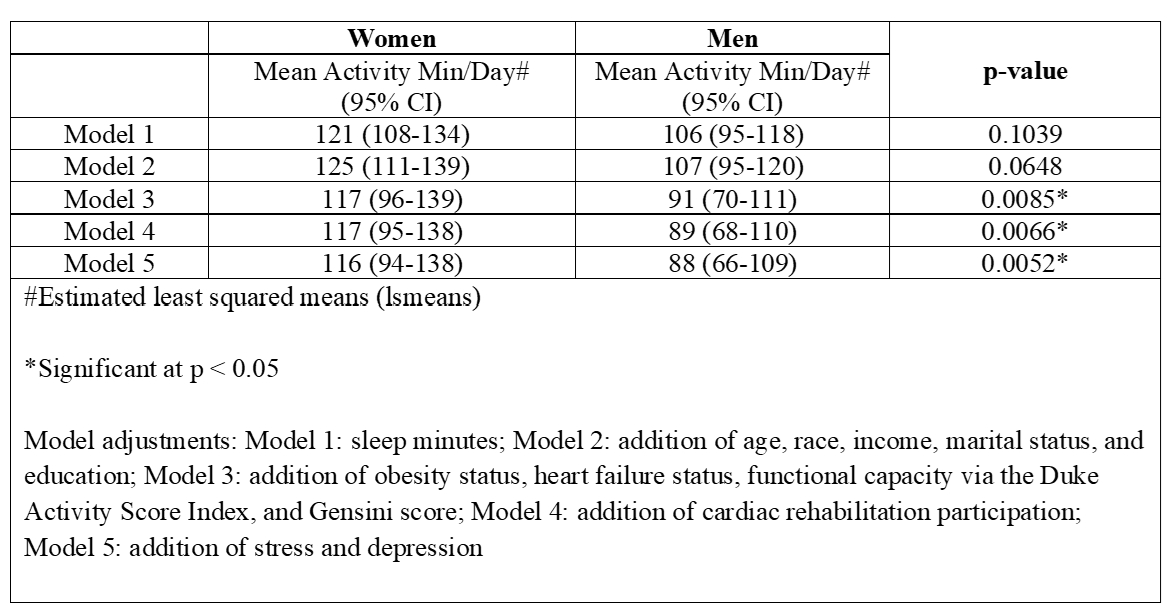
Abstract Body: Introduction: Light and moderate-to-vigorous physical activity (LPA and MVPA) are critical for secondary prevention in individuals with recent myocardial infarction (MI). Examining sex differences in physical activity (PA) patterns may inform the development of sex-specific post-MI health promotion strategies. Because women in community samples typically engage in lower levels of PA than men, we hypothesized that, among post-MI individuals, female sex would be associated with lower objectively measured LPA and MVPA. Methods: We recruited individuals aged ≤ 61 years within 8 months of an MI in metropolitan Atlanta. Participants wore a wrist accelerometer for 7 days to track PA and sleep. We constructed linear mixed-effect models to estimate the association between sex and minutes of total, daily PA. We adjusted sequentially for sleep minutes, demographics (age, race, income, marital status, education), physical factors (heart failure, functional capacity, Gensini score), cardiac rehabilitation participation, and psychosocial factors (stress, depression). Results: Our sample included 276 participants (43% women, 53% Black) with mean age 51 years (SD: 7) from the third wave of the Myocardial Ischemia and Mental Stress (MIMS3) study. On average, women had 19 greater minutes of LPA compared to men per day (119 vs.100 minutes), while no sex differences were found for MVPA (2 minutes/day for each). In models adjusting for a minimum of sleep, sociodemographic, and health factors, women engaged in a statistically significantly higher amount of overall PA compared to men (Table). In the fully adjusted model, women, vs. men, performed 116 (95% CI: 94-138) minutes vs. 88 (66-109) minutes of total PA/day on average. Results remained similar when patients with poor functional capacity were excluded. Discussion: On average, women engaged in more PA compared to men. Our results contradict the notion that women perform less PA compared to men, although previous studies mostly focused on self-reported, leisure MVPA. More research is needed to evaluate whether women spend more time performing gender-specific tasks that would contribute to LPA than men such as caregiving and house work. Whether these differences help protect post-MI women from mortality similar to leisure MVPA warrants more research, given the concern for burnout and vital exhaustion in this population.
Suvada, Kara
(
Emory University
, Atlanta , Georgia , United States )
Vaccarino, Viola
(
EMORY UNIV ROLLINS SCHL PUBLIC HLTH
, Atlanta , Georgia , United States )
Sullivan, Samaah
(
The University of Texas Southwestern Medical Center
, Dallas , Texas , United States )
She, Hua
(
Emory University
, Atlanta , Georgia , United States )
Lobelo, Felipe
(
Emory university
, Atlanta , Georgia , United States )
Osei, Jeffery
(
Emory University
, Atlanta , Georgia , United States )
Shallenberger, Lucy
(
Emory University
, Atlanta , Georgia , United States )
Stefanos, Lewam
(
EMORY UNIV ROLLINS SCHL PUBLIC HLTH
, Atlanta , Georgia , United States )
Roberts, Tatum
(
EMORY UNIV ROLLINS SCHL PUBLIC HLTH
, Atlanta , Georgia , United States )
Krafty, Robert
(
EMORY UNIV ROLLINS SCHL PUBLIC HLTH
, Atlanta , Georgia , United States )
Shah, Amit
(
EMORY UNIVERSITY
, Atlanta , Georgia , United States )
Sullivan Samaah, Quyyumi Arshed, Vaccarino Viola, Suvada Kara, Moazzami Kasra, Young An, Garcia Mariana, Almuwaqqat Zakaria, She Hua, Shah Amit, Bremner James Douglas