Logo

American Heart Association

  23
  0


Final ID: Su3062

Intravenous sotalol in pediatric cardiac intensive care patients compared to other antiarrhythmics: insights from a multicenter database

Abstract Body (Do not enter title and authors here): Background: Sotalol is an antiarrhythmic for which an intravenous (IV) form became available in 2015. Studies suggest it is safe and effective for treating pediatric arrhythmias, with fewer effects on physiologic parameters and cardiac output than amiodarone, and it does not appear to be associated with its long-term risks. However, data in pediatric patients remains limited. This study aimed to characterize the use of intravenous sotalol in pediatric intensive care admissions and compare its use and outcomes with intravenous amiodarone and procainamide.
Methods: Data were drawn from the Pediatric Health Information System across six hospitals with the highest IV sotalol use (October 2015 to December 2019). Included were admissions of pediatric patients who received intravenous sotalol, amiodarone, or procainamide. Collected variables included demographics, arrhythmias, congenital heart disease, length of stay, and mortality. Trends were analyzed by year. Multivariable regressions were conducted to model length of stay and mortality with various clinical variables and antiarrhythmic medications included as independent variables.
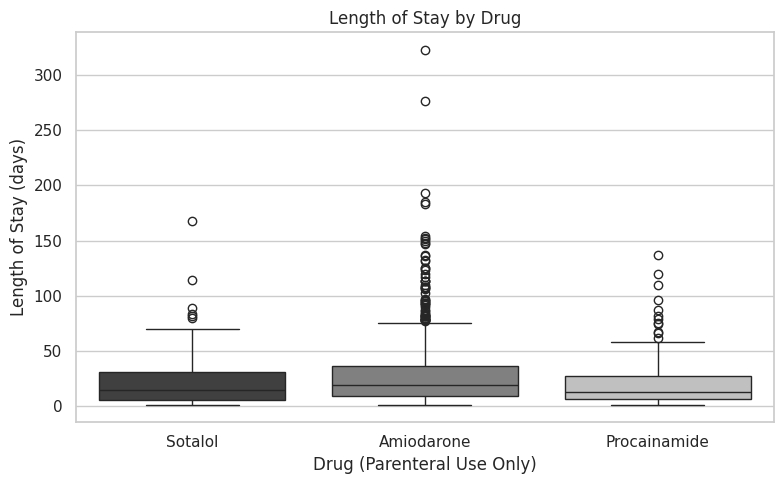
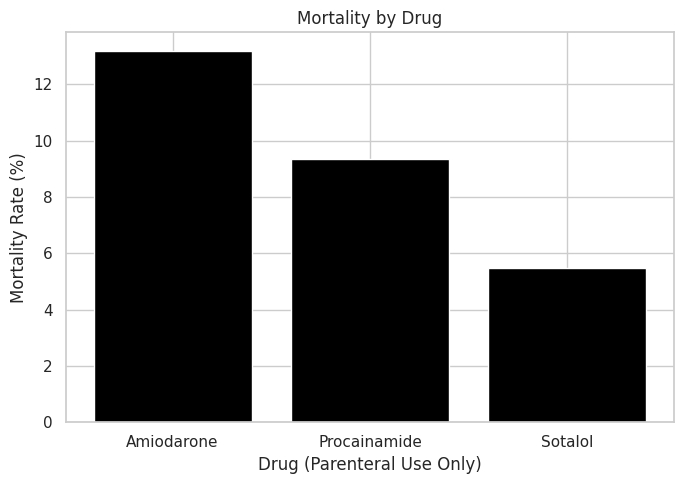
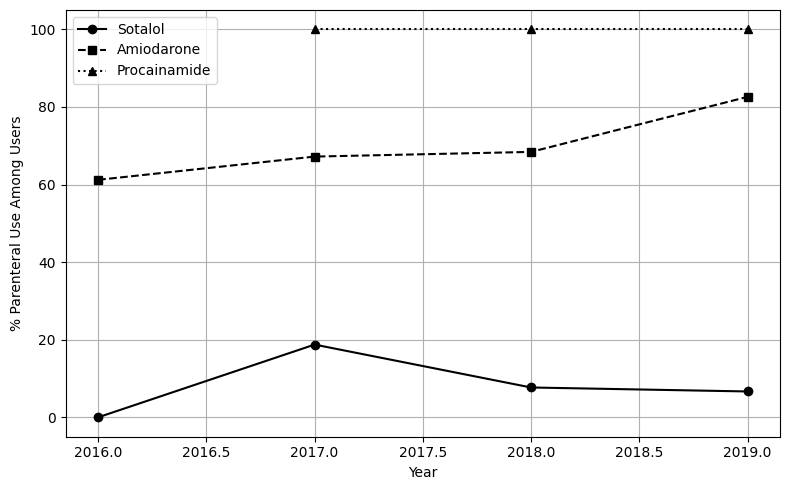
Results: Of 927 admissions, 128 (14%) received sotalol, 660 (71%) amiodarone, and 139 (15%) procainamide. Cardiac surgery was least common in the sotalol group (p<0.01). Sotalol and amiodarone use both increased over time (p=0.03 and p<0.01) (Figure 1). Supraventricular tachycardia was the most common arrhythmia (Table 1). Mean length of stay (days) was shortest with procainamide (21.8), followed by sotalol (22.7), and amiodarone (29.5) (Figure 2). Inpatient mortality was lowest with sotalol (5.4%) and highest with amiodarone (13.1%) (p=0.02) (Figure 3). Regression analysis demonstrated no independent association between sotalol and length of stay (β = -0.2, p=0.83), while amiodarone was independently associated with increased length of stay (β = 8.4, p<0.01). Sotalol was linked to decreased mortality (OR = 0.95, p=0.04) and amiodarone with increased mortality (OR = 1.1, p<0.01). Procainamide showed no significant associations.
Conclusion: Intravenous sotalol use in pediatric intensive care patients was associated with lower inpatient mortality and comparable length of stay compared to amiodarone and procainamide after regression analyses. These results support that intravenous sotalol is a safe alternative for pediatric arrhythmia management, meriting further prospective studies.
  • Loomba, Rohit  ( Ann and Robert H. Lurie Children's Hospital , Chicago , Illinois , United States )
  • Backes, Emily  ( Children's Mercy Hospital , Kansas City , Missouri , United States )
  • Farias, Juan  ( Children's Mercy Hospital , Kansas City , Missouri , United States )
  • Borquez, Alejandro  ( Rady Children’s Hospital , San Diego , California , United States )
  • Malloy-walton, Lindsey  ( Children's Mercy Hospital , Kansas City , Missouri , United States )
  • Flores, Saul  ( Texas Children's Hospital , Houston , Texas , United States )
  • Author Disclosures:
    Rohit Loomba: No Answer | Emily Backes: DO NOT have relevant financial relationships | Juan Farias: DO NOT have relevant financial relationships | Alejandro Borquez: No Answer | Lindsey Malloy-Walton: DO have relevant financial relationships ; Speaker:alta thera :Past (completed) | Saul Flores: DO NOT have relevant financial relationships
Meeting Info:

Scientific Sessions 2025

2025

New Orleans, Louisiana

Session Info:

Risk Stratification, Engagement, and Functional Outcomes in CHD

Sunday, 11/09/2025 , 03:15PM - 04:15PM

Abstract Poster Board Session

More abstracts on this topic:
A Bifunctional Actuator Reverses NaV1.5 Dysfunction Linked To Cardiac Arrhythmias

Fossier Lucile, Yehya Marc, Mahling Ryan, Gabelli Sandra, Colecraft Henry, Ben Johny Manu

A comparison of the efficacy of initial high energy versus initial low energy biphasic shocks for cardioversion of atrial fibrillation and atrial flutter – a real-life experience

Alampoondi Venkataramanan Sai Vikram, Vunnam Ramarao, Voruganti Dinesh, Tsai Shane

More abstracts from these authors:
Electrocardiogram Abnormalities and Arrhythmias: Analysis of the NHLBI Study on Long-term Outcomes after the Multisystem Inflammatory Syndrome in Children (MUSIC)

Dionne Audrey, Aggarwal Sanjeev, Block Joseph, Borquez Alejandro, Capone Christine, D'addese Laura, Elias Matthew, Gallotti Roberto, Hebson Camden, Jackson Lanier, Krishnan Anita, Sharma Binu, Lu Jason, Luceri Michael, Mccrindle Brian, Morgan Lerraughn, Nowlen Todd, Nguyen Hoang, Rao Suchitra, Taylor Michael, Siddeek Hani, Szmuszkovicz Jacqueline, Truong Dongngan, Trachtenberg Felicia, Newburger Jane, Deweert Katherine, Mills Marcos, Fremed Michael, Lang Sean, Patel Jyoti, Bradford Tamara

Exploring Disparities in Pediatric Wolff-Parkinson-White Patients by Race and Ethnicity: Results of a Multicenter Ambispective Registry

El Assaad Iqbal, Dechert-crooks Brynn, Erickson Christopher, Janson Christopher, Kannankeril Prince, Kertesz Naomi, Gamboa David, Law Ian, Malloy-walton Lindsey, Sanatani Shubhayan, Shenthar Jayaprakash, Beach Cheyenne, Stephenson Elizabeth, Tanel Ronn, Von Bergen Nicholas, Etheridge Susan, Escudero Carolina, Niu Mary, Tan Reina Bianca, Anderson Charles, Arora Gaurav, Aziz Peter, Blaufox Andrew, Chaouki Ahmad

You have to be authorized to contact abstract author. Please, Login
Not Available