Logo

American Heart Association

  13
  0


Final ID: MP2236

Cardiometabolic Risk Factor Control in the Progression from Pre–Heart Failure to Clinical Heart Failure: The Atherosclerosis Risk in Communities (ARIC) Study

Abstract Body (Do not enter title and authors here): Background: Pre–heart failure (pre-HF) is associated with a significantly increased risk of progression to clinical heart failure (HF). However, the independent and collective associations of lifestyle and cardiometabolic risk factor control on the risk of progression from pre-HF to clinical HF have not yet been fully characterized.
Methods: We conducted a prospective analysis of ARIC Visit 5 participants (2011–2013) with pre-HF and no baseline HF or atherosclerotic cardiovascular disease. Pre-HF was defined by the presence of elevated cardiac biomarkers—high-sensitivity cardiac troponin T and/or I above the 99th percentile and/or NT-proBNP ≥125 pg/mL—and/or abnormal echocardiographic findings. We modeled lifestyle factors (physical activity and diet per AHA’s Life’s Simple 7) and cardiometabolic risk factor control (diabetes, hypertension, obesity and chronic kidney disease) categorically and continuously (per 1-SD) and assessed their associations with incident clinical HF, using survival analysis and Cox regression.
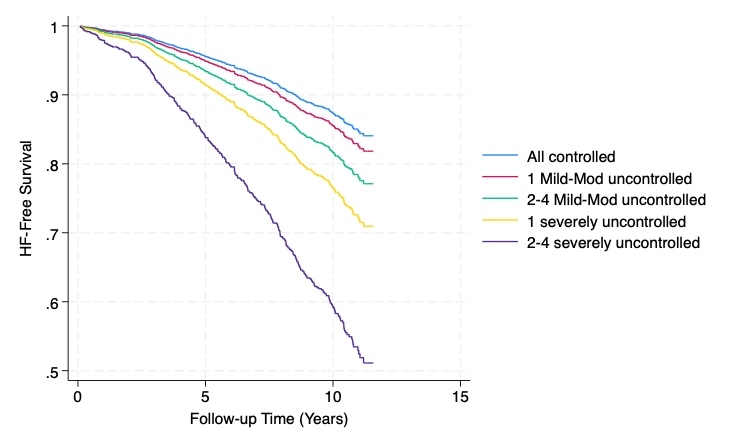
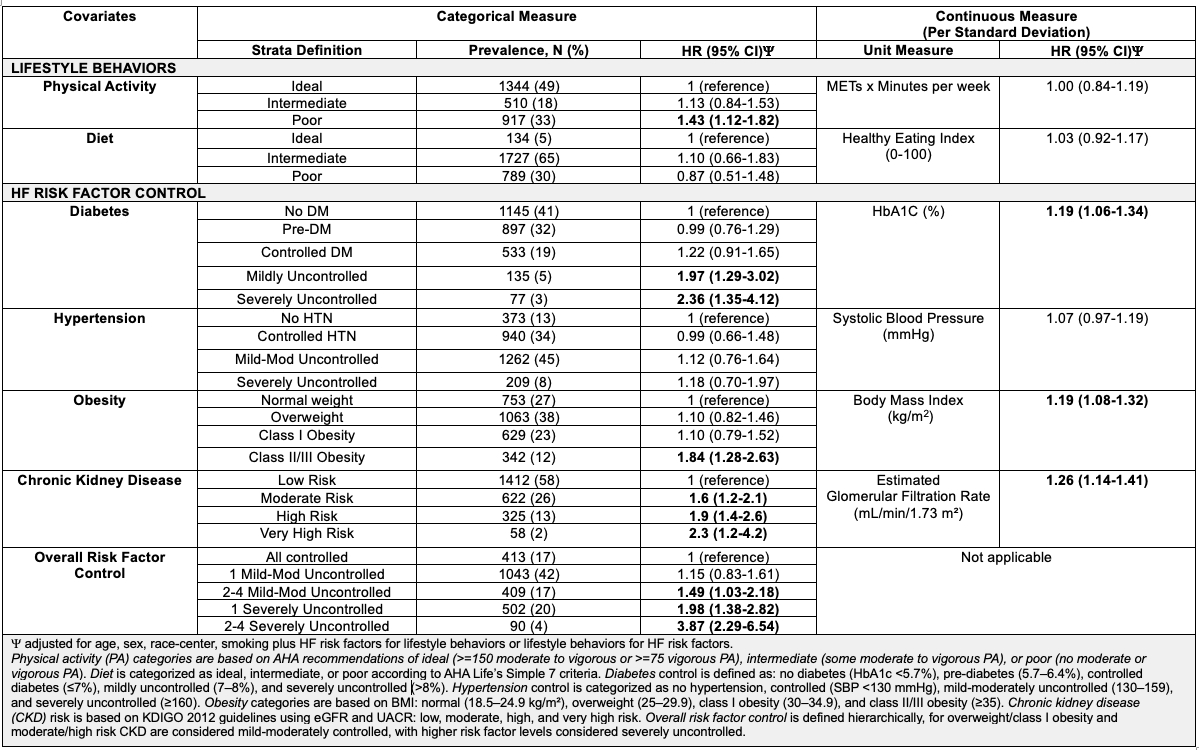
Results: A total of 2,781 participants (mean age of 76 years, 63% women and 19% Black adults) were included. Over a median follow-up of 9 years, 433 participants developed clinical HF. Most participants had less than ideal physical activity (51%) and diet (95%), while 83% had at least 1 uncontrolled cardiometabolic risk factor. Compared to respective reference groups, poor physical activity, uncontrolled diabetes, class II/III obesity, and chronic kidney disease were associated with HF risk (Table 1). When modeled per 1-SD, the strongest predictors of progression to clinical HF were lower estimated glomerular filtration rate (eGFR), higher HbA1C, and higher body mass index (BMI).We observed a progressive association between the number and severity of uncontrolled cardiometabolic risk factors and transition from pre-HF to HF, with the highest risk among those with ≥2 severely uncontrolled risk factors (Figure 1).
Conclusion: Uncontrolled cardiometabolic risk factors are highly prevalent and potent predictors of progression from pre-HF to clinical HF. Optimization of risk factor control and proven HF prevention strategies addressing cardiometabolic kidney health may confer substantial clinical benefits in this high-risk pre-HF population.
  • Grant, Jelani  ( Johns Hopkins Hospital , Parkville , Maryland , United States )
  • Ndumele, Chiadi  ( JOHNS HOPKINS HOSPITAL , Silver Spring , Maryland , United States )
  • Wallace, Amelia  ( JH Bloomberg Sch. of Public Health , Baltimore , Maryland , United States )
  • Zhang, Sui  ( JH Bloomberg Sch. of Public Health , Baltimore , Maryland , United States )
  • Echouffo, Justin  ( Johns Hopkins Hospital , Baltimore , Maryland , United States )
  • Hamo, Carine  ( New York University School of Medic , New York , New York , United States )
  • Nambi, Vijay  ( Baylor College of Medicine , Sugar Land , Texas , United States )
  • Khan, Sadiya  ( Northwestern University , Chicago , Illinois , United States )
  • Selvin, Elizabeth  ( JOHNS HOPKINS UNIVERSITY , Baltimore , Maryland , United States )
  • Shah, Amil  ( UT Southwestern Medical Center , Dallas , Texas , United States )
  • Author Disclosures:
    Jelani Grant: DO NOT have relevant financial relationships | Chiadi Ndumele: DO NOT have relevant financial relationships | Amelia Wallace: DO NOT have relevant financial relationships | Sui Zhang: No Answer | Justin Echouffo: DO NOT have relevant financial relationships | Carine Hamo: DO NOT have relevant financial relationships | VIJAY NAMBI: No Answer | Sadiya Khan: DO NOT have relevant financial relationships | Elizabeth Selvin: DO NOT have relevant financial relationships | Amil Shah: DO NOT have relevant financial relationships
Meeting Info:

Scientific Sessions 2025

2025

New Orleans, Louisiana

Session Info:

Heart Failure in CKM Syndrome: Prevention, Management and Outcomes

Monday, 11/10/2025 , 01:45PM - 02:55PM

Moderated Digital Poster Session

More abstracts on this topic:
9-Year Longitudinal Assessment of the 12-lead Electrocardiogram of Volunteer Firefighters

Bae Alexander, Dzikowicz Dillon, Lai Chi-ju, Brunner Wendy, Krupa Nicole, Carey Mary, Tam Wai Cheong, Yu Yichen

Early supported discharge program decreases length of hospital stay and demonstrates high clinic follow-up rates after stroke

Tenberg Amelia, Zink Elizabeth, Bahouth Mona

More abstracts from these authors:
Different Heart Failure Risk Factors Have Distinct Patterns of Preclinical Cardiac Dysfunction: The Atherosclerosis Risk in Communities (ARIC) Study

Grant Jelani, Coresh Josef, Shah Amil, Ndumele Chiadi, Zhang Sui, Wallace Amelia, Nambi Vijay, Echouffo Justin, Minhas Anum, Matsushita Kunihiro, Selvin Elizabeth, Ballantyne Christie

The Association of PREVENT-HF Risk Estimates with Subclinical (Stage B) HF and Clinical Implications for HF Risk: The Atherosclerosis Risk in Communities (ARIC) Study

Grant Jelani, Matsushita Kuni, Shah Amil, Coresh Joe, Ndumele Chiadi, Zhang Sui, Khan Sadiya, Ozkan Bige, Nambi Vijay, Pandey Ambarish, Blumenthal Roger, Ballantyne Christie, Selvin Elizabeth

You have to be authorized to contact abstract author. Please, Login
Not Available