Temporal trends and segmental breakpoints in age-standardized DALY rates for ischemic heart disease: a global and country-level analysis 1990–2021
Abstract Body (Do not enter title and authors here): Background:
Ischaemic heart disease (IHD) is a major cause of death and morbidity globally, and it accounts for a high proportion of the worldwide disease burden.
Purpose: To comprehend the temporal trends and breakpoints in age-standardized disability-adjusted life year (DALY) rates to analyze the impact of interventions and assign priority to regions in need of public health intervention.
Methods:
The current study examines trends in age-standardized DALY rates for IHD at the global and country levels from 1990 to 2021 based on Global Burden of Disease (GBD) Study data. Joinpoint regression analysis was used to determine segmental breakpoints and compute Annual Percentage Change (APC) and Average Annual Percentage Change (AAPC) across regions.
Results:
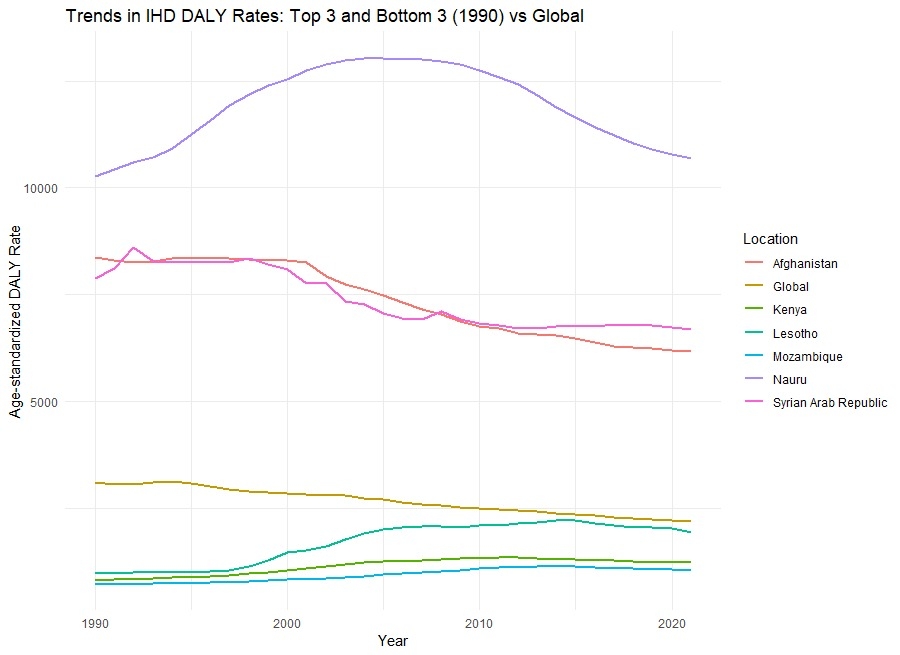
In the IHD DALY dataset, Russia exhibited an age-standardized rate of 5901.48 per 100,000 individuals in 1990 (95% CI: 5703.59–6010.77), while Andorra reported 1555.69 (1177.61–2044.18). Tuvalu recorded the highest rate among selected countries in 1992 at 6360.38 (5415.19–7274.86).
The AAPC data revealed significant variations. Afghanistan showed an AAPC of -1.20 (CI: -1.31 to -1.09, p < 0.0001), while Albania recorded -0.34 (-0.54 to -0.14, p = 0.00198). Algeria experienced a more pronounced decline at -1.68 (-1.77 to -1.59, p < 0.0001).
At the global level, IHD APC trends show a segmented pattern. From 1990 to 1994, the APC was 0.15% (95% CI: -0.53 to 0.84), but a significant decline followed from 1994 to 2021, with an APC of -1.27% (-1.31 to -1.24, p < 0.0001). The slope for the 1990–1994 period was 0.0015 (SE: 0.0035), while for 1994–2021, the slope was -0.0128 (SE: 0.0002).
Conclusion:
This analysis underscores significant global reductions in the burden of IHD over the past three decades, with breakpoints often occurring after 1994. Many countries, including Denmark, Israel, and Norway, have seen very substantial reductions; Lesotho remains one of the few that still continues an increasing trend. The findings therefore suggest targeted interventions are needed in the high-burden nations. These trends will help to inform future prevention strategies and health policies for further reductions in IHD-related morbidity and mortality around the world and guide future cardiovascular disease prevention strategies and health policies to further reduce IHD-related morbidity and mortality worldwide.
Rath, Shree
(
All India Institute of Medical Sc.
, Bhubaneswar , India )
Author Disclosures:
Shree Rath:DO NOT have relevant financial relationships
Buhadur Ali Muhammad Khan, Shahzaib Muhammad, Qureshi Muhammad Ahmad, Ammar Ur Rahman Mohammad, Munir Luqman, Khalid Amna, Hayat Malik Saad, Shoaib Muhammad Mukarram