Trends and Disparities in Maternal Hypertensive Disorders Among High-Income Nations from 1990–2021: A Benchmarking Global Analysis
Abstract Body (Do not enter title and authors here): Background: Maternal hypertensive disorders (MHD), a leading cause of maternal and perinatal morbidity and mortality, remain a critical public health issue even in high-income countries (HIC) with advanced obstetric care. Despite progress in healthcare systems, the evolving trends in MHD burden across HIC remain poorly characterized.
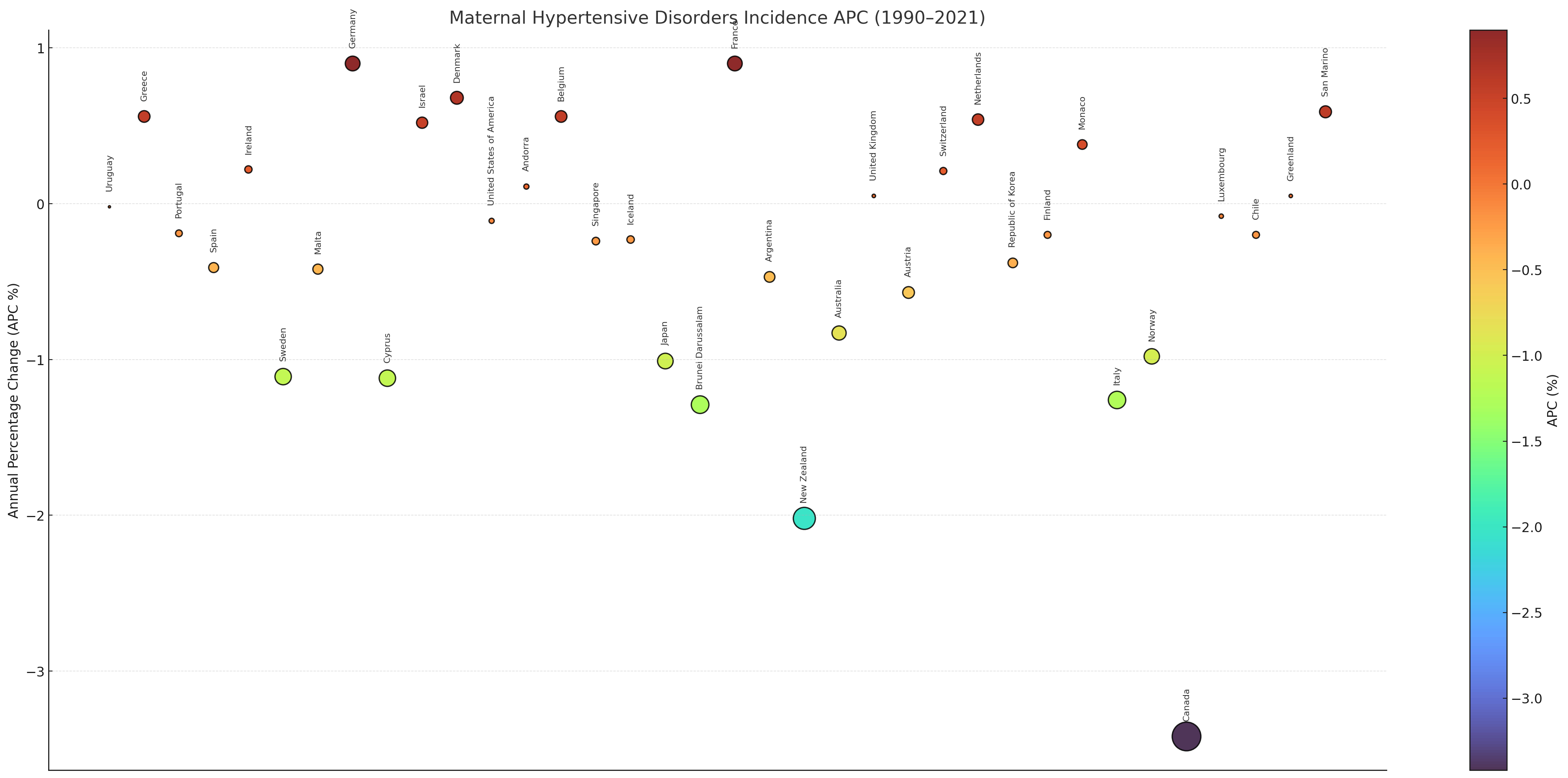
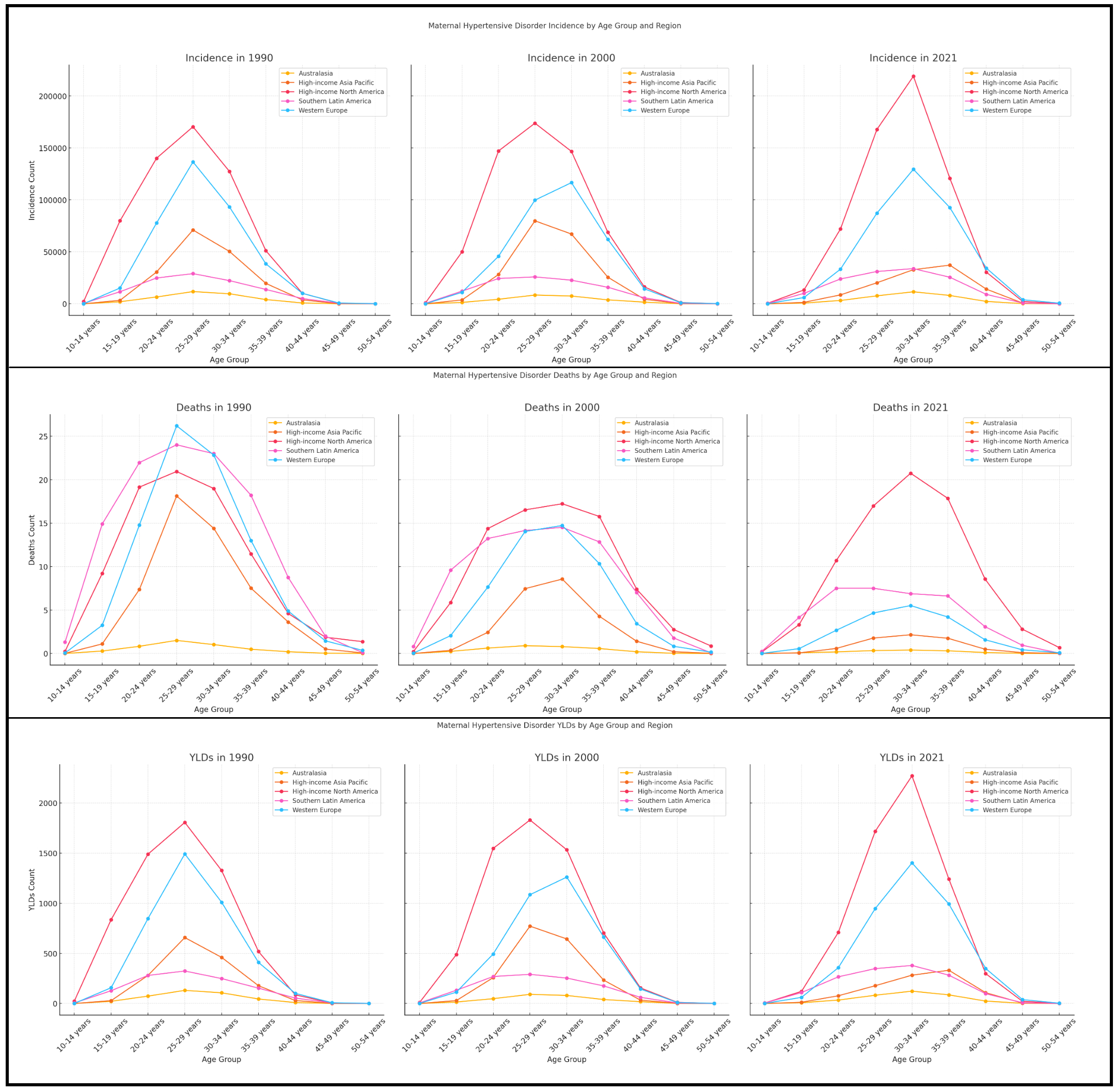
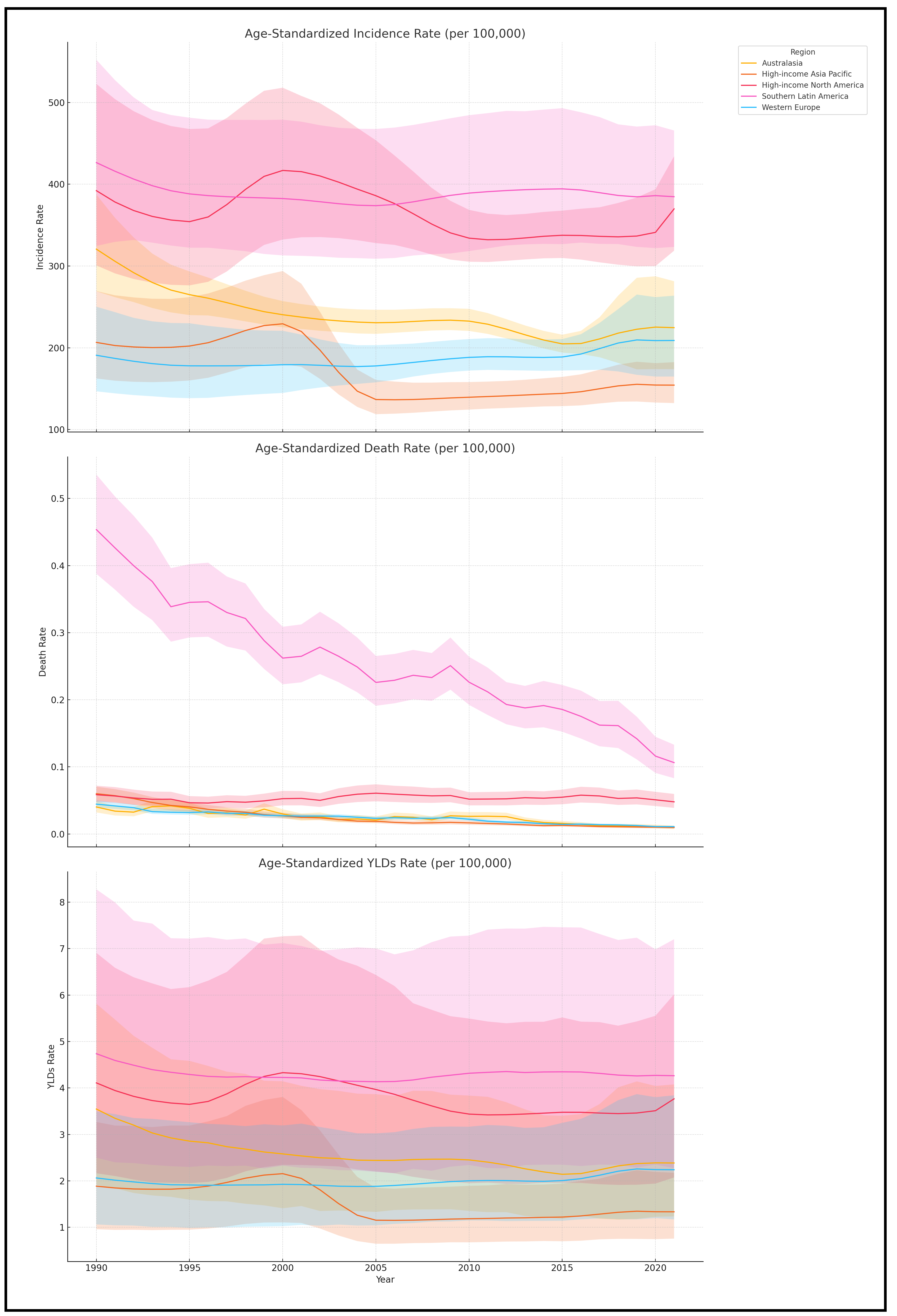
Methods: We employed the Global Burden of Disease Study 2021 analytical framework to estimate the burden of MHD across HIC. Case definitions were standardized using ICD-10 codes, and estimates were generated through DisMod-MR 2.1, a Bayesian meta-regression tool. Mortality was modeled using cause-of-death ensemble modeling, while years lived with disability (YLDs) were computed by applying disability weights to prevalence estimates. Temporal trends in age-standardized rates were evaluated using log-linear regression to calculate annual percentage changes (APCs). Results: Between 1990 and 2021, the total number of prevalent cases of maternal hypertensive disorders increased in High-income North America (HINA) from 124,114 (95% UI: 77,999–192,941) to 131,063 (85,937–185,149), in Southern Latin America from 24,774 (15,450–37,690) to 31,021 (20,449–45,050), and in Western Europe from 82,654 (51,187–127,529) to 85,625 (53,336–127,823). Conversely, declines were observed in High-income Asia Pacific (from 31,578 [19,282–48,836] to 18,741 [12,085–27,289]) and Australasia (from 8,037 [5,348–11,685] to 7,408 [4,516–10,924]). The highest annual increase in age-standardized incidence was seen in Germany (0.97%), followed by France (0.86%), Denmark (0.66%), and Israel (0.58%), while the USA exhibited a slight decline (−0.13%). In terms of mortality, Canada was the only high-income country to report an increasing APC (0.19%), whereas all others, including the USA, showed declines, with the USA decreasing by −0.67%. Across all time points, the burden was greatest in women aged 20–29 years, with HINA consistently exhibiting the highest incidence, mortality, and YLDs, despite declining death rates elsewhere and persistently elevated disability burden. Conclusion: Despite declining mortality, MHD remain a persistent challenge in HIC , with rising incidence in parts of Europe and substantial disability burden in HINA. The disproportionate burden among women aged 20–29 years underscores the need for region-specific maternal health strategies focused on early detection, long-term management, and equitable care access.
Patel, Jay
(
MGM Medical College, Aurangabad, Maharashtra, India-431003
, Aurangabad , India )
Kochhar, Gunjan
(
university of oklahoma health sciences center
, Oklahoma City , Oklahoma , United States )
Sudan, Sourav
(
Saint Vincent Hospital
, Worcester , Massachusetts , United States )
Parisapogu, Anusha
(
University of Connecticut
, Hartford , Connecticut , United States )
Varagantiwar, Vaidheesh
(
Internal medicine,Rajiv Gandhi institute of medical sciences, Adilabad,504001, India
, Adilabad , India )
Sanapala, Deepika
(
Katuri medical college
, Krishna , India )
Sami, Shahzad Ahmed
(
Internal medicine, DCH regional medical center/university of Alabama, Tuscaloosa, AL, 35401
, Tuscaloosa , Alabama , United States )
Gajjar, Jay
(
Smt. NHL Municipal Medical College, India
, Ahmedabad , India )
Rayudu, Uma Shailendri
(
Gitam institute of medical sciences and research
, Visakhapatnam , India )
Patel, Jeel
(
Gujarat Adani Institute of Medical Sciences
, Bhuj , India )
Patel, Ridham
(
Internal Medicine, Corpus Christi Medical Center, Corpus Christi, Texas, USA, 78411
, Austin , Texas , United States )
Jay Patel:DO NOT have relevant financial relationships
| Jeel Patel:DO NOT have relevant financial relationships
| Ridham Patel:DO NOT have relevant financial relationships
| Hardik Dineshbhai Desai:DO NOT have relevant financial relationships
| Gunjan Kochhar:DO NOT have relevant financial relationships
| Sourav Sudan:No Answer
| Anusha Parisapogu:DO NOT have relevant financial relationships
| Vaidheesh Varagantiwar:No Answer
| deepika sanapala:DO NOT have relevant financial relationships
| SHAHZAD AHMED SAMI:No Answer
| Jay Gajjar:DO NOT have relevant financial relationships
| Uma Shailendri Rayudu:DO NOT have relevant financial relationships
Ali Muhammad Faizan, Khan Muhammad, Sharif Aleena, Hossain Mohammad, Ahmad Husnain, Eltawansy Sherif, Faizan Muhammad, Ahmed Ashraf, Abdul Malik Mohammad Hamza Bin, Pahwani Ritesh, Patel Rahul, Mehdi Hassan