Associations of Diet during Pregnancy with Cardiovascular Health (Life’s Essential 8) among Women in Midlife
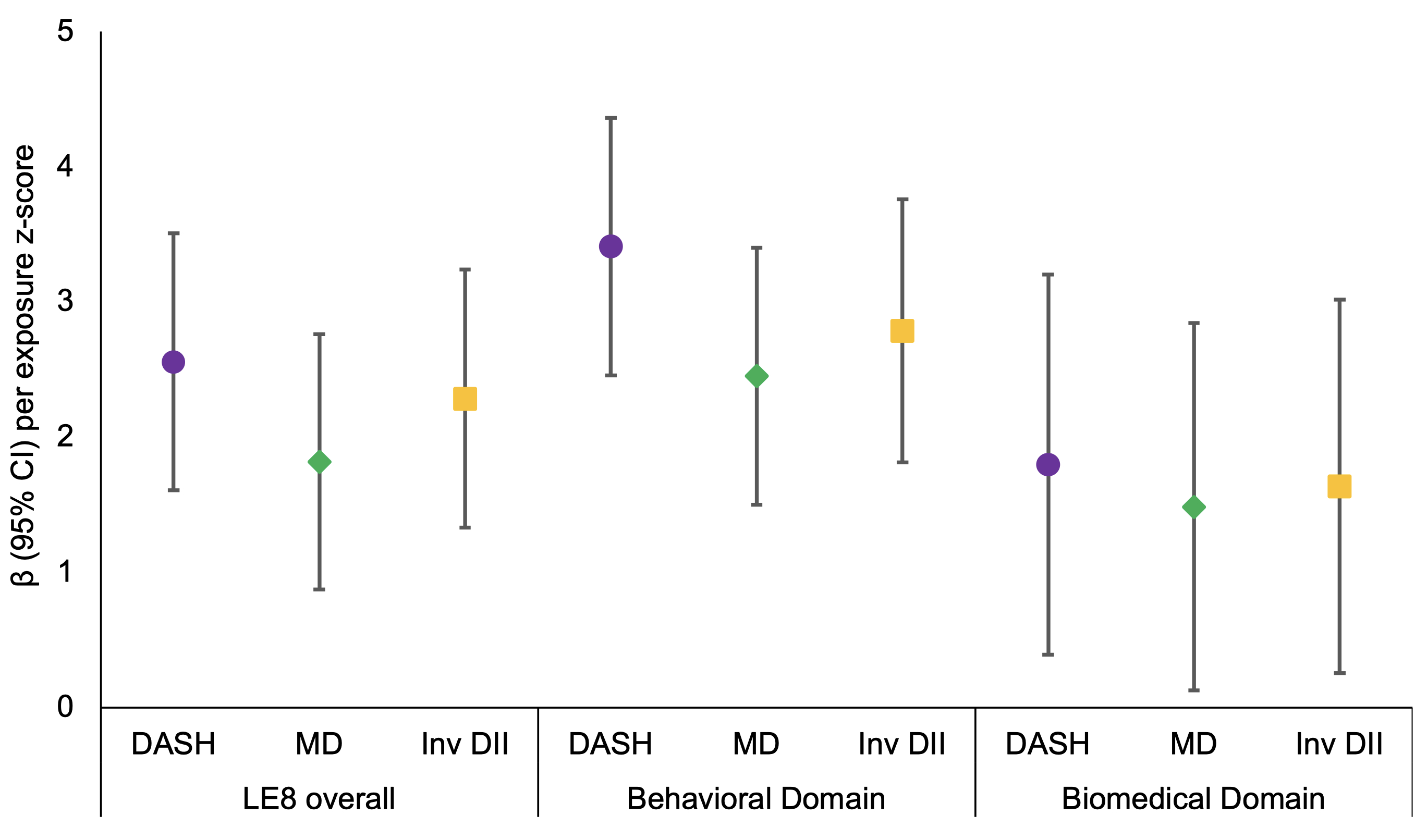
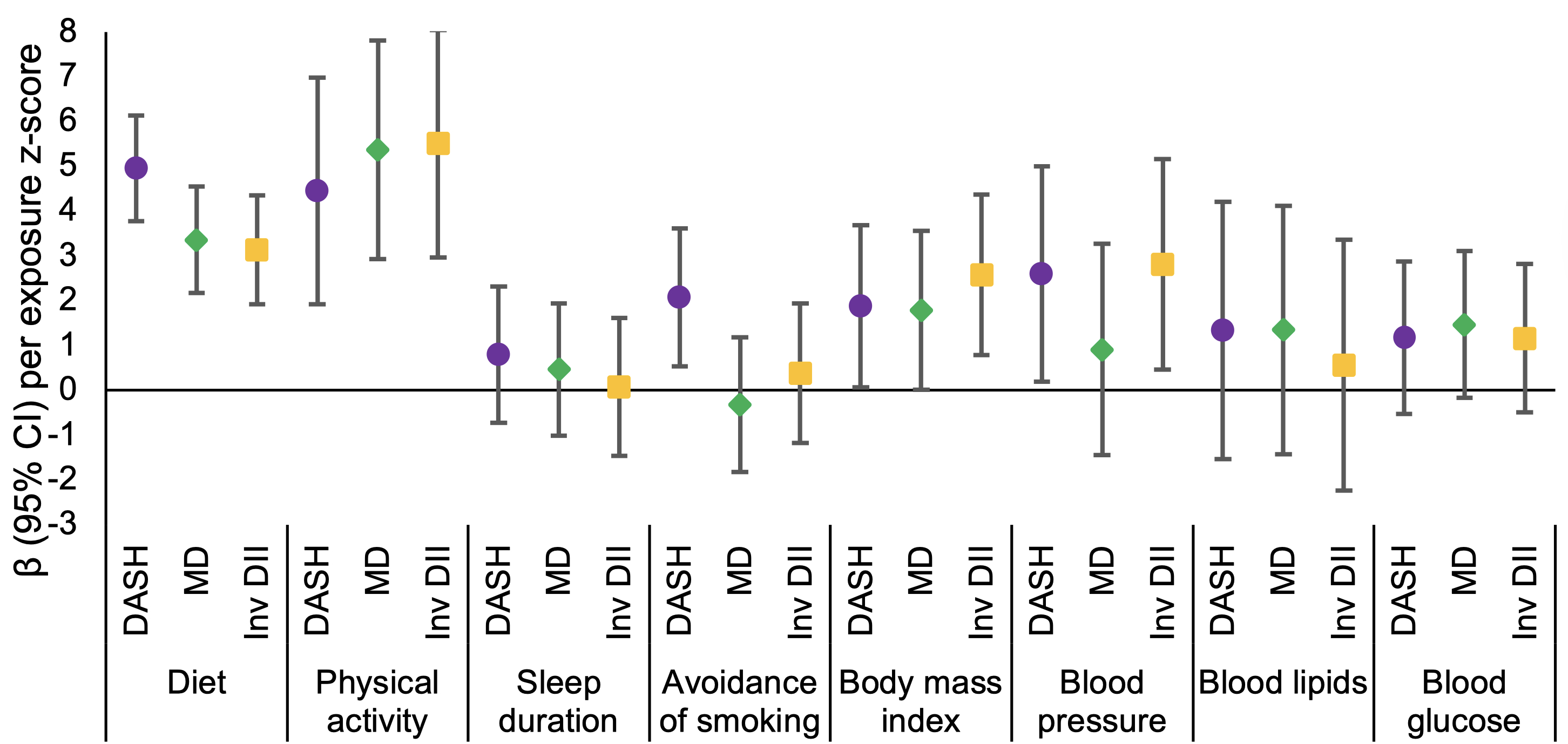
Abstract Body: Background: Cardiovascular health (CVH) often worsens among midlife women. Diet during pregnancy, a similarly sensitive period due to physiological and weight changes, may influence long-term CVH, but few studies have examined this relationship over extended follow-up. Objective: Examine associations of diet during pregnancy with maternal CVH in midlife. Methods: We analyzed data from 760 women enrolled in the Project Viva cohort in Massachusetts during early pregnancy (1999-2002) with midlife follow-up. Participants completed food frequency questionnaires during their first and second trimesters, from which we calculated three diet scores: Dietary Approaches to Stop Hypertension (DASH), Mediterranean Diet (MD), and the Dietary Inflammatory Index (DII). We inverted DII so higher scores reflect healthier diets for all scores. We averaged the trimesters and generated internal z-scores for comparability. About 18 years later (mean 51y), participants completed questionnaires and research visits, including blood collection. We assessed CVH using the American Heart Association’s Life’s Essential 8 framework (range 0-100; higher scores=better CVH), including four behavioral (diet, physical activity, sleep duration, smoking) and four biomedical (BMI, blood pressure, lipids, glucose) components. We used linear regression models adjusted for age, pre-pregnancy BMI, education, parity, and income. Results: Most participants were non-Hispanic White (70%) and college graduates (75%). Mean(SD) midlife CVH score was 76 (12). Higher (per 1-SD) DASH scores were associated with better overall CVH (β 2.6; 95%CI 1.6, 3.5), behavioral (3.4; 2.5, 4.4) and biomedical (1.8; 0.4, 3.2) subscores. Higher MD scores were associated with better overall CVH (1.8; 0.9, 2.8), behavioral (2.5; 1.5, 3.4) and biomedical scores (1.5; 0.1, 2.8). Higher inverted DII scores were associated with better overall CVH (2.3; 1.3, 3.2), behavioral (2.8; 1.8, 3.8) and biomedical scores (1.6; 0.3, 3.0)(Fig1). All diet scores were similarly associated with midlife diet, physical activity, and BMI; only DASH was associated with smoking; only DASH and DII were associated with blood pressure. Associations with lipids and glucose were in expected directions but weaker and non-significant(Fig2). Conclusions: Women who consumed healthier diets during pregnancy had better CVH two decades later. Supporting high-quality maternal nutrition may not only promote pregnancy and child health, but also long-term maternal CVH.
Rifas-shiman, Sheryl
(
Harvard Medical School and Harvard Pilgrim Health Care Institute
, Boston , Massachusetts , United States )
Aris, Izzuddin
(
Harvard Medical School and Harvard Pilgrim Health Care Institute
, Boston , Massachusetts , United States )
Hivert, Marie-france
(
Harvard Medical School and Harvard Pilgrim Health Care Institute
, Boston , Massachusetts , United States )
Zhang, Mingyu
(
Harvard Medical School
, Boston , Massachusetts , United States )
Chavarro, Jorge
(
Harvard T.H. Chan School of Public Health
, Boston , Massachusetts , United States )
Oken, Emily
(
Harvard Medical School and Harvard Pilgrim Health Care Institute
, Boston , Massachusetts , United States )