Rising Heat, Falling Cold: Three-Decade Shifts in Cardiovascular Mortality Among Youth Attributable to Non-Optimal Temperature Exposure Across 204 Countries
Abstract Body (Do not enter title and authors here): Background:Non-optimal temperatures have become silent amplifiers of cardiovascular(CV) risk, yet their impact on individuals <20 remains underrecognized. Children and adolescents possess limited physiological adaptability, making them especially vulnerable to environmental extremes. As global temperatures rise and climate resilience remains uneven, understanding the long-term influence of cold and heat exposure on CV health in the younger population is crucial for guiding future public health and climate policy.
Method: Utilizing the Global Burden of Disease study 2021 framework to estimate the burden of CVD attributable to non-optimal temperature in individuals aged <20 years across 204 countries and territories from 1990-2021. The burden was calculated using population attributable fractions(PAFs), which quantify the proportion of CVD deaths,disability-adjusted life years(DALYs), and years of life lost(YLLs) linked to exposure to low and high temperatures(LT, HT) beyond the optimal temperature threshold. Estimates were stratified by age group, sex, year, and region.
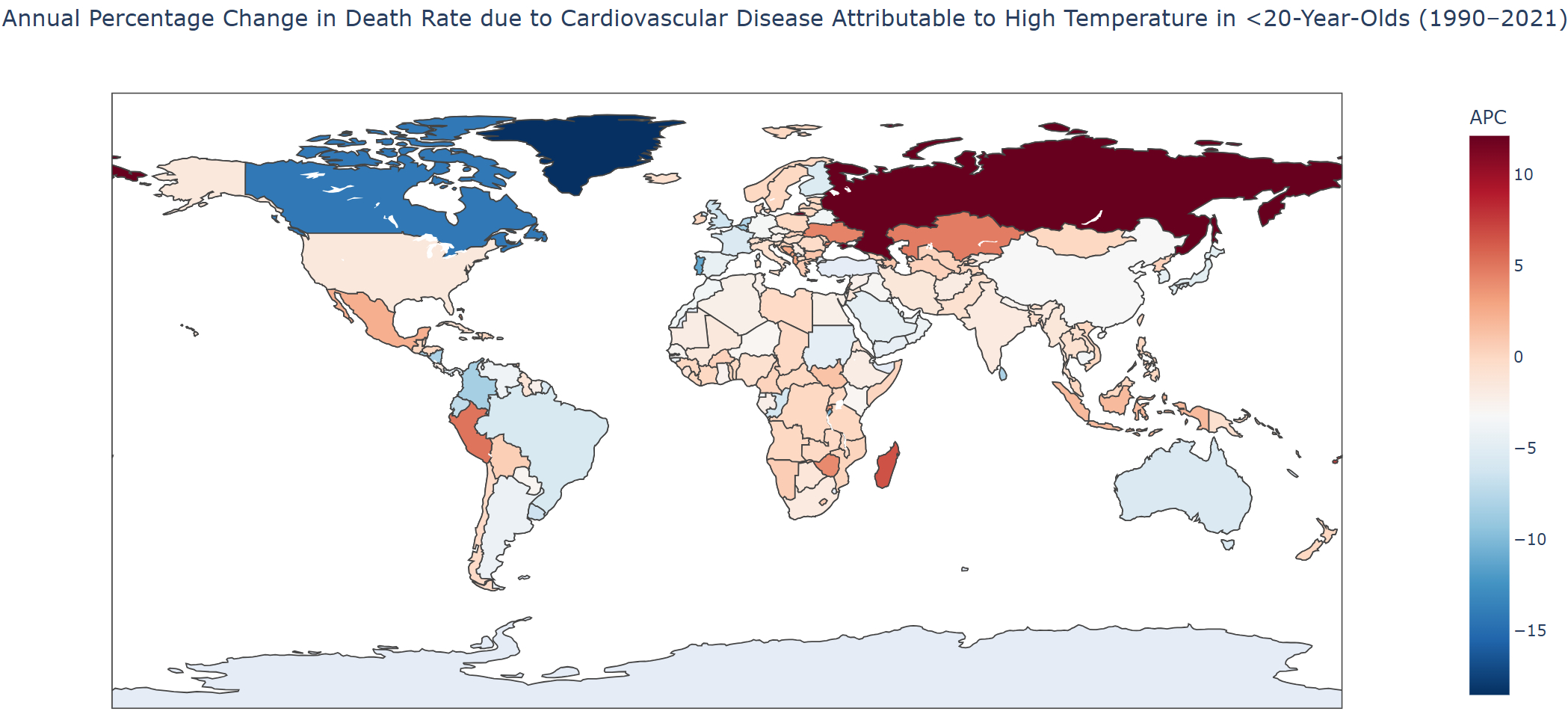
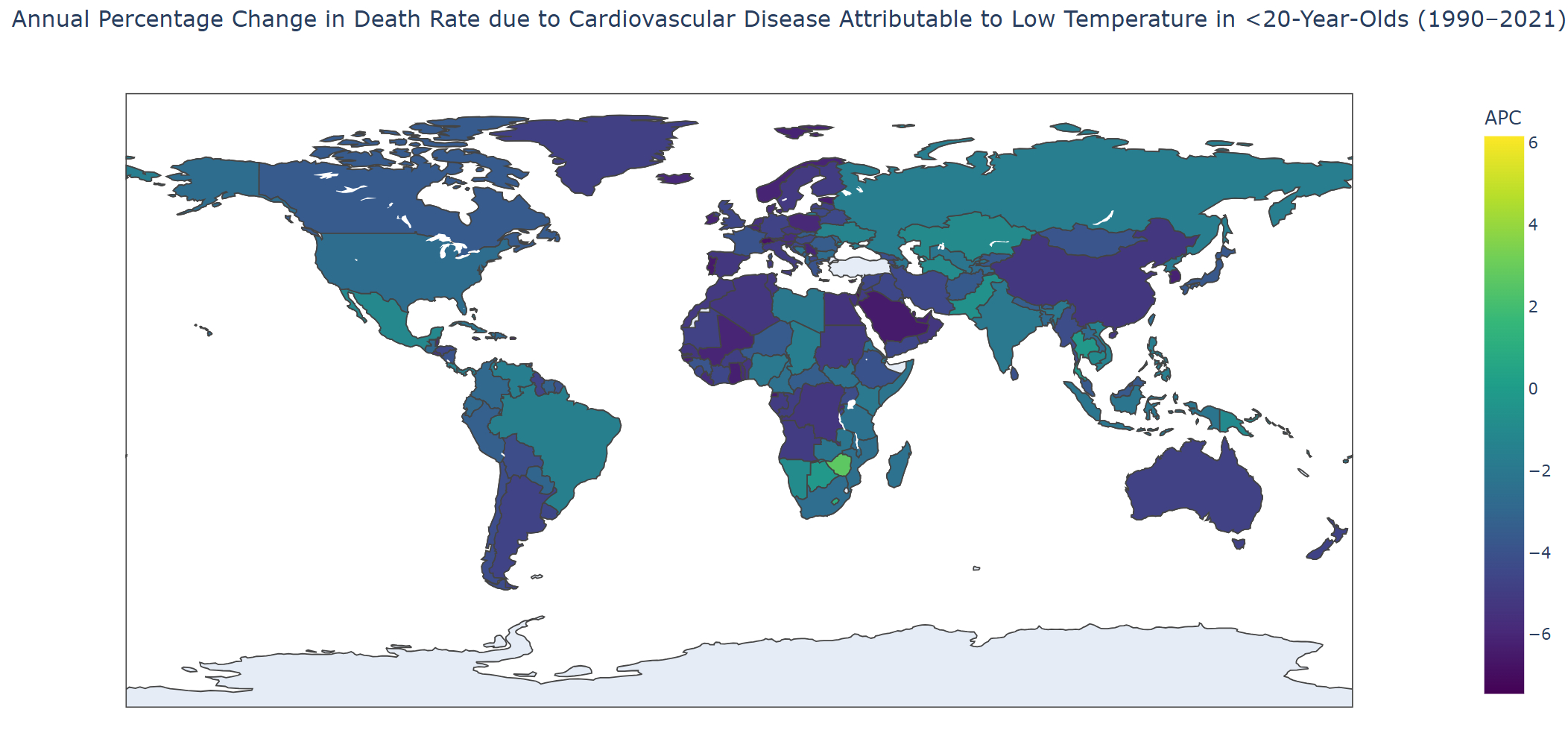
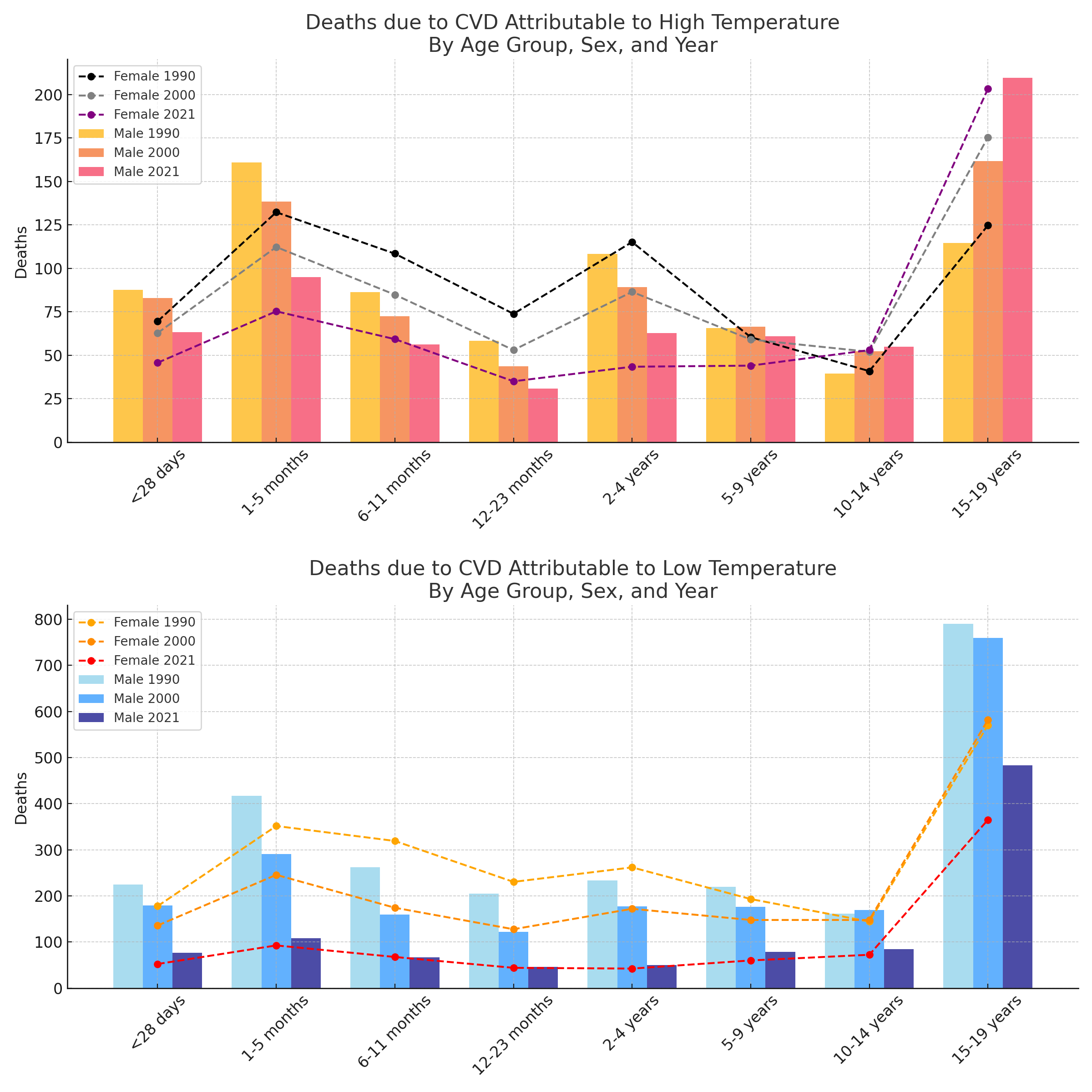
Result: Between 1990 and 2021, CVD deaths attributable to LT in youth declined from 4,762(95% UI: 3,900–6,015) to 1,790(1,458–2,290), while DALYs and YLLs showed parallel reductions from 395,310(320,864–504,340) to 142,752(114,672–185,052). Conversely, HT exposure saw an increase in burden: deaths rose by 18%, DALYs by 21%, and YLLs by 21%. Regionally, Sub-Saharan Africa exhibited the steepest increase in CVD deaths due to HT, surging by 101%, followed by a 37% rise in Central Europe, Central Asia, and Eastern Europe. Age-wise, the most pronounced increases in heat-related CVD deaths occurred in the 15–19 year group (+73%) and 10–14 year group (+34%), whereas younger age groups experienced a consistent decline. Despite higher historical burdens from cold exposure, the accelerating rise in heat-related mortality reflects a shifting climate-related threat among global youth.
Conclusion: Over the last three decades, the burden of CVD attributable to non-optimal temperature in individuals under 20 has transitioned from being predominantly cold-driven to increasingly heat-driven—particularly in older pediatric age groups and certain geographic regions. This evolving epidemiological pattern underscores the urgent need for climate-resilient health systems, early-life cardiovascular monitoring, and targeted public health interventions to mitigate temperature-related health risks in the next generation.
Patel, Sagar
(
Internal medicine -Ward Wizard Medicare Pvt Ltd, Nadiad, Gujarat, India, 387002
, Nadiad , India )
Imtiaz, Hassaan
(
Mclaren Bay Region
, Saginaw , Michigan , United States )
Sami, Shahzad Ahmed
(
Internal medicine, DCH regional medical center/university of Alabama, Tuscaloosa, AL, 35401
, Tuscaloosa , Alabama , United States )
Patel, Jay
(
Mahatma Gandhi Mission's Medical Co
, Bilimora , India )
Patel, Ridham
(
Internal Medicine, Corpus Christi Medical Center, Corpus Christi, Texas, USA, 78411
, Austin , Texas , United States )
Kochhar, Gunjan
(
University of Oklahoma health sciences center,
, Oklahoma City , Oklahoma , United States )
Rayudu, Uma Shailendri
(
Gitam institute of medical sciences and research
, Visakhapatnam , India )
Patel, Jeel
(
Gujarat Adani Inst. of Medical Sci.
, Bhuj , India )
Sinha, Neelima
(
Department of Medicine, Kurji Holy Family Hospital, Patna, Bihar, India, 800010
, Bihar , India )
Varagantiwar, Vaidheesh
(
Internal medicine,Rajiv Gandhi institute of medical sciences, Adilabad,504001, India
, Adilabad , India )
Sagar Patel:DO NOT have relevant financial relationships
| Vaidheesh Varagantiwar:No Answer
| Hardik Dineshbhai Desai:DO NOT have relevant financial relationships
| Hassaan Imtiaz:DO NOT have relevant financial relationships
| SHAHZAD AHMED SAMI:No Answer
| Jay Patel:DO NOT have relevant financial relationships
| Ridham Patel:DO NOT have relevant financial relationships
| Gunjan Kochhar:DO NOT have relevant financial relationships
| Uma Shailendri Rayudu:DO NOT have relevant financial relationships
| Jeel Patel:DO NOT have relevant financial relationships
| Neelima Sinha:DO NOT have relevant financial relationships