
Logo

American Heart Association

  14
  0


Final ID: Mo4022

Characterizing Shared Genetic Architectures in Brain and Cardiovascular Diseases via Clustering of Survival GWAS Summary Statistics

Abstract Body (Do not enter title and authors here):
Background:
Clustering neurological, psychiatric, and cardiovascular diseases based on GWAS summary statistics offers opportunities to uncover their shared genetic architecture across the brain–heart axis. Survival GWAS improves biological and clinical resolution over traditional binary trait GWAS by modeling disease age-of-onset as time-to-event (TTE) traits.

Research Question:
Can unsupervised clustering of survival GWAS summary statistics uncover biologically coherent disease groups? If so, can we identify cluster-specific hallmark genes that reflect shared genetic architecture and inform downstream analyses such as pathway discovery and therapeutic repurposing?

Methods:
We selected 64 brain and cardiovascular diseases using distinct one-decimal sub-phecodes. For each TTE trait approximated by age at diagnosis, we extracted Z-scores for 1.28 million HapMap3 SNPs using Genetic Analysis of Time-to-Event phenotypes (GATE), which applied a frailty-adjusted Cox to 408,582 White British participants in the UK Biobank. Trait clustering was performed using HDBSCAN (a hierarchical density-based clustering method) on the first 15 principal components of the Z-scores to emphasize low-rank genetic structure while reducing noise. Within each resulting cluster, we conducted fixed-effect meta-analysis across traits to generate cluster-level GWAS summary statistics, which were then analyzed using MAGMA to assess gene-level associations.

Results:
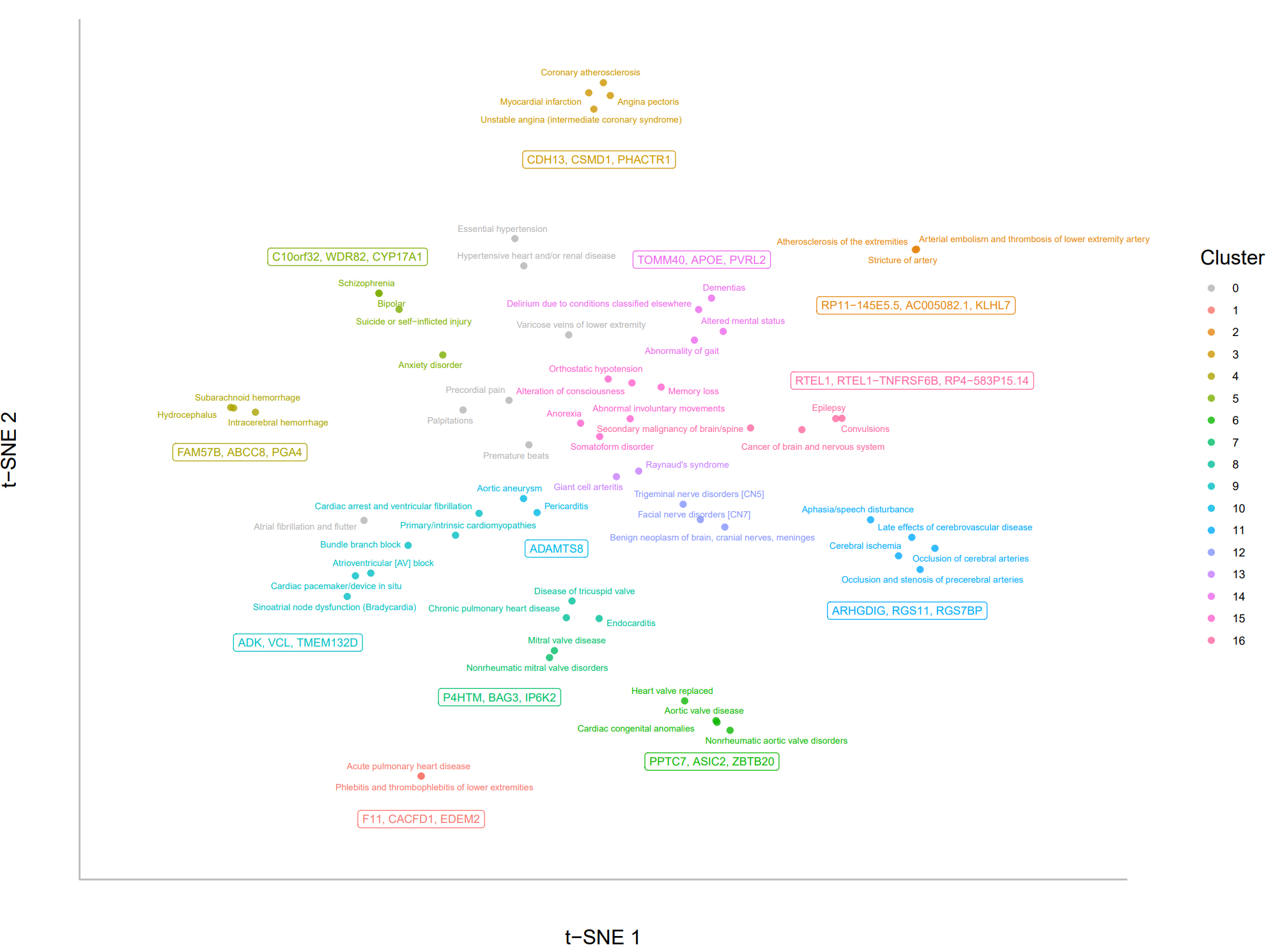
We identified 16 disease clusters and reported top three significant genes (FDR < 0.05) for each cluster, visualized using a t-SNE plot (Figure). Several clusters yielded biologically coherent disease grouping and gene signals. For example, the coronary artery disease cluster highlighted CDH13, CSMD1, and PHACTR1; the dementia cluster revealed TOMM40, APOE, and PVRL2; and the conduction disorder cluster identified ADK, VCL and TMEM132D. These genes participate in vascular, neurodegenerative, and electrophysiological processes aligned with their respective disease clusters. In contrast, clusters composed of symptom-based or heterogeneous traits (e.g., palpitations and hypertension) showed no significant gene hits.

Conclusions:
Clustering TTE traits based on disease age-of-onset-aware GWAS summary statistics can reveal convergent biology across the brain–heart axis. The identification of well-established loci supports this approach as a framework for pathway discovery and therapeutic repurposing in genetically overlapping conditions.
  • Yan, Zhiyu  ( Harvard T. H. Chan School of Public Health , Boston , Massachusetts , United States )
  • Zhang, Yujia  ( Harvard T. H. Chan School of Public Health , Boston , Massachusetts , United States )
  • Mahajan, Rahul  ( Mass General Brigham , Boston , Massachusetts , United States )
  • Duan, Rui  ( Harvard T. H. Chan School of Public Health , Boston , Massachusetts , United States )
  • Pinello, Luca  ( Massachusetts General Hospital , Boston , Massachusetts , United States )
  • Lin, Xihong  ( Harvard T. H. Chan School of Public Health , Boston , Massachusetts , United States )
  • Anderson, Christopher  ( Mass General Brigham , Boston , Massachusetts , United States )
  • Author Disclosures:
    Zhiyu Yan: DO NOT have relevant financial relationships | Yujia Zhang: DO NOT have relevant financial relationships | Rahul Mahajan: DO NOT have relevant financial relationships | Rui Duan: No Answer | Luca Pinello: DO NOT have relevant financial relationships | Xihong Lin: No Answer | Christopher Anderson: DO have relevant financial relationships ; Consultant:MPM BioImpact:Active (exists now) ; Advisor:Neurology (Journal):Active (exists now) ; Research Funding (PI or named investigator):American Heart Association:Past (completed) ; Research Funding (PI or named investigator):Bayer AG:Past (completed)
Meeting Info:

Scientific Sessions 2025

2025

New Orleans, Louisiana

Session Info:

Population-based Genomic Risk Prediction for Cardiovascular Disease 1

Monday, 11/10/2025 , 10:30AM - 11:30AM

Abstract Poster Board Session

More abstracts on this topic:
Atrial Fibrillation and Risk of Incident Cognitive Impairment: The Reasons for Geographic and Racial Differences in Stroke (REGARDS) Study

Le Vinh, Wilkinson Katherine, Judd Suzanne, Soliman Elsayed, Hyacinth Hyacinth I., Olson Nels, Smith Melissa, Cushman Mary

Causal Association of Left Atrial Emptying Fraction With Ischemic Stroke: A Mendelian Randomization Analysis

Nguyen Kevin, Cole John, Perry James, Gaynor Brady, Bai Zilong, Wang Fei, Xu Huichun, Leifer Dana

More abstracts from these authors:
ECG deep learning model accurately predicts ischemic stroke risk

Mahajan Rahul, Pace Danielle, Friedman Sam, Dsouza Valentina, Anderson Christopher, Ho Jennifer, Ellinor Patrick, Maddah Mahnaz, Khurshid Shaan

Aladyn Individual: Dynamic Individual Comorbidity Modeling for Genomic Discovery and Clinical Prediction

Urbut Sarah, Natarajan Pradeep, Ding Yi, Taraszka Kodi, Yeung Ming Wai, Patel Aniruddh, Hornsby Whitney, Duan Rui, Gusev Alexander, Parmigiani Giovanni

You have to be authorized to contact abstract author. Please, Login
Not Available