Exercise versus Regadenoson for Myocardial Perfusion Assessment in Hypertrophic Cardiomyopathy
Abstract Body (Do not enter title and authors here): Background: Despite limited supporting evidence, adenosine-based vasodilators have become the default stress test agents in hypertrophic cardiomyopathy (HCM), where perfusion defects have been reported at higher-than-expected rates, with some studies showing 100% perfusion deficits in apical HCM.
Aims: To elucidate the prevalence and mechanism of perfusion defects in HCM by performing a head-to-head comparison of physiologic stressors against supraphysiologic stressors and isolate the effect of myocyte hypercontractility on myocardial perfusion using a subgroup of patients on cardiac myosin inhibitors (CMIs).
Methods: This is a prospective study of 25 patients with HCM. Participants underwent myocardial contrast echocardiography (MCE) during maximal effort supine bicycle, followed by a period of rest, then regadenoson MCE. Quantitative perfusion analysis with NarNar software derived myocardial blood volume, microvascular blood flux rate, myocardial blood flow (MBF), and coronary flow reserve (CFR).
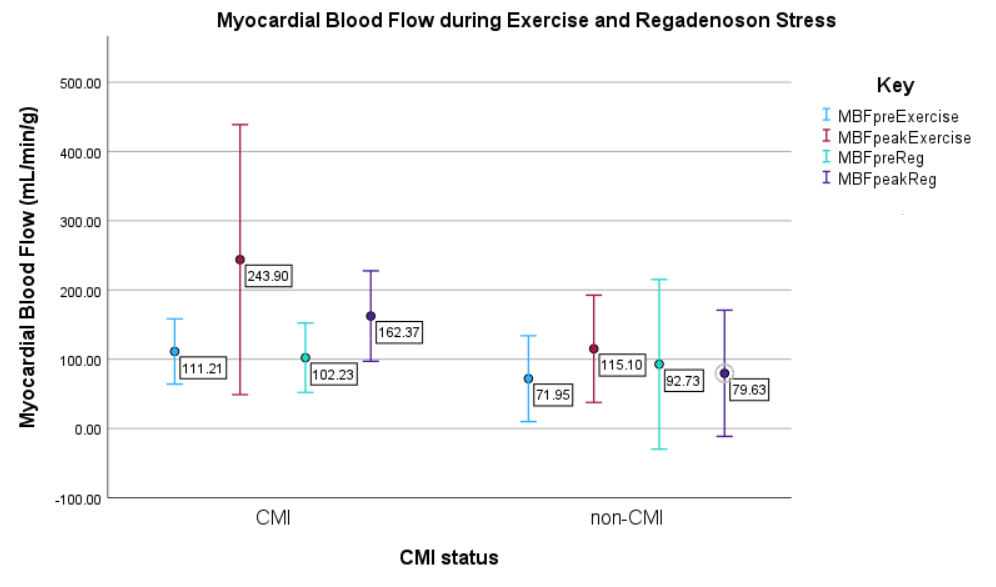
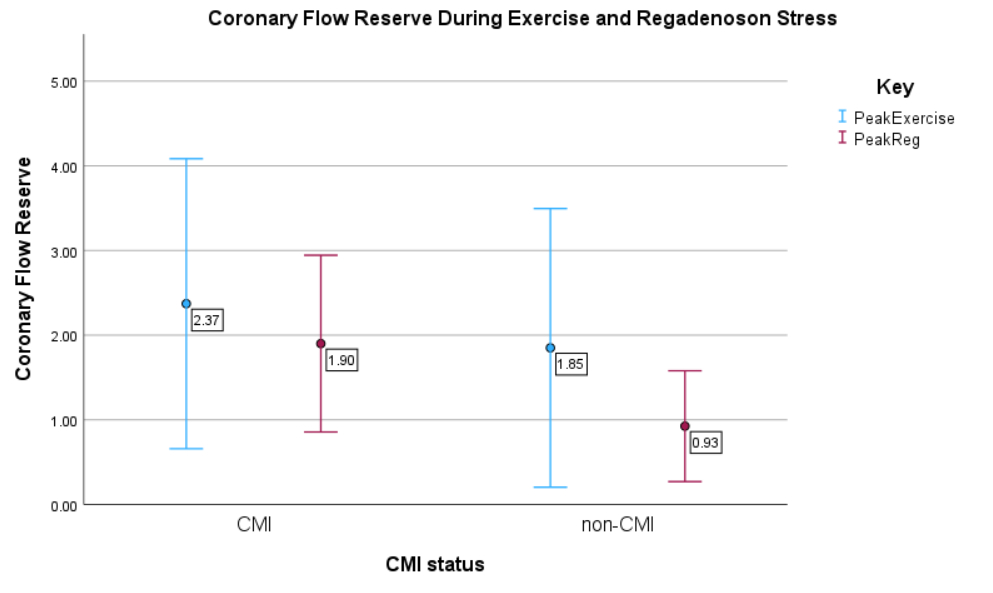
Results: The study is ongoing, 22 patients successfully underwent the study protocol, exercised to exhaustion or limiting symptoms (all participants exercised for ≥6 minutes, reaching ≥100 peak watts). A total of 11 patients (50%) were symptomatic in daily living with NYHA class II-III. MCE was able to reproduce symptoms in patients, but symptom burden was significantly higher with regadenoson (96%) compared to exercise (59%), p=<0.001. Perfusion analysis has been completed for 11 patients and is ongoing. For the 11 patients, during exercise stress, MBF increased from a mean of 97±49 to 197±178 mL/min/g (CFR 2.2±1.6), while regadenoson stress increased MBF from a mean of 99±60 to 132±76 mL/min/g (CFR 1.5±1.0). In the CMI subgroup, mean CFR was 2.4±1.9 with exercise and 1.9±1.1 with regadenoson, while the non-CMI group had a mean of 1.9±1.0 with exercise and 0.9±0.4 with regadenoson.
Conclusion: Preliminary findings suggest that regadenoson, as compared to exercise, overestimates myocardial perfusion defects in HCM, results in frequently impaired CFR (<2.0), and causes frequent symptomatology not reflective of patients’ daily symptoms. These results support reevaluating the routine use of supraphysiologic vasodilators in HCM stress testing. Furthermore, CMI use led to higher CFR values, supporting our hypothesis that alleviation of myocyte hypercontractility may improve perfusion in HCM patients. Further experiments are being conducted to confirm our findings.
Nguyen, Olivia
(
OREGON HEALTH SCIENCE UNIVERSITY
, Portland , Oregon , United States )
Hodovan, James
(
OREGON HEALTH SCIENCE UNIVERSITY
, Portland , Oregon , United States )
Alqabani, Mohammad
(
OREGON HEALTH SCIENCE UNIVERSITY
, Portland , Oregon , United States )
Kamna, Daniel
(
OREGON HEALTH SCIENCE UNIVERSITY
, Portland , Oregon , United States )
Jahan, Israt
(
OREGON HEALTH SCIENCE UNIVERSITY
, Portland , Oregon , United States )
Davidson, Brian
(
OREGON HEALTH SCIENCE UNIVERSITY
, Portland , Oregon , United States )
Masri, Ahmad
(
OREGON HEALTH SCIENCE UNIVERSITY
, Portland , Oregon , United States )
Author Disclosures:
Olivia Nguyen:DO NOT have relevant financial relationships
| James Hodovan:No Answer
| Mohammad Alqabani:No Answer
| Daniel Kamna:DO NOT have relevant financial relationships
| israt jahan:No Answer
| Brian Davidson:DO NOT have relevant financial relationships
| Ahmad Masri:DO have relevant financial relationships
;
Consultant: Cytokinetics, BMS, BridgeBio, Pfizer, Ionis, Lexicon, Attralus, Alnylam, Haya, Alexion, Akros, Edgewise, Rocket, Lexeo, Prothena, BioMarin, AstraZeneca, Avidity, Neurimmune, and Tenaya.:Active (exists now)
; Research Funding (PI or named investigator): Pfizer, Ionis, Attralus, Cytokinetics and Janssen. :Active (exists now)