
Logo

American Heart Association

  113
  0


Final ID: MDP980

Predicted Peak Oxygen Consumption in Patients with Hypertrophic Cardiomyopathy is Highly Variable by Sex and Predictive Equation

Abstract Body (Do not enter title and authors here): Introduction/Background
Cardiopulmonary exercise testing (CPET) can stratify risk of sudden cardiac death and determine eligibility for advanced therapies for patients with hypertrophic cardiomyopathy (HCM). Achieving <80% of predicted peak oxygen consumption during physical exertion (pVO2) has negative prognostic value and has been used as an eligibility criterion in clinical trials.

Research questions/hypothesis
pVO2 predictive equations are derived from predominantly male historical cohorts, thus they may be unreliable for women.

Goals/aims
To determine the sex-based variability in pVO2 predictive equations in patients with HCM.

Methods/approach
This was an observational study of HCM patients undergoing symptom-limited CPET. Wasserman cycle and treadmill (±obesity correction), Jones cycle for men and women, Hansen/Jones, FRIEND, and FRIEND 2018 equations were used to generate predicted pVO2 values.

Results/data
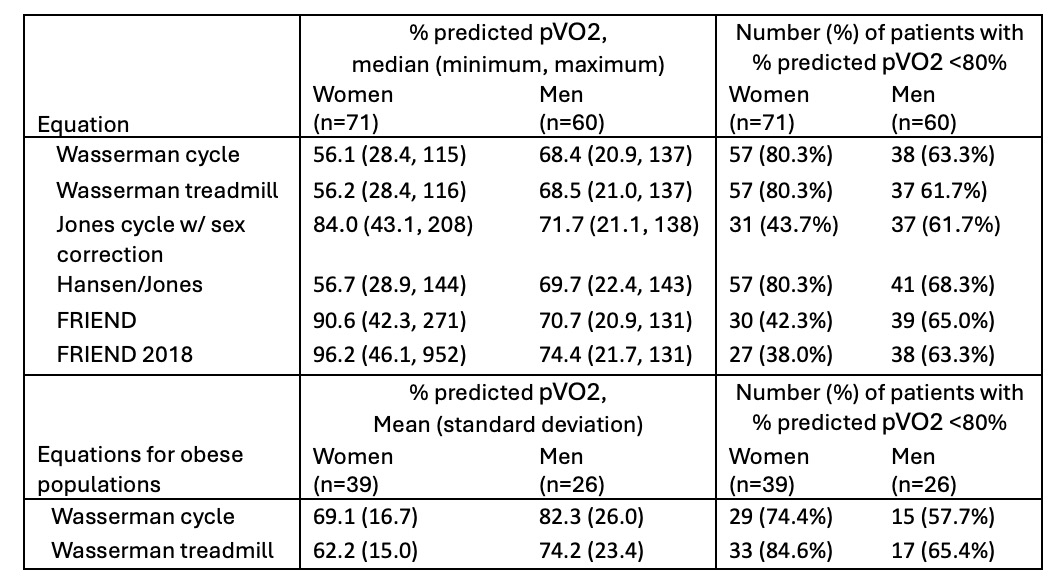
A total of 131 HCM patients (median age 47 years, range 18-86) underwent CPET and were included in the analysis; 71 (53.8%) were women. The table summarizes the differences in percent (%) predicted pVO2 by sex for each equation. Equations without built-in sex corrections (Wasserman cycle and treadmill ± obesity correction, Hansen/Jones) resulted in lower percent predicted pVO2 values in women vs men, whereas those with sex corrections resulted in higher values for women vs men. Across equations, there was a high degree of variability in percent predicted pVO2 for women (range for medians 56 to 96%) compared to men (range for medians 68 to 74%). In equations that incorporate sex corrections, fewer women were found to have percent predicted values <80%.

Conclusions
There is a high degree of variability among equations of percent predicted pVO2, especially in women. Such variability likely introduces unwanted biases in evaluation, risk prediction, and recruitment in clinical trials. Further investigation is warranted to evaluate which predictive equations provide meaningful prognostic value in HCM patients without introducing sex-based biases.
  • Tandon, Hannah  ( Oregon Health & Science University , Portland , Oregon , United States )
  • Jahan, Israt  ( Oregon Health & Science University , Portland , Oregon , United States )
  • Burton, Yunwoo  ( Oregon Health & Science University , Portland , Oregon , United States )
  • Petek, Bradley  ( Oregon Health & Science University , Portland , Oregon , United States )
  • Masri, Ahmad  ( Oregon Health & Science University , Portland , Oregon , United States )
  • Author Disclosures:
    Hannah Tandon: DO NOT have relevant financial relationships | israt jahan: No Answer | Yunwoo Burton: No Answer | Bradley Petek: DO NOT have relevant financial relationships | Ahmad Masri: DO have relevant financial relationships ; Research Funding (PI or named investigator):Pfizer; Attralus; Cytokinetics:Active (exists now) ; Other (please indicate in the box next to the company name):Akros; Prothena; Tenaya (fees):Past (completed) ; Other (please indicate in the box next to the company name):Cytokinetics; BMS; BridgeBio; Pfizer; Ionis; Lexicon; Attralus; Alnylam; Haya; Alexion; BioMarin; AstraZeneca (fees):Active (exists now) ; Research Funding (PI or named investigator):Ionis:Past (completed)
Meeting Info:

Scientific Sessions 2024

2024

Chicago, Illinois

Session Info:

Diet and Exercise in Heart Failure

Sunday, 11/17/2024 , 03:15PM - 04:30PM

Moderated Digital Poster Session

More abstracts on this topic:
An Interpretable Model for Predicting Preoperative Cardiorespiratory Fitness Using Wearable Data in Free-Living Conditions.

Hussain Iqram, Zeepvat Julianna, Reid Cary, Czaja Sara, Pryor Kane, Boyer Richard

Blood Biochemical Responses to Acute Endurance and Resistance Exercise: Findings from the Molecular Transducers of Physical Activity Consortium (MoTrPAC)

Robbins Jeremy, Goodpaster Bret, Clish Clary, Keshishian Hasmik, Trappe Scott, Walsh Martin, Burant Charles, Gerszten Robert, Katz Daniel, Rao Prashant, Many Gina, Montalvo Hernandez Samuel, Smith Gregory, Jin Christopher, Tiwari Gaurav, Iyer Gayatri

More abstracts from these authors:
Exercise versus Regadenoson for Myocardial Perfusion Assessment in Hypertrophic Cardiomyopathy

Nguyen Olivia, Hodovan James, Alqabani Mohammad, Kamna Daniel, Jahan Israt, Davidson Brian, Masri Ahmad

Outcomes Registry for Cardiac Conditions in Athletes (ORCCA): The Path Forward

Harmon Kimberly, Petek Bradley

You have to be authorized to contact abstract author. Please, Login
Not Available