Outcomes Following Septal Myectomy in Young Patients with Obstructive Hypertrophic Cardiomyopathy
Abstract Body (Do not enter title and authors here): Background: Younger patients with obstructive hypertrophic cardiomyopathy (oHCM) who undergo septal myectomy (SM) tend to be a selected group, without many comorbidities like in older adults, yet they are at risk of complications due to their unique anatomy, and their outcomes have not been well-described at a national level. This study aimed to evaluate non-fatal complications and clinical outcomes in patients aged ≤ 30 years.
Methods: Data from the Symphony Health Claims database between January 1, 2015 and June 30, 2024 were used. Short-term complications (within 30 days post-SM) and long-term (> 30 days) incident rates (IR) were summarized and calculated, respectively. Outcomes were stratified by age (≤30 vs. >30 years). Categorical variables were compared using chi-square or Fisher’s exact tests, and IRs were compared using exact Poisson methods.
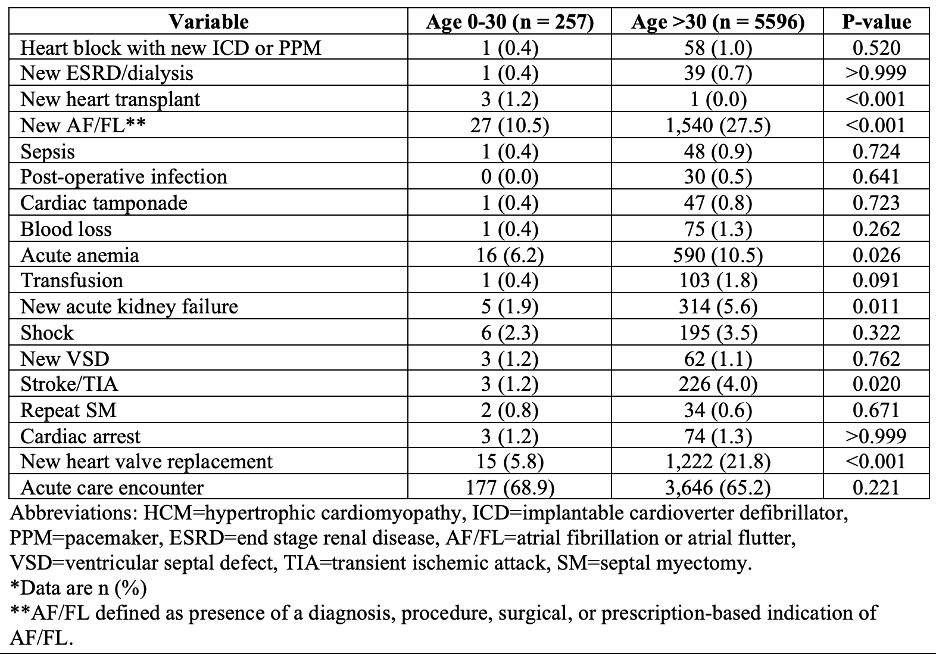
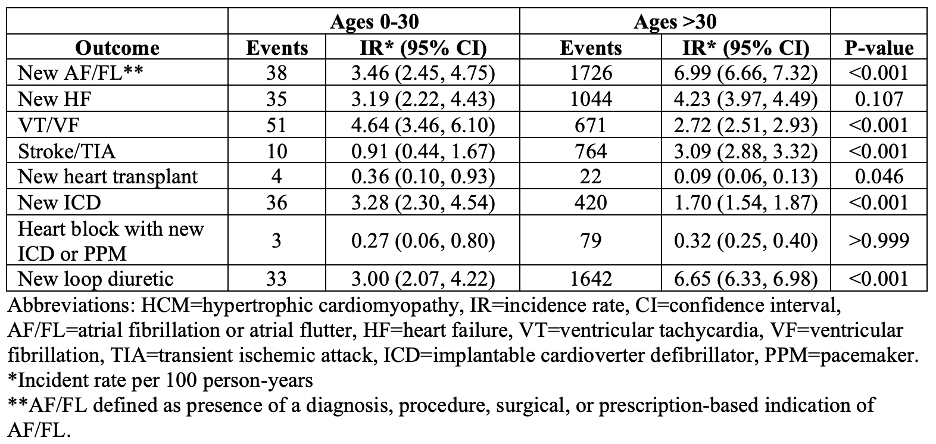
Results: A total of 5,853 patients underwent SM, including 257 patients aged ≤30 years (median age 22 [16, 27] years, 34.6% female) and 5,596 patients aged >30 years (median age 63 [54, 70] years, 52.3% female). Within 30 days of SM, and compared to older patients, younger patients experienced significantly lower rates of new atrial fibrillation/flutter (AF/FL) (10.5% vs. 27.5%; p < 0.001), acute anemia (6.2% vs. 10.5%; p = 0.02), acute kidney failure (1.9% vs. 5.6%; p = 0.01), stroke or transient ischemic attack (TIA) (1.2% vs. 4.0%; p = 0.02), and new heart valve replacement (5.8% vs. 21.8%; p < 0.001), Table 1. Over median 4.1 (IQR: 2.3, 6.2) years of follow-up (excluding first 30 days post-SM), younger patients also had lower IRs of AF/FL, stroke/TIA, and new loop diuretic prescriptions, but similar heart failure IR compared to older patients. In contrast, ventricular tachycardia/ventricular fibrillation (VT/VF), new heart transplant, and new ICD was more common in the younger cohort, Table 2.
Conclusion: Younger patients who underwent SM had significantly lower rates of immediate postoperative complications. Longer-term, younger patients experienced significant burden of events, with a lower incidence rate of AF/AFL, TIA/stroke, new loop diuretics use, and higher incidence of VT/VF, heart transplant and new ICD placement as compared to older patients. Ongoing clinical trials of cardiac myosin inhibitors in pediatric patients will provide long-term comparative data to understand if some of these events are unique to SM or represent the natural history of HCM, despite addressing LVOT obstruction.
Kamna, Daniel
(
OHSU
, Portland , Oregon , United States )
Elman, Miriam
(
OHSU
, Portland , Oregon , United States )
Alani, Ahmed
(
OHSU
, Portland , Oregon , United States )
Alqabani, Mohammad
(
OHSU
, Portland , Oregon , United States )
Butzner, Michael
(
Cytokinetics
, South San Francisco , California , United States )
Balaji, Seshadri
(
OHSU
, Portland , Oregon , United States )
Song, Howard
(
OHSU
, Portland , Oregon , United States )
Masri, Ahmad
(
OHSU
, Portland , Oregon , United States )
Author Disclosures:
Daniel Kamna:DO NOT have relevant financial relationships
| Miriam Elman:No Answer
| Ahmed Alani:No Answer
| Mohammad Alqabani:No Answer
| Michael Butzner:DO have relevant financial relationships
;
Employee:Cytokinetics, Inc.:Active (exists now)
; Individual Stocks/Stock Options:Cytokinetics, inc. :Active (exists now)
| Seshadri Balaji:DO NOT have relevant financial relationships
| Howard Song:DO have relevant financial relationships
;
Consultant:Medtronic, Inc:Active (exists now)
| Ahmad Masri:DO have relevant financial relationships
;
Consultant: Cytokinetics, BMS, BridgeBio, Pfizer, Ionis, Lexicon, Attralus, Alnylam, Haya, Alexion, Akros, Edgewise, Rocket, Lexeo, Prothena, BioMarin, AstraZeneca, Avidity, Neurimmune, and Tenaya.:Active (exists now)
; Research Funding (PI or named investigator): Pfizer, Ionis, Attralus, Cytokinetics and Janssen. :Active (exists now)