Direct Oral Anticoagulant Dual Therapy Halves Bleeding and Preserves Ischemic Protection After PCI: A Systematic Review and Meta-analysis of Randomized Controlled Trials
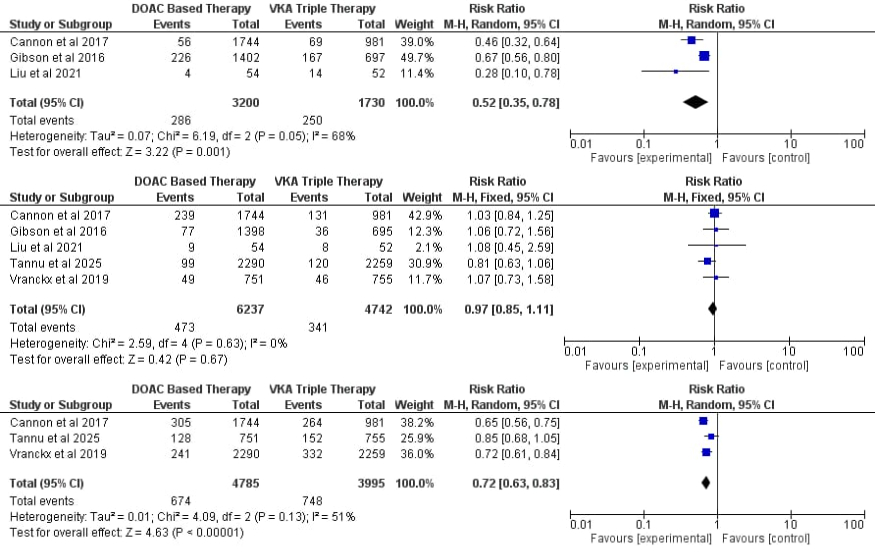
Abstract Body (Do not enter title and authors here): Background Patients with atrial fibrillation undergoing percutaneous coronary intervention (PCI) face a dilemma: preventing stent thrombosis while minimizing anticoagulation-related bleeding. Vitamin K antagonist (VKA)–based triple therapy (VKA plus dual antiplatelet therapy) reduces ischemic events but carries a high bleeding risk. Direct oral anticoagulant (DOAC)–based dual therapy may offer benefit, but individual randomized trials have been underpowered to confirm ischemic safety. Methods We systematically searched PubMed, Embase, Scopus, and the Cochrane Library through May 2025 for randomized controlled trials comparing DOAC-based dual therapy versus VKA-based triple therapy after PCI in atrial fibrillation patients. Data extraction and quality assessment followed the Cochrane Risk of Bias 2.0 tool. Pooled risk ratios (RRs) with 95% confidence intervals (CIs) were calculated using the Mantel–Haenszel method in RevMan 4.2.1. A random-effects model was applied if heterogeneity (I) exceeded 50%; otherwise, a fixed-effects model was used. Statistical significance was defined as p < 0.05. Results Five trials enrolling 6,237 patients on DOAC dual therapy and 4,742 on VKA triple therapy were included. DOAC dual therapy significantly reduced bleeding without compromising ischemic protection. TIMI (Thrombolysis In Myocardial Infarction) major plus minor bleeding was 48% lower with DOACs (286/3,200 vs. 250/1,730 events; RR 0.52, 95% CI 0.35–0.78; I = 68%; p = 0.001). ISTH (International Society on Thrombosis and Haemostasis) major plus clinically relevant non-major bleeding decreased by 28% (674/4,785 vs. 748/3,995 events; RR 0.72, 95% CI 0.63–0.83; I = 51%; p < 0.0001). The composite ischemic endpoint—cardiovascular death, myocardial infarction, stroke, or stent thrombosis—was similar between groups (473/6,237 vs. 341/4,742 events; RR 0.97, 95% CI 0.85–1.11; I = 0%; p = 0.67). Conclusions In atrial fibrillation patients undergoing PCI, DOAC-based dual therapy nearly halved bleeding risk compared with VKA triple therapy while preserving ischemic safety. These findings support DOAC dual therapy as the default post-PCI strategy, reserving triple therapy for those at very high thrombotic risk. Broad adoption may reduce hospitalizations, transfusions, and bleeding-related mortality without compromising cardiovascular outcomes.
Alajjuri, Omar Ala'
(
Montefiore St. Luke's Cornwall Hospital
, Newburgh , New York , United States )
Das, Ashesh
(
K.P.C Medical College and Hospital, BM Birla Heart Research Institute
, Kolkata , India )
Patel, Divya
(
Allegheny General Hospital
, Pittsburgh , Pennsylvania , United States )
Thadisina, Sai Reddy
(
Jawaharlal Institute of Postgraduate Medical Education and Research
, Puducherry , India )
Patel, Jainishkumar
(
General Hospital, Chhotaudepur
, Chhotaudepur , India )
Reddy, Gadila Sindhu
(
Jawaharlal Institute of Postgraduate Medical Education and Research
, Puducherry , India )
Abrol, Aradhya
(
Geisinger
, Kangra , India )
Singh, Chandandeep
(
Dayanand Medical College & Hospital
, Punjab , India )
Raparthi, Aishwarya
(
Andhra Medical College King George Hospital
, Visakhapatnam , India )
Patel, Riyakumari
(
SMIMER
, Surat , India )
Sheth, Param
(
JSS Medical College , JSS academy o
, Mysuru , India )
Author Disclosures:
Omar Ala' Alajjuri:DO NOT have relevant financial relationships
| Aishwarya Raparthi:No Answer
| Riyakumari Patel:DO NOT have relevant financial relationships
| Param Sheth:DO NOT have relevant financial relationships
| Venkata Dileep Kumar Veldi:DO NOT have relevant financial relationships
| Ashesh Das:No Answer
| Divya Patel:DO NOT have relevant financial relationships
| Sai Reddy Thadisina:DO NOT have relevant financial relationships
| Jainishkumar Patel:DO NOT have relevant financial relationships
| Gadila Sindhu Reddy:DO NOT have relevant financial relationships
| Aradhya Abrol:DO NOT have relevant financial relationships
| Chandandeep Singh:DO NOT have relevant financial relationships