Early DOAC (≤ 6 Days) After AF-Stroke Lowers Recurrent Ischemia Without Raising Symptomatic ICH: A Systematic Review and Meta-analysis of Randomized Controlled Trials
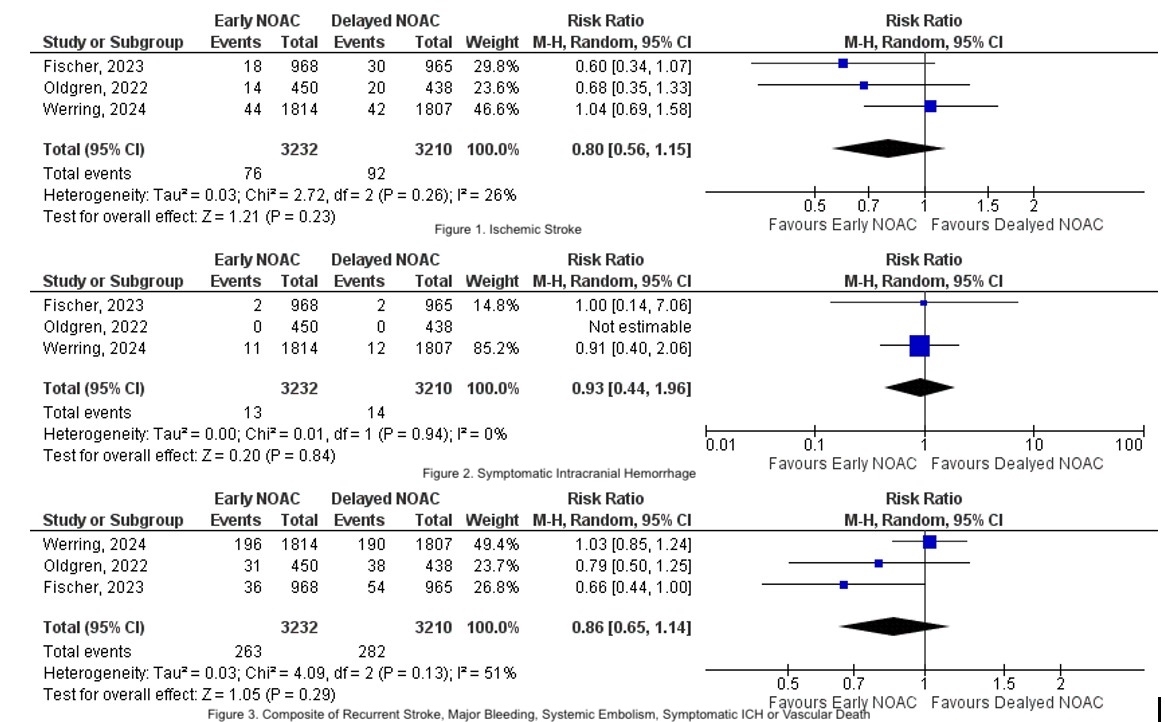
Abstract Body (Do not enter title and authors here): Introduction Early direct-oral-anticoagulant (DOAC) therapy after atrial-fibrillation–related ischemic stroke is disputed; guideline of delaying up to two weeks from vitamin-K-antagonist comes from fears of intracranial haemorrhage, leaving patients vulnerable to embolism. Pooling over 6,000 patients from ELAN, TIMING, and OPTIMAS trials—the first randomized tests of early (≤ 48 h/≤ 6 d) versus delayed DOAC start—provides an estimate of how prompt anticoagulation shifts the stroke-prevention–versus-bleeding trade-off. Methods A systematic search of PubMed, Embase, Scopus, and Cochrane Library showed Randomized Controlled Trials (RCTs) comparing early (≤ 48 h/≤ 6 d) versus late DOAC after atrial-fibrillation related ischemic stroke. After re-classifying ELAN patients who started on day 7 into the delayed arm and removing participants without 90-day data, 6442 remained for meta-analysis. Data was analysed using RevMan 4.2.1. Pooled risk ratios (RRs) with 95% confidence intervals (CIs) were calculated using Mantel-Haenszel methods. Random- or fixed-effects models were applied based on heterogeneity (I2). Risk of bias was assessed using RoB 2.0. Outcomes Across 6,442 patients pooled from ELAN, TIMING and OPTIMAS, early-initiation NOACs (≤48 h after mild stroke or ≤6 days after moderate stroke) were as safe as delayed therapy: symptomatic intracranial haemorrhage occurred in 0.4 % vs 0.4 % of participants (13/3,232 vs 14/3,210; RR 0.93, 95 % CI 0.44–1.96; P= 0.84; I2 = 0 %). Efficacy signals favoured early strategy: recurrent ischaemic stroke fell from 2.9 % to 2.4 % (76 vs 92 events; RR 0.80, 0.56–1.15; P = 0.23; I2 = 26 %) and the composite of recurrent stroke, major bleeding, systemic embolism, symptomatic ICH or vascular death declined from 8.8 % to 8.1 % (282 vs 263 events; RR 0.86, 0.65–1.14; P = 0.29; I2 = 51 %). Absolute risk reductions were −0.5 % for recurrent stroke (NNT ≈ 194) and −0.6 % for the composite end point (NNT ≈ 154). Conclusion Starting a DOAC early after ischemic stroke did not increase symptomatic intracranial haemorrhage or serious bleeding and showed a trend of fewer recurrent embolic events and a lower strokes, major bleedings, systemic embolisms, or vascular deaths. Although absolute risk reductions were modest, their direction and precision with zero detectable safety penalty, challenge the traditional “wait-and-see” paradigm and suggest that holding anticoagulation beyond the first week may leave preventable strokes on the table.
Prasad, Aishwarya
(
Montefiore St. Luke's Cornwall
, Wappingers Falls , New York , United States )
Zeeshan, Muhammad
(
Allama iqbal medical college
, Gujrat , Pakistan )
Das, Ashesh
(
KPC Medical College
, Kolkata , India )
Thakkar, Jigar
(
grant medical college
, KALYAN , India )
Shaik, Mohammed Ashwaq Hussain
(
ACSR GOVT medical College
, Nellore , India )
Ghosh, Aneek
(
Nazareth Hospital, Philadelphia
, Philadelphia , Pennsylvania , United States )
Naseem, Ali
(
King edward medical University
, Lahore , Pakistan )
Rajawat, Digvijay Singh
(
All india Institute of Medical Sciences
, Patna , India )
Goel, Anika
(
Kakatiya Medical College, Telangana
, Hyderabad , India )
Bharia, Urvashi
(
LT municipal Medical
, Mumbai , India )
Islam, M Rafiqul
(
Shaheed Suhrawardy Medical College
, Dhaka , Bangladesh )
Owais Yusufzai, Muhammad
(
Bacha Khan Medical College
, Mardan , Pakistan )
Author Disclosures:
Aishwarya Prasad:DO NOT have relevant financial relationships
| Anika Goel:DO NOT have relevant financial relationships
| Urvashi Bharia:DO NOT have relevant financial relationships
| M Rafiqul Islam:DO NOT have relevant financial relationships
| Muhammad Owais Yusufzai:DO NOT have relevant financial relationships
| Venkata Dileep Kumar Veldi:DO NOT have relevant financial relationships
| MUHAMMAD ZEESHAN:DO NOT have relevant financial relationshipsjigar Thakkar:DO NOT have relevant financial relationships
| Mohammed Ashwaq Hussain Shaik:No Answer
| Aneek Ghosh:DO NOT have relevant financial relationships
| Ali Naseem:DO NOT have relevant financial relationships
| Digvijay Singh Rajawat:No Answer