COMPARISON OF CARDIOTOXIC EFFECTS AMONG BTK (BRUTON TYROSINE KINASE) INHIBITORS: A PHARMACOVIGILANCE ANALYSIS
Abstract Body (Do not enter title and authors here): Introduction: First-generation BTK inhibitors (BTKi) Ibrutinib showed benefits in the RESONATE-2 trial and have been widely used since then. However, its associated Cardiovascular (CV) side effects limit its use in certain populations. Newer generation BTKis like Acalabrutinib and Zanubrutinib have been shown to have a relatively better CV safety profile, yet post-marketing surveillance data is limited.
Methods: We analyzed CV Adverse Events (AEs) reported to the Food and Drug Administration (FDA)’s Adverse Events (FAERS) database, WHO’s VigiAccess database, and the European Medicines Agency’s (EMA) EudraVigilance database, for Ibrutinib and newer generation BTKi Acalabrutinib and Zanubrutinib using descriptive statistics. Reporting Odds Ratio (ROR) was calculated for all reported CV AEs, and both newer generation BTKis were compared with Ibrutinib. Fisher’s exact test was used to compare and look for differences among new-generation BTKis.
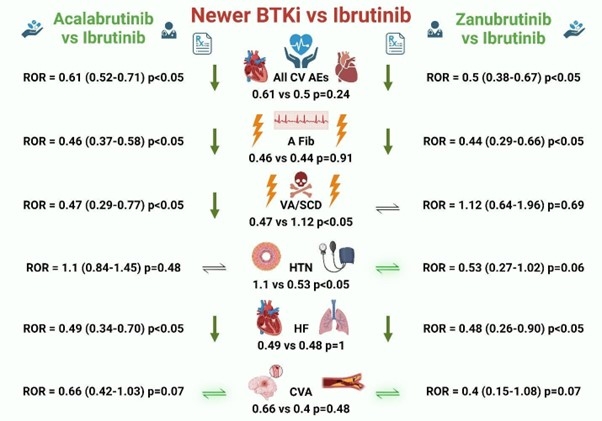
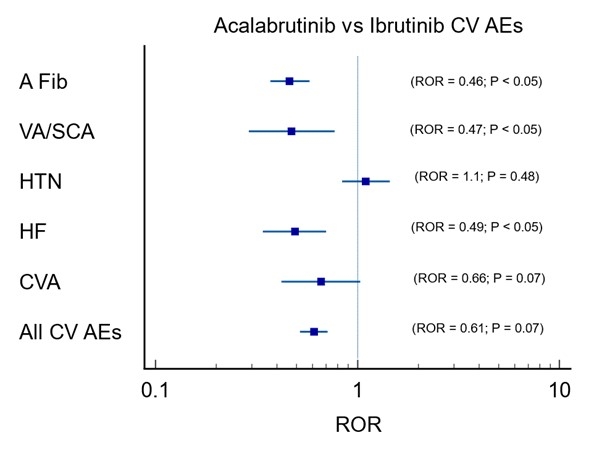
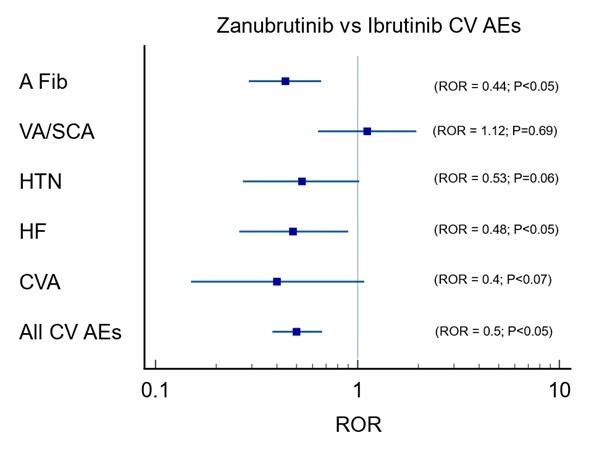
Results: On FAERS database, BTKis had increased CV AEs reported with AFib being the highest [2,146 (6.76%)] followed by HF [808 (2.54%)], HTN [688 (2.17%)], VA/SCD (Ventricular Arrhythmia/Sudden Cardiac Arrest) [461 (1.45%), and CVA [395 (1.24%)]. All CV AEs [ROR:5.42 (5.23-5.63) P<0.05] were significantly higher, with the most common association noted with AFib [ROR:21.5 (20.57-22.50) P<0.05]. While comparing Acalabrutinib with Ibrutinib, fewer AFib, VA/SCA, and HF were reported, whereas reported HTN was not significantly different between them. While comparing Zanubrutinib with Ibrutinib, a smaller number of AFib and HF were observed, while reported VA/SCA was not significantly different between them. Both newer generation BTK inhibitors, Acalabrutinib and Zanubrutinib, had overall equal reduction (ROR = 0.61 vs 0.5, P=0.24) in reported CV AEs. Zanubrutinib had higher VA/SCA than Acalabrutinib (ROR = 1.12 vs. 0.47, P<0.05). At the same time, Zanubrutinib had less HTN than Acalabrutinib (ROR = 0.47 vs. 1.12, P<0.05). Most of these findings were supported by coinciding findings from VigiAccess and EudraVigilance databases.
Conclusion: The Newer generation BTKis have fewer CV AEs when compared to Ibrutinib, which was consistent with current data. Among the newer generation BTKis, Acalabrutinib signaled for relatively higher reported HTN, while Zanubrutinib signaled for relatively higher reported VA/SCAs. Further surveillance of CV AEs associated with newer BTKi from different populations will add value to our research.
Pandya, Krutarth
(
Cleveland Clinic
, Cleveland , Ohio , United States )
Patel, Sagar
(
St. Michael's Hospital
, Newark , New Jersey , United States )
Naseem, Masooma
(
Ziauddin University
, Karachi , Pakistan )
Patel, Riya
(
MetroHealth
, Cleveland , Ohio , United States )
Dani, Sourbha
(
LAHEY HOSPITAL MEDICAL CENTER
, Burlington , Massachusetts , United States )
Author Disclosures:
Krutarth Pandya:DO NOT have relevant financial relationships
| Sagar Patel:No Answer
| Masooma Naseem:DO NOT have relevant financial relationships
| Riya Patel:DO NOT have relevant financial relationships
| Sourbha Dani:DO NOT have relevant financial relationships