Logo

American Heart Association

  19
  0


Final ID: MP1016

COMPARISON OF CARDIOTOXIC EFFECTS BETWEEN AIs AEROMATASE INHIBITORS) AND SERMs (SELECTIVE ESTROGEN RECEPTOR INHIBITORS): A PHARMACOVIGILANCE ANALYSIS

Abstract Body (Do not enter title and authors here): Introduction: Cardiovascular (CV) diseases are a major cause of morbidity and mortality in breast cancer survivors. Side effects of antineoplastic agents used in treating breast cancer have been known to be a culprit for the development of CV diseases. Aromatase Inhibitors (AIs) and Selective Estrogen Receptor Modulators(SERMs) are widely used for Estrogen receptor positive breast cancer, but limited data is available on the CV risk profiles of these classes. We aimed to compare CV risk profiles of AIs and SERMs.

Methods: We queried the Food and Drug Administration (FDA)’s Adverse Event Reporting System (FAERS) database for CV AEs of AIs and SERMs from 1996-2023. We included Anastrozole, Letrozole, and Exemestane for AIs and Raloxifene, Tamoxifen, Fulvestrant, and Toremifene for SERMs. The data on CV risk profiles were collected, analyzed, and compared for both classes using descriptive statistics. Reporting Odds Ratio (ROR) was calculated for all reported CV AEs and both AIs and SERMs. Fisher’s exact test was used to compare and look for differences among AIs and SERMs.

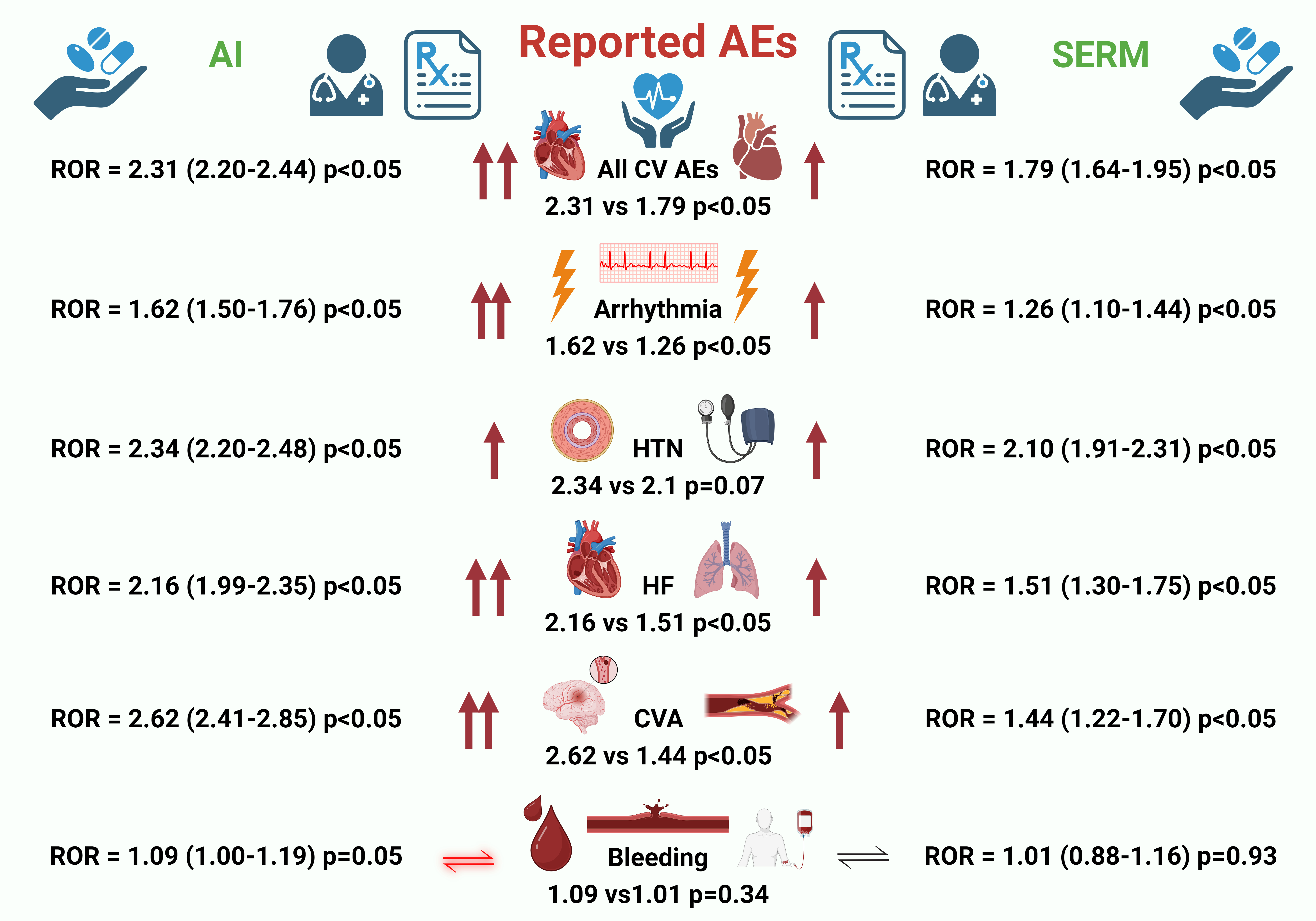
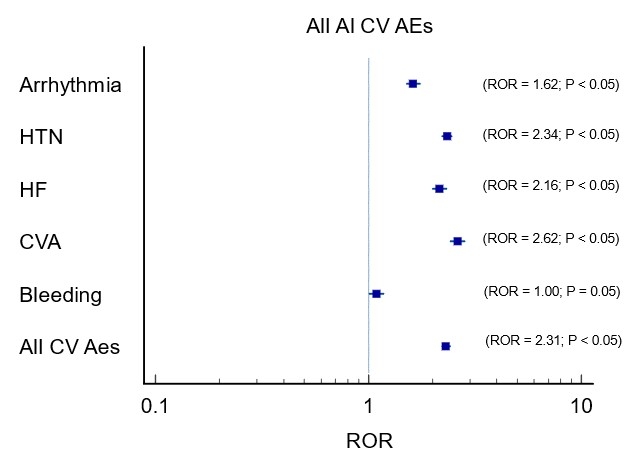
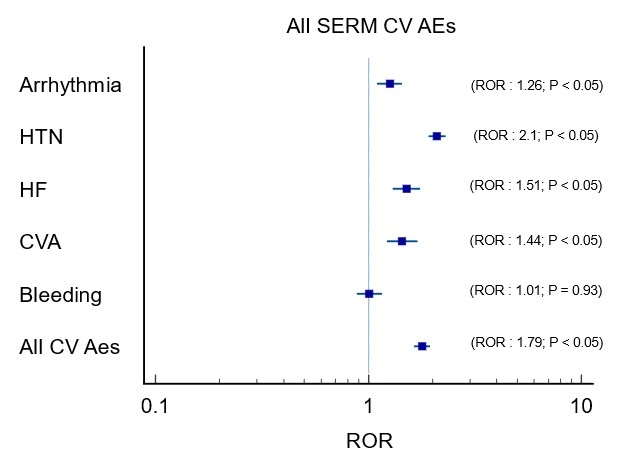
Results: On the FAERS database, a total of 37,128 events were reported for AIs, while 16,616 events were reported for SERMs. 2,499 CV AEs were reported for AIs, and 865 CV AEs were reported for SERMs. Though both AIs [ROR:2.31 (2.20-2.44) P<0.05], and SERMs [ROR:1.79 (1.64-1.95) P<0.05], had increasingly reported CV AEs, when comparing the adjusted ratio, AIs had more reported CV AEs compared to SERMs (ROR = 2.31 vs 1.79, P<0.05). On subsequent analysis, CVA (ROR = 2.62 vs 1.44, P<0.05), HF (ROR = 2.16 vs 1.51, P<0.05), and Arrhythmia (ROR = 1.62 vs 1.26, P<0.05) were also reported more with AIs compared to SERMs. HTN was found to be equally reported among both classes. Most of these findings were supported by coinciding findings from VigiAccess and EudraVigilance databases. More cardiac AEs were seen with AIs when compared with SERMs on VigiAccess [(3.92% vs 3.44%); ROR = 1.15 (1.08-1.22, p<0.05)] as well as EudraVigilance [(5.02% vs 4.07%); ROR = 1.24 (1.15-1.34, p<0.05)] databases.

Conclusion: AIs are observed to be associated with higher rates of CV AEs compared to SERMs. Further studies are warranted to establish the CV risk profile of these agents.
  • Pandya, Krutarth  ( Cleveland Clinic , Cleveland , Ohio , United States )
  • Patel, Riya  ( MetroHealth , Cleveland , Ohio , United States )
  • Author Disclosures:
    Krutarth Pandya: DO NOT have relevant financial relationships | Riya Patel: DO NOT have relevant financial relationships
Meeting Info:

Scientific Sessions 2025

2025

New Orleans, Louisiana

Session Info:

Oncological Considerations in Arrhythmia Management

Saturday, 11/08/2025 , 01:45PM - 03:00PM

Moderated Digital Poster Session

More abstracts on this topic:
A First-in-Class Humanized Antibody Fragment Targeting Platelet Glycoprotein Ibα: A Comprehensive Preclinical Study of CA1001 for the Treatment of Acute Ischemic Stroke

Xu Xiaohong, Preeti Preeti, Yu Ruoying, Shaykhalishahi Hamed, Zhang Cheng, Shen Chuanbin, Li Bei, Tang Naping, Chang Yan, Xiang Qian, Cui Yimin, Lei Xi, Ni Heyu, Zhu Guangheng, Liu Zhenze, Hu Xudong, Slavkovic Sladjana, Neves Miguel, Ma Wenjing, Xie Huifang

A soluble guanylate cyclase stimulator improves survival in a rat model of heart failure with reduced ejection fraction and chronic kidney disease induced by aorto-caval fistula and 5/6 nephrectomy

Kala Petr, Miklovic Matus, Molnar Matej, Mikula Jan, Skaroupkova Petra, Gawrys Olga, Ostadal Petr, Melenovsky Vojtech, Cervenka Ludek

More abstracts from these authors:
COMPARISON OF CARDIOTOXIC EFFECTS AMONG BTK (BRUTON TYROSINE KINASE) INHIBITORS: A PHARMACOVIGILANCE ANALYSIS

Pandya Krutarth, Patel Sagar, Naseem Masooma, Patel Riya, Dani Sourbha

Colchicine for secondary prevention in patients with Acute Coronary Syndrome (ACS). A systematic review and meta-analysis.

Shaikh Safia, Alraies M Chadi, Hamza Mohammad, Umer Ahmed Muaaz, Kc Manish, Neppala Sivaram, Singh Sahib, Basit Jawad, Pandya Krutarth, Sattar Yasar

You have to be authorized to contact abstract author. Please, Login
Not Available