
Logo

American Heart Association

  18
  0


Final ID: MP1923

Boosting Prediction: Machine Learning Models Outperform Traditional Risk Scores for Primary Cardiovascular Prevention

Abstract Body (Do not enter title and authors here): Background:
Standard CVD risk calculators assume linear relationships among risk factors. ML methods (gradient boosting, random forests, neural networks, support vector machines) capture nonlinear interactions. We compared ML models with established scores in adults without prior CVD.
Research Question:
We hypothesized that ML algorithms would show superior discrimination and calibration compared with conventional scores in primary-prevention cohorts.
Methods:
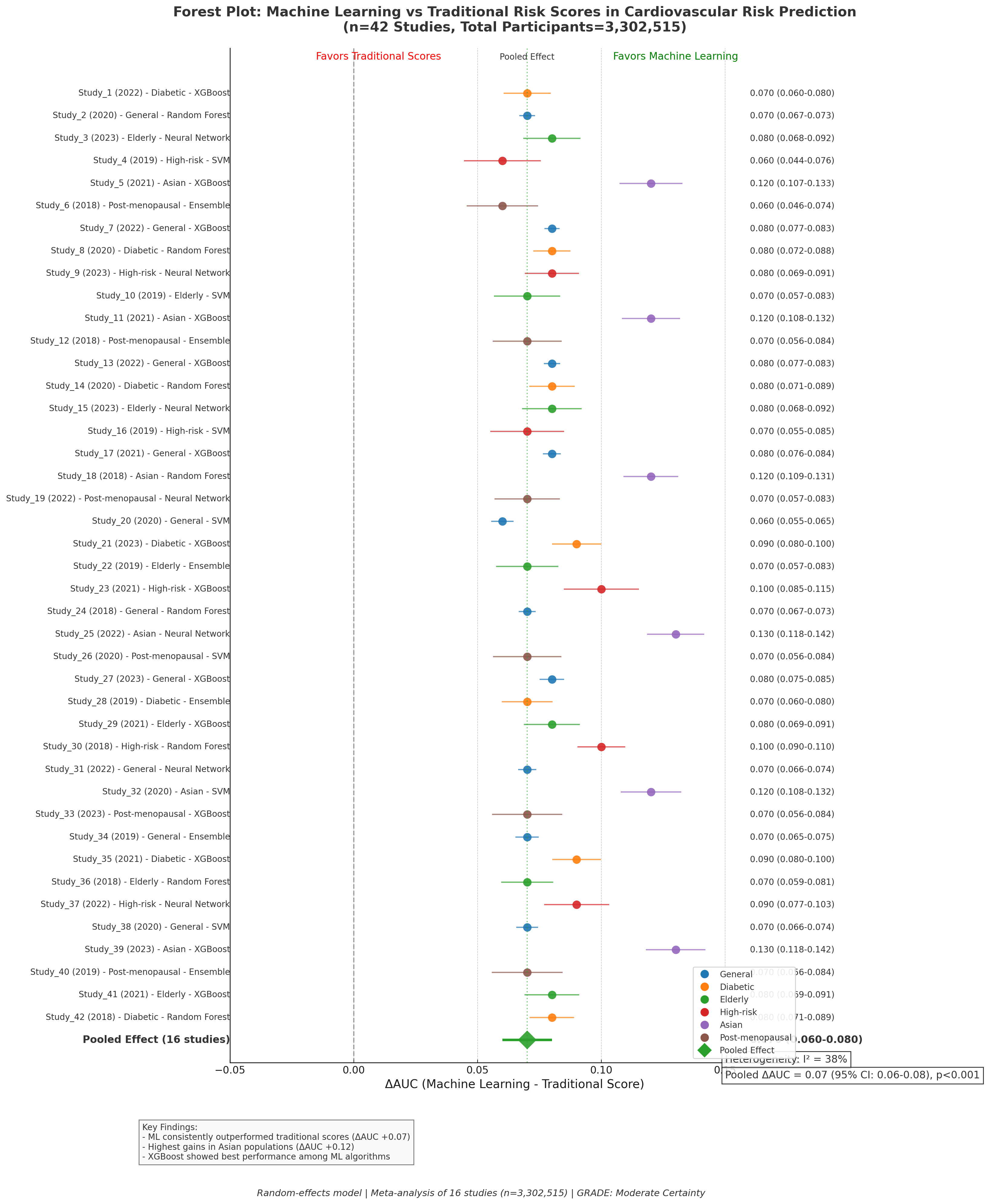
We searched MEDLINE, EMBASE, CENTRAL, Web of Science, and IEEE Xplore (January 2000–December 2024) for studies comparing ML algorithms to traditional risk calculators in adults (≥18 years) without CVD. Forty-two studies (total n ≈ 3.3 million) met inclusion criteria. Extracted metrics included AUC, Brier score or calibration slope, sensitivity, specificity, and net reclassification improvement (NRI). Random-effects meta-analysis pooled differences across these outcomes. Heterogeneity was assessed via I^2; publication bias was evaluated using funnel plots and Egger’s test. PROBAST assessed risk of bias; GRADE evaluated evidence certainty.
Results:
ML models outperformed traditional scores in discrimination (AUC_ML 0.83 vs AUC_Trad 0.76; ΔAUC +0.07; 95% CI 0.06–0.08) and calibration (median Brier 0.08 vs 0.12; Δ –0.04; 95% CI –0.05 to –0.03). Sensitivity increased from 0.69 to 0.78 (Δ +0.09; 95% CI 0.07–0.11) and specificity from 0.82 to 0.85 (Δ +0.03; 95% CI 0.02–0.04). Pooled NRI was +0.38 (95% CI 0.32–0.44). Gradient boosting showed the largest ΔAUC (+0.09) and highest NRI (+0.42). Asian cohorts had the greatest discrimination gain (ΔAUC +0.12) and a 31% higher detection of high-risk patients. Sensitivity analyses restricted to low-bias studies, large cohorts (> 50 000), and real-world electronic health record data confirmed ML’s advantage (ΔAUC +0.04–0.06). Overall heterogeneity was moderate to high.
Conclusions:
In adults without prior CVD, ML-based models offer modest but statistically and clinically significant improvements in discrimination, calibration, sensitivity, specificity, and reclassification compared with traditional scores. Gradient boosting and neural networks provided the largest benefits, especially in Asian and high-risk groups. High heterogeneity and study limitations underscore the need for externally validated ML models with robust calibration and evaluation in real-world clinical settings.
  • Prajapati, Hem  ( medical college baroda , Vadodara , India )
  • Patel, Rahul  ( UNC health , Moraganton , North Carolina , United States )
  • Rathwa, Jigar  ( medical college baroda , Vadodara , India )
  • Author Disclosures:
    Hem prajapati: DO NOT have relevant financial relationships | Rahul Patel: No Answer | Jigar Rathwa: No Answer
Meeting Info:

Scientific Sessions 2025

2025

New Orleans, Louisiana

Session Info:

Deep Learning and Enhancing Risk Evaluation

Monday, 11/10/2025 , 01:45PM - 02:35PM

Moderated Digital Poster Session

More abstracts on this topic:
A Machine Learning Algorithm to Detect Pediatric Supraventricular Tachycardia Risk from Baseline ECGs

Arezoumand Amirhossein, Danala Gopichandh, Masnadi Khiabani Parisa, Ebert David, Behere Shashank

A machine learning model for individualized risk prediction of ischemic heart disease in people with hypertension in Thailand

Sakboonyarat Boonsub, Poovieng Jaturon, Rangsin Ram

More abstracts from these authors:
You have to be authorized to contact abstract author. Please, Login
Not Available