Diagnostic Accuracy of the Systemic Immune-Inflammation Index for Predicting Contrast-Induced Nephropathy in Patients With Myocardial Infarction Undergoing Percutaneous Coronary Intervention: A Meta-Analysis
Abstract Body (Do not enter title and authors here): Background: Contrast-induced nephropathy (CIN) is an important cause of morbidity in patients with myocardial infarction (MI) undergoing percutaneous coronary intervention (PCI). Although the current guidelines support a multivariable risk assessment, the specific role of systemic immune-inflammation index (SII) remains unclear. This study aims to assess the diagnostic accuracy of the SII in predicting CIN among MI patients undergoing PCI.
Methods: Embase, Scopus, and PubMed were systematically searched from inception to April 2025 to identify studies assessing the accuracy of SII in predicting CIN in MI patients (STEMI and NSTEMI) undergoing PCI. Mean differences (MD) were pooled using the inverse variance method under a random-effects model and presented with MD and 95% confidence intervals (CIs) using R Studio. Area under the curve (AUC) was pooled using the same approach and reported with 95% CIs using Review Manager v5.4.1. Diagnostic test accuracy meta-analysis was performed using Meta-DiSc v2 to present pooled sensitivity and specificity.
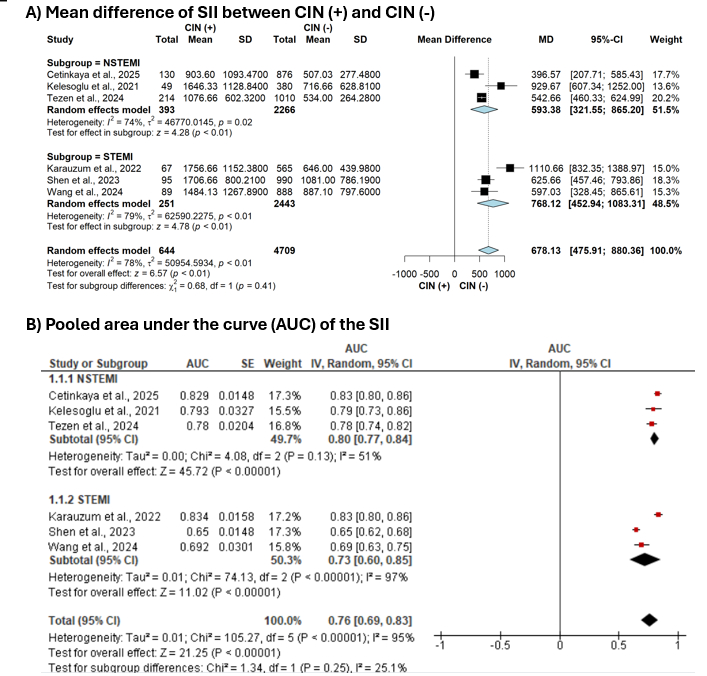
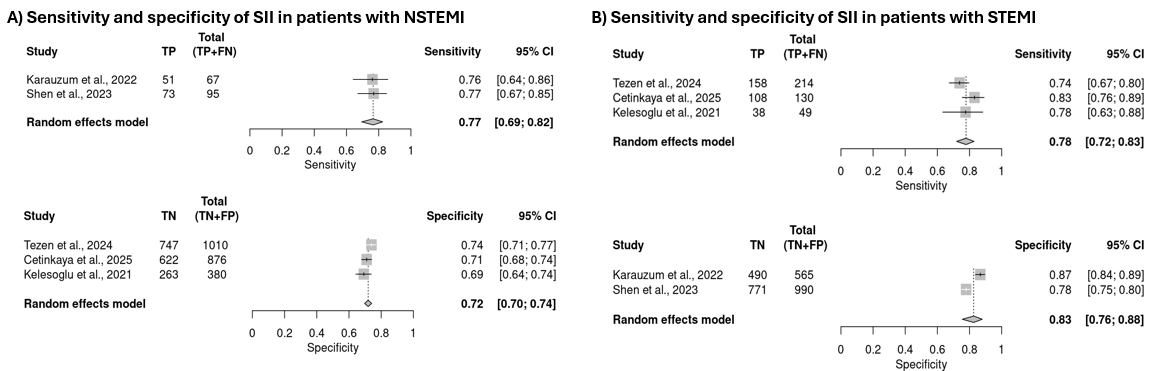
Results: Six studies including 2,659 NSTEMI patients (CIN=393; no CIN=2,266) and 2,714 STEMI patients (CIN=251; no CIN=2,443) were included. Patients with CIN showed significantly higher SII in NSTEMI (MD: 593.38; 95% CI: 321.55, 865.20; p<0.01) and STEMI (MD: 768.12; 95% CI: 452.94, 1083.31; p<0.01). The AUC of SII was significant for NSTEMI (AUC = 0.80; 95% CI: 0.77, 0.84; p<0.00001) and STEMI (AUC = 0.73; 95% CI: 0.60, 0.85; p<0.00001). Diagnostic test accuracy meta-analysis identified SII as a reliable predictor for NSTEMI (sensitivity 77%, 95% CI: 69, 82; specificity 72%, 95% CI: 70, 74) and STEMI (sensitivity 78%, 95% CI: 72, 83; specificity 83%, 95% CI: 76, 88).
Conclusion: The SII is a reliable biomarker for predicting CIN in NSTEMI and STEMI patients, showing significant diagnostic accuracy. Integrating SII into existing risk models can improve early risk stratification and guide preventive measures. Future research should validate optimal SII thresholds, explore its dynamic changes around contrast exposure, and evaluate combined use with other biomarkers to enhance personalized CIN risk prediction and management in line with current cardiology guidelines.
Odat, Ramez
(
Jordan University of Science and Technology
, Irbid , Jordan )
Aldamen, Ali
(
Yarmouk University
, Irbid , Jordan )
Al Zoubi, Bashar M.
(
Hashemite University
, Amman , Jordan )
Khalefa, Basma
(
Ain shams university
, Cairo , Egypt )
Patel, Rahul
(
University of North Carolina Health Blue Ridge
, Morganton , North Carolina , United States )
Altarawneh, Tala
(
Marshall University
, Huntington , West Virginia , United States )
Soni, Kriti
(
SUNY Upstate Medical University
, Syracuse , New York , United States )
Agrawal, Siddharth
(
New York medical college landmark
, Woonsocket , Rhode Island , United States )
Jain, Hritvik
(
AIIMS Jodhpur
, Jodhpur , India )
Author Disclosures:
Ramez Odat:DO NOT have relevant financial relationships
| Ali Aldamen:DO NOT have relevant financial relationships
| Bashar M. Al Zoubi:No Answer
| Basma Khalefa:DO NOT have relevant financial relationships
| Rahul Patel:No Answer
| Tala Altarawneh:No Answer
| Kriti Soni:DO NOT have relevant financial relationships
| Siddharth Agrawal:DO NOT have relevant financial relationships
| Hritvik Jain:DO NOT have relevant financial relationships