Peripartum Arrhythmia Risk in Adults with Congenital Heart Disease: Insights from a Commercial Claims Dataset
Abstract Body (Do not enter title and authors here): Background The longitudinal burden of arrhythmias during the peripartum period among adults with congenital heart disease (ACHD) remains understudied. Objectives To quantify arrhythmia subtype burden and identify associations with peripartum arrhythmias in the pregnancy and postpartum period in women ACHD. Methods We analyzed Merative MarketScan data (2010-2016) to identify pregnancies among adults with and without ACHD using validated algorithms. Significant arrhythmias included ventricular tachycardia, atrial fibrillation/flutter, supraventricular tachycardia, and pathologic AV block. Regression models were adjusted for age, repeat pregnancies, cardiac and non-cardiac comorbidities.
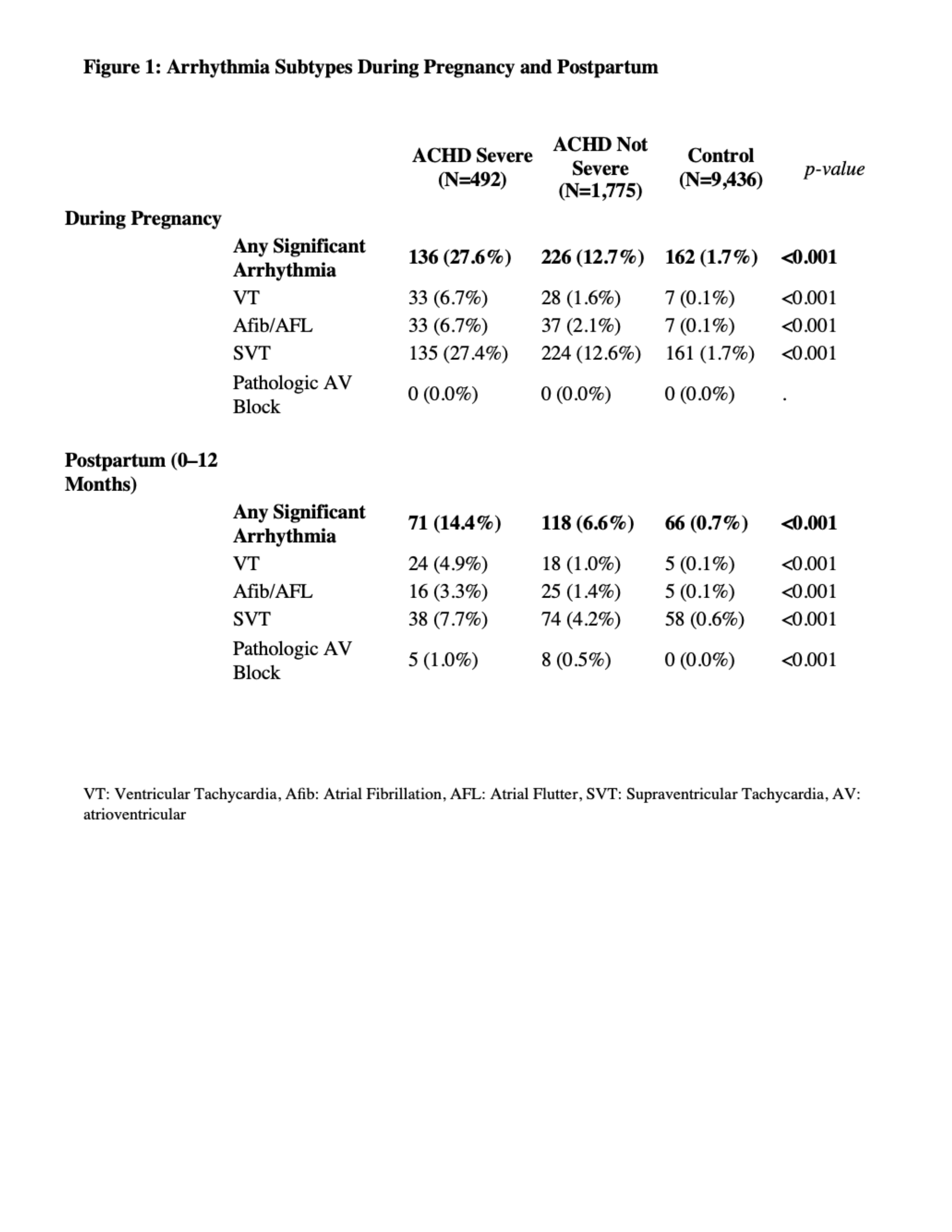
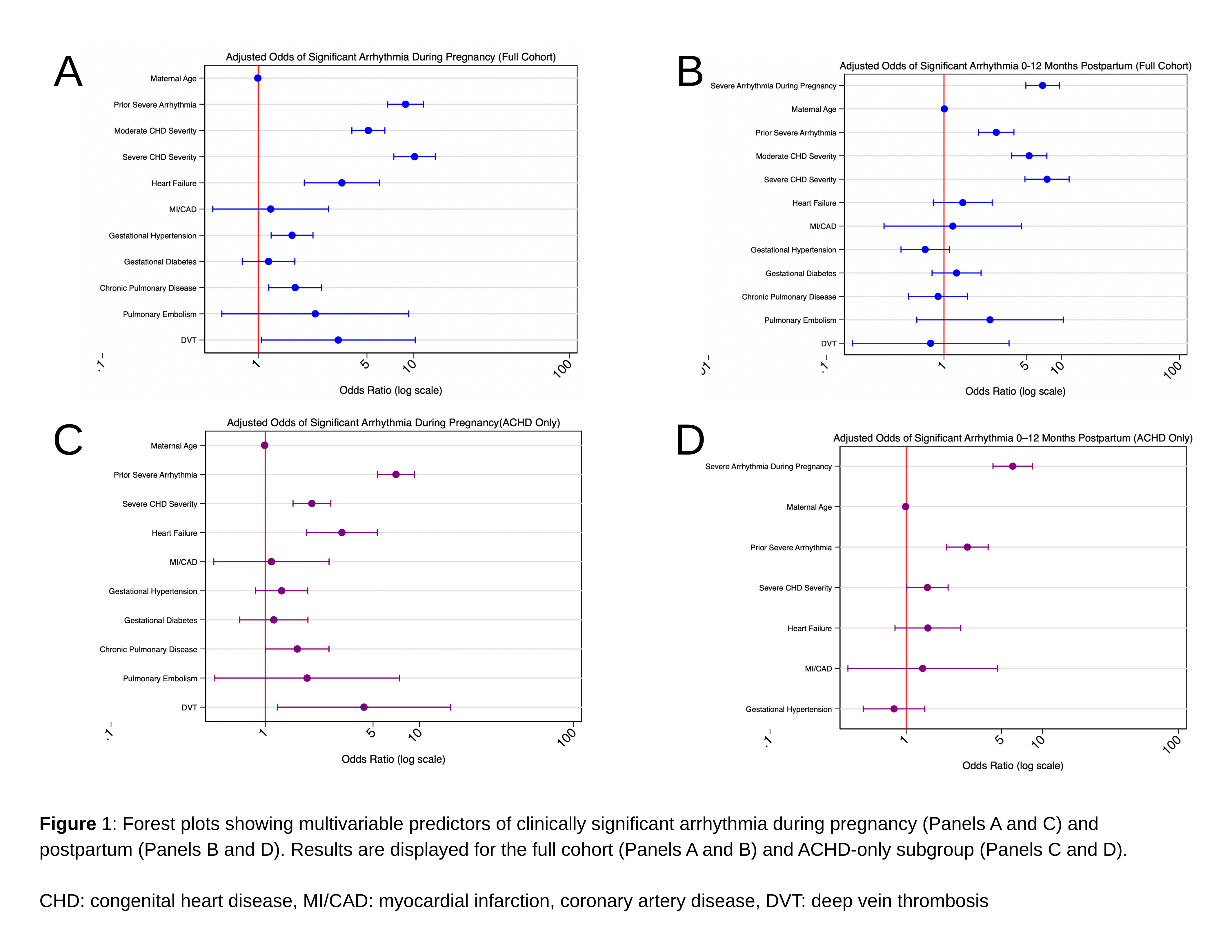
Results Among 11,703 pregnancies, significant arrhythmias were more frequent in ACHD vs controls during pregnancy (severe ACHD 5.3%, non-severe 2.5%, controls 0.5%) and postpartum (severe ACHD 6.5%, non-severe 3.5%, controls 0.5%). Supraventricular tachycardia was the most common subtype, Table 1. For all patients, variables independently associated with arrhythmia during pregnancy included pre-pregnancy arrhythmia (odds ratio [OR] 8.86, 95% CI 6.80–11.54), presence of ACHD (severe ACHD: OR 10.12, 95% CI 7.45–13.76; moderate ACHD: OR 5.11 (4.00–6.52), heart failure (OR 3.45, 95% CI 1.98–6.01), pulmonary disease (OR 1.73, 95% CI 1.17–2.56), gestational hypertension (OR 1.65, 95% CI 1.21–2.25), and deep venous thrombosis (DVT) (OR 3.27, 95% CI 1.05–10.22), Figure 1 panel A. Variables independently associated with arrhythmia postpartum included pre-pregnancy arrhythmia, arrhythmia during pregnancy, and presence of ACHD , Figure 1 panel B.
Among ACHD patients, pre-pregnancy arrhythmia, ACHD severity, heart failure, and DVT were independently associated with arrhythmia during pregnancy, while only pre-pregnancy and pregnancy arrhythmias were independently associated with arrhythmia during postpartum, Figure 1 panel D.
Conclusions Peripartum arrhythmia risk in ACHD extends through pregnancy and postpartum and spans the full spectrum of CHD severity. Prior arrhythmia and greater CHD severity are consistently associated with increased odds of arrhythmia during and after pregnancy, while heart failure demonstrates a significant association specifically during pregnancy. These findings underscore the importance of preconception counseling and expectation setting, particularly for women with a history of arrhythmia, to inform individualized risk stratification and management throughout pregnancy.
Herrick, Nicky
(
UC San Francisco
, San Francisco , California , United States )
Duan, Rong
(
UC San Francisco
, San Francisco , California , United States )
Gonzalez, Juan
(
UC San Francisco
, San Francisco , California , United States )
Sabanayagam, Aarthi
(
UC San Francisco
, San Francisco , California , United States )
Agarwal, Anushree
(
UC San Francisco
, San Francisco , California , United States )
Author Disclosures:
Nicky Herrick:DO NOT have relevant financial relationships
| Rong Duan:DO NOT have relevant financial relationships
| Juan Gonzalez:DO NOT have relevant financial relationshipsAnushree Agarwal:DO NOT have relevant financial relationships