
Logo

American Heart Association

  126
  0


Final ID: MDP187

Assessment of the Accuracy of the Perioperative Mortality Risk in Adults with Congenital Heart Disease (PEACH) Score

Abstract Body (Do not enter title and authors here): INTRODUCTION: Previous mortality risk scores for adult cardiac surgery patients did not include adult congenital heart disease (ACHD) patients. Development of ACHD specific mortality risk scores include the procedure-specific ACHS score and recently derived PEACH score. While validated in Europe, further evaluation of the PEACH score in additional settings is necessary.

RESEARCH QUESTION: We assessed the efficacy of the PEACH score to predict mortality in ACHD patients undergoing congenital cardiac surgery at our institution. We compared the PEACH score to the ACHS and STS scores and assessed for additional risk factors which may further augment the PEACH score.

METHODS: A retrospective cohort study was conducted of patients who underwent congenital cardiac surgery at the University of Colorado Hospital and Children’s Hospital Colorado between 2010-2022. Patients were identified by the institutional STS congenital cardiac surgery database and were eligible if 18 years or older and underwent congenital cardiac surgery. Components of the PEACH score and additional postulated risk factors were evaluated by univariate analysis. A receiver operating characteristic (ROC) curve was used to compare the PEACH score to existing risk models. Logistic regression analysis determined additional risk factors to augment the PEACH score.

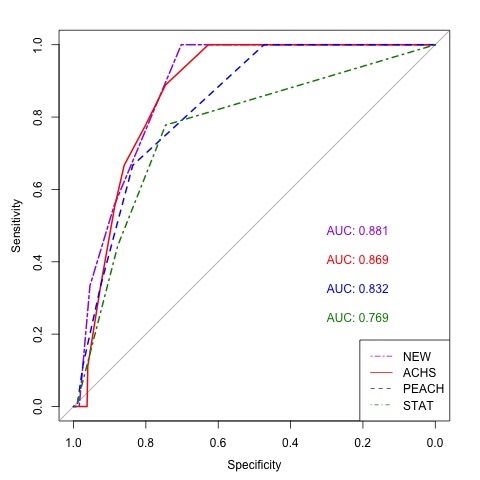
RESULTS: A total of 516 patients were included with a median age of 30 (IQR 23-42) and 51% were male. There were nine deaths overall. The PEACH score was predictive of mortality (OR: 2.09, p<0.001) with a score of 0: 0 deaths/240 patients (0%); 1-2: 6 deaths/229 patients (2.6%); 3+: 3 deaths/41 patients (7.3%). Of additional risk factors tested, platelets less than 184,000 per mcL (OR: 8.36, p=0.01) was significantly associated with mortality. Comparison of the models revealed PEACH score AUC 0.832 (95% CI: 0.740,0.924), ACHS score AUC 0.869 (95% CI: 0.806, 0.932), and STAT AUC 0.769 (95% CI: 0.616, 0.922, Figure 1). The addition of platelet level improved the predictive ability of the PEACH score (AUC 0.881).

CONCLUSION: In this single-center analysis, the PEACH score provided strong predictive ability for peri-operative mortality. The addition of platelet levels may further augment this score.
  • Taylor-fishwick, Jon  ( University of Colorado Anschutz Medical Center , Aurora , Colorado , United States )
  • Duarte, Vivian  ( University of Colorado Anschutz Medical Center , Aurora , Colorado , United States )
  • Olson, Kaitlin  ( University of Colorado , Aurora , Colorado , United States )
  • Khanna, Amber  ( University of Colorado , Aurora , Colorado , United States )
  • Soohoo, Megan  ( University of Colorado Anschutz Medical Center , Aurora , Colorado , United States )
  • Author Disclosures:
    Jon Taylor-Fishwick: DO NOT have relevant financial relationships | Vivian Duarte: DO NOT have relevant financial relationships | Kaitlin Olson: No Answer | Amber Khanna: No Answer | Megan SooHoo: No Answer
Meeting Info:

Scientific Sessions 2024

2024

Chicago, Illinois

Session Info:

ACHD and Pediatric Acquired CV Disease

Saturday, 11/16/2024 , 02:50PM - 04:15PM

Moderated Digital Poster Session

More abstracts on this topic:
A Body Shape Index at Age 25-64 Predicts Mortality and CHD Hospitalization

Shafran Itamar, Krakauer Nir, Krakauer Jesse, Cohen Gali, Gerber Yariv

A Contemporary Machine Learning-Based Risk Stratification for Mortality and Hospitalization in Heart Failure with Preserved Ejection Fraction Using Multimodal Real-World Data

Fudim Marat, Weerts Jerremy, Patel Manesh, Balu Suresh, Hintze Bradley, Torres Francisco, Micsinai Balan Mariann, Rigolli Marzia, Kessler Paul, Touzot Maxime, Lund Lars, Van Empel Vanessa, Pradhan Aruna, Butler Javed, Zehnder Tobias, Sauty Benoit, Esposito Christian, Balazard Félix, Mayer Imke, Hallal Mohammad, Loiseau Nicolas

More abstracts from these authors:
You have to be authorized to contact abstract author. Please, Login
Not Available