Use of Congenital Heart Disease Registries for Patient Outcomes: A Cautionary Tale
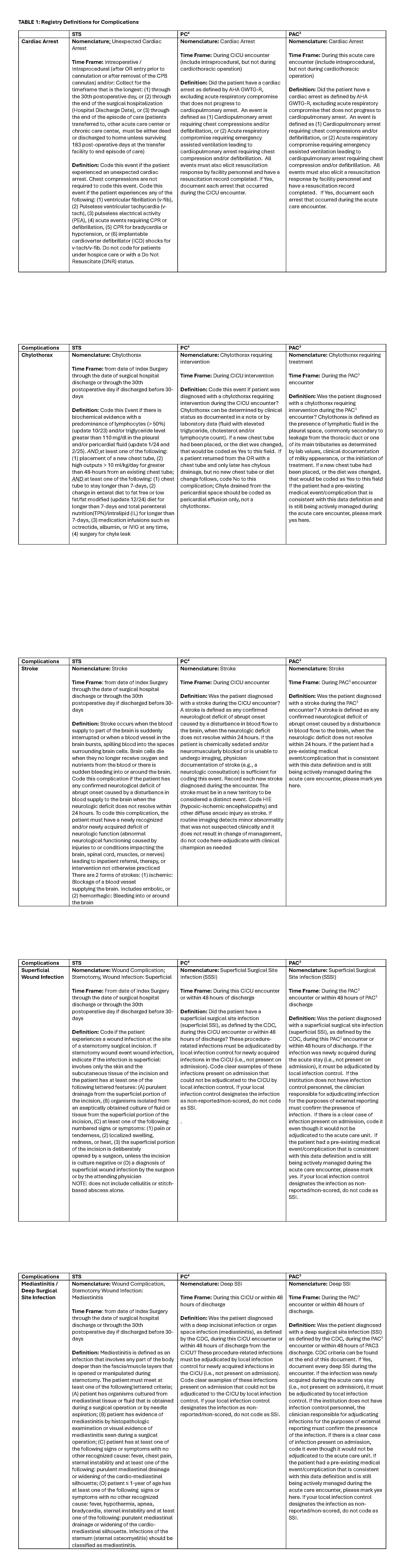
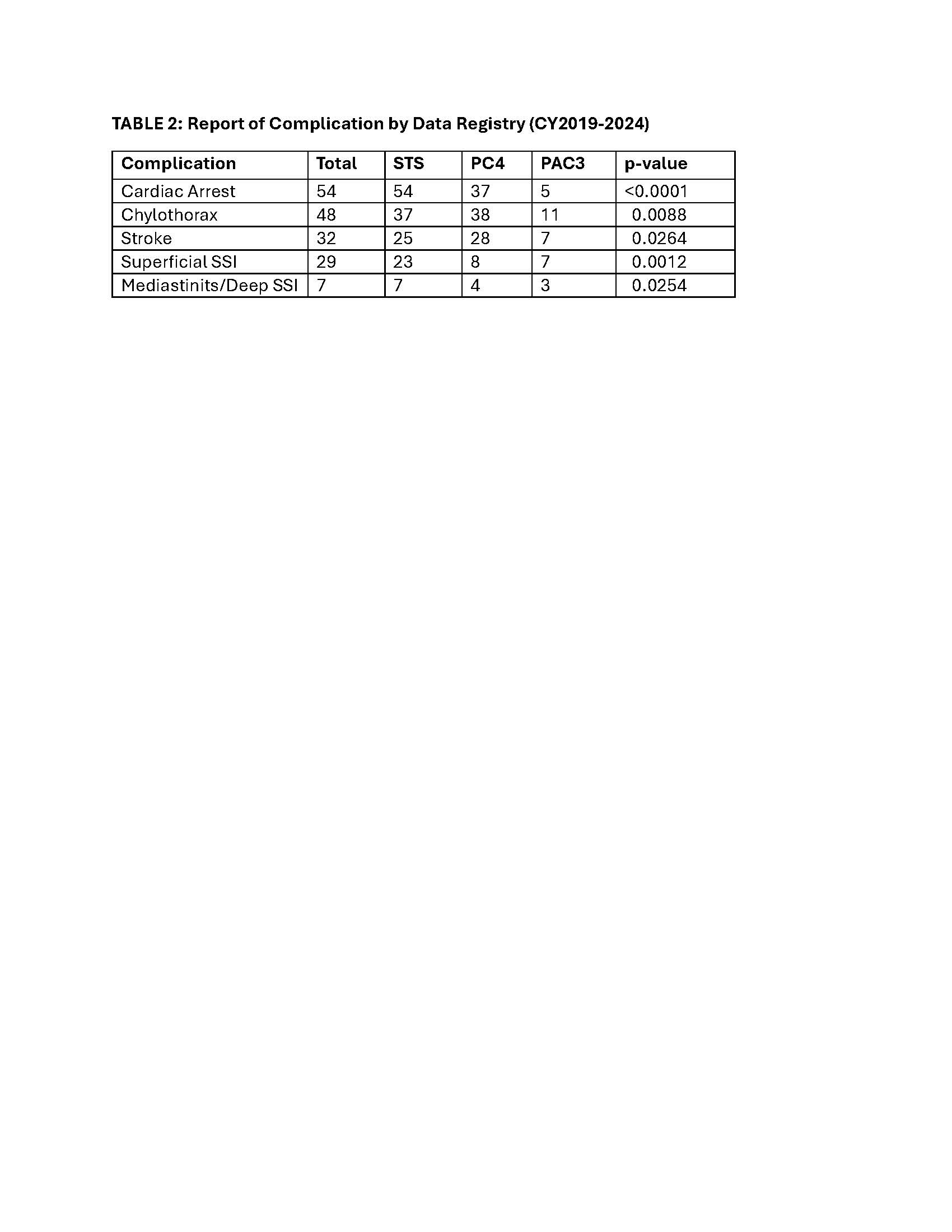
Abstract Body (Do not enter title and authors here): Background: Congenital Heart Disease (CHD) registries-Society of Thoracic Surgeons (STS), Pediatric Cardiac Critical Care Consortium (PC4), and Pediatric Acute Care Cardiology Collaborative (PAC3)-are essential tools for Congenital Heart Centers, advancing quality improvement and research. While STS is procedure-based and PC4/PAC3 are service-based, efforts to harmonize data, reduce redundancy, and facilitate data sharing aim to improve effort and cost-efficiency. However, differences in data definitions (Table 1) such as location, timing, and criteria for recording events persist, creating data silos and fragmentation, limiting the ability to assess patient outcomes. Hypothesis: Variations in registry definitions lead to significant discrepancies in patient outcome reports. Methods: A single-center, retrospective study of hospitalization that included an index operation (1st Cardiopulmonary Bypass (CPB) or no-CPB operation of episode of care) and post-operative care in both the Cardiac Intensive Care Unit (CICU) and Cardiac Acute Care Unit (ACCU) between CY 2019-2024. Local data registries-STS (index operation), PC4 (CICU), and PAC3 (ACCU)-were each queried separately for report of five post-operative complications: Cardiac Arrest (CA), Chylothorax, Stroke, Superficial Surgical Site Infection (SSSI), and Mediastinitis/Deep Surgical Site Infection (DSSI). A chi-square test for independence was used to evaluate whether the distribution of each post operative event varied significantly across the three registries. Results: Significant differences for CA (p<0.0001), Chylothorax (p=0.0088), Stroke (p=0.0264), SSSI (p=0.0012), and DSSI (p=0.0254) exist between STS, PC4, and PAC3 registries (Table 2). Notably, some events were only captured by one registry (CA: 15 only in STS; Chylothorax: 5 only in STS, 8 only in PC4; Stroke: 6 only in PC4, 2 only in PAC3; SSSI:16 only in STS, 3 only in PC4 1 only in PAC3). Conclusions: Our results show significant difference in CA, Chylothorax, Stroke, SSSI, and DSSI reports between STS, PC4, and PAC3 registries. This highlights the need to use multiple registries to evaluate the incidence of clinically significant events. Researchers must consider registry definitions when utilizing single registry data. Hospital-level rather than procedure or service-based reporting will also improve the ability to assess/evaluate patient outcomes. Given our findings, similar analysis for other post-operative complications is warranted.
Baust, Tracy
(
Children's National Hospital
, Washington , District of Columbia , United States )
Kreutzer, Janet
(
Children's National Hospital
, Washington , District of Columbia , United States )
Balbin, Maria-theresa
(
Children's National Hospital
, Washington , District of Columbia , United States )
Mehta, Rittal
(
Children's National Hospital
, Washington , District of Columbia , United States )
Morgan, Mary
(
Children's National Hospital
, Washington , District of Columbia , United States )
Peyasena, Janika
(
Children's National Hospital
, Washington , District of Columbia , United States )
Hom, Lisa
(
Children's National Hospital
, Washington , District of Columbia , United States )
Domnina, Yuliya
(
Children's National Hospital
, Washington , District of Columbia , United States )
Harahsheh, Ashraf
(
Children's National Hospital
, Washington , District of Columbia , United States )
Author Disclosures:
Tracy Baust:DO NOT have relevant financial relationships
| Janet Kreutzer:DO NOT have relevant financial relationships
| Maria-Theresa Balbin:No Answer
| Rittal Mehta:DO NOT have relevant financial relationships
| Mary Morgan:DO NOT have relevant financial relationships
| Janika Peyasena:No Answer
| Lisa Hom:No Answer
| Yuliya Domnina:No Answer
| Ashraf Harahsheh:DO NOT have relevant financial relationships