
Improved Quality of Life Following Cardiologist-Directed Care in Postural Orthostatic Tachycardia Syndrome
Abstract Body (Do not enter title and authors here): Introduction Postural Orthostatic Tachycardia Syndrome (POTS) is a chronic autonomic disorder mainly found in a younger female demographic and is characterized by orthostatic intolerance, often presenting with a combination of cardiovascular, neurological, and musculoskeletal symptoms. Despite the central role of blood pressure and heart rate dysregulation in its pathophysiology, POTS is misclassified as psychosomatic frequently. Many patients see 8 to 10 providers before a diagnosis and ultimately self-refer to cardiology after prolonged symptom burden. This study evaluates quality-of-life (QoL) outcomes in POTS patients treated with a cardiologist-led protocol focused on hemodynamic stabilization and symptom control.
Methods This single-center study included patients with a diagnosis of POTS (ICD G90.A) or autonomic dysfunction (ICD G90.8) who received care between May and December 2024. All patients were managed using a non-invasive, multifaceted treatment protocol developed and overseen by a cardiologist, focusing on blood pressure and heart rate regulation. Patients completed the 36-Item Short Form Survey (SF-36) before and after the intervention, with primary follow-up occurring at 3 months. All patients had complete pre- and post-treatment data. Paired t-tests were used to assess statistical significance across SF-36 domains, with Cohen’s d reported for clinical effect size.
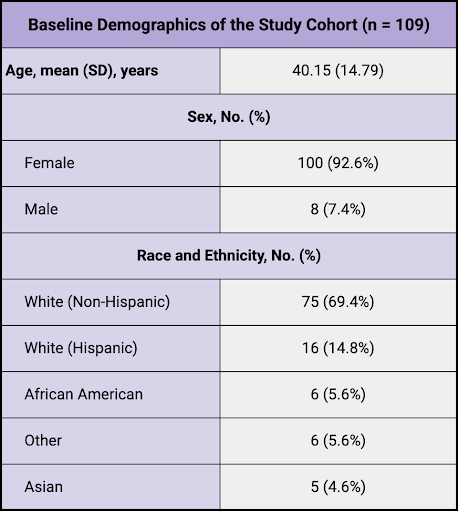
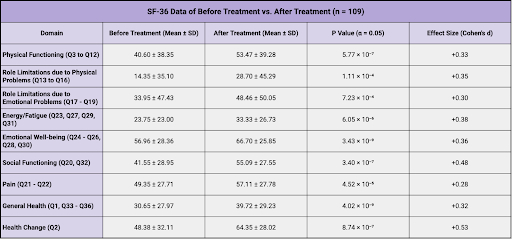
Results Among 109 patients (92.6% female; Table 1), all SF-36 domains saw statistically significant improvements (p < 0.001). Physical functioning, energy/fatigue, emotional well-being, and social functioning showed the most notable gains. The largest effect size was seen in the Health Change domain (Cd = 0.53), reflecting patients’ perception of meaningful improvement (Table 2). Despite a short follow-up interval, the consistency of gains supports the statistical and clinical significance of cardiologist-led management in this population.
Conclusion POTS remains underrecognized and undertreated in medicine. This study demonstrates that targeted, cardiologist-directed interventions can lead to measurable and meaningful improvements in QoL for POTS patients. These findings underscore the need to reframe POTS as a condition that warrants early and ongoing symptom management. Increasing POTS presentation awareness among physicians may reduce diagnostic delays and improve outcomes for a historically underserved population.
Khalid, Emad
( Cena Research Institute
, Houston
, Texas
, United States
)
Farooqui, Sami
( Cena Research Institute
, Houston
, Texas
, United States
)
Ali, Asif
( Cena Research Institute
, Houston
, Texas
, United States
)
Author Disclosures:
Emad Khalid:DO have relevant financial relationships
;
Researcher:Cena Research Institute:Active (exists now)
; Advisor:Healthseers:Expected (by end of conference)
| Sami Farooqui:DO NOT have relevant financial relationships
| Asif Ali:DO have relevant financial relationships
;
Executive Role:Tabia Health :Active (exists now)
; Executive Role:HealthSeers:Active (exists now)