
Logo

American Heart Association

  18
  0


Final ID: MP1292

Analysis of Discrepancies Between Radiologist and AI CCTA Readings Across Clinical Thresholds

Abstract Body (Do not enter title and authors here): Background
CCTA informs clinical decisions with stenosis thresholds that guide treatment, testing, and insurance approval. AI-based tools may reduce interpretative variability, but real-world consistency with radiologist assessments remains ambiguous. This study evaluates the magnitude and clinical impact of segment-level disagreement between radiologist- and AI-read CCTA.

Methods
A single-center retrospective study of 48 patients who underwent CCTA with a radiologist and AI interpretation recorded percent stenosis across 16 coronary segments. Analysis excluded non-diseased segments identified by both reads. We calculated mean absolute difference (MAD) and threshold disagreement (TD), with thresholds defined at 50% and 70% stenosis. Data was labeled as an upward single- or double-crossing (USC; UDC), defined as stenosis differing by one threshold (eg. <50% vs. 50-69% or 50-69% vs. ≥70%) or both thresholds (eg. <50% vs. ≥70%), respectively. These terms describe the direction of difference, not accuracy.

Results
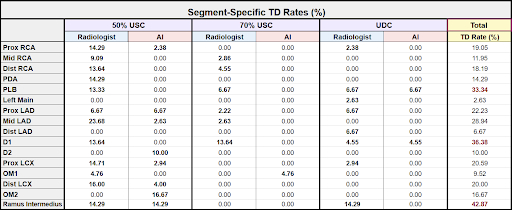
Across 395 segments, the overall MAD between the radiologist and AI readings was 20.09% (SD = 6.06%). Ramus Intermedius had the highest MAD (30.0%) and segment-specific TD rate (42.86%). Distal LAD (29.5%) and PLB (28.9%) also showed high MADs (Figure 1 and Table 1).
There were 75 TDs (18.99%), including 63 with a USC (50% = 54; 70% = 9) and 12 with a UDC. At 50%, radiologist USC occurred in 43 segments, and AI USC was in 11 segments. At 70%, radiologist USC occurred in 8 and AI USC in 1. Radiologists also produced more UDCs vs. AI (10 vs. 2). Chi-square testing showed significantly more frequent USCs by radiologists at the 50% threshold (chi-square = 20.37, p < 0.0001, OR = 3.91). Fisher’s exact test displayed near significance at the 70% threshold (p ~ 0.05, OR = 8.00) and significantly more UDCs by radiologists (p < 0.05, OR = 5.00) compared to AI (Figure 2).

Conclusion
Variation exists between radiologist- and AI-read CCTA, with nearly 1 in 5 segments having a TD. Posterior coronary segment readings, where anatomical limitations may challenge visualization, had the most inconsistencies. Discrepancies were most common in borderline and high-stakes ranges, where clinical decisions and insurance coverage hinge on stenosis classification. Findings support further validation of AI and caution against sole reliance. Comparative studies using heart catheterization are warranted to comment on accuracy versus variation.
  • Delgado, Yulissa  ( Cena Research Institute , Houston , Texas , United States )
  • Farooqui, Sami  ( Cena Research Institute , Houston , Texas , United States )
  • Khalid, Emad  ( Cena Research Institute , Houston , Texas , United States )
  • Canales, Daphne  ( Cena Research Institute , Houston , Texas , United States )
  • Ali, Asif  ( Cena Research Institute , Houston , Texas , United States )
  • Author Disclosures:
    Yulissa Delgado: DO NOT have relevant financial relationships | Sami Farooqui: DO NOT have relevant financial relationships | Emad Khalid: DO have relevant financial relationships ; Researcher:Cena Research Institute:Active (exists now) ; Advisor:Healthseers:Expected (by end of conference) | Daphne Canales: DO NOT have relevant financial relationships | Asif Ali: DO have relevant financial relationships ; Executive Role:Tabia Health :Active (exists now) ; Executive Role:HealthSeers:Active (exists now)
Meeting Info:

Scientific Sessions 2025

2025

New Orleans, Louisiana

Session Info:

Beyond the Pixels: Using Quantitative and Computational Advances to Optimize Value in CV Imaging

Sunday, 11/09/2025 , 11:50AM - 01:05PM

Moderated Digital Poster Session

More abstracts on this topic:
AI-enabled Plaque Phenotype Analysis of Coronary Computed Tomography Angiography Findings in Patients with Nonacute Chest Pain using FFRCT: Results from the PRECISE Trial

Jukema Ruurt, Chow Benjamin, Kelsey Michelle, Nanna Michael, Vemulapalli Sreekanth, Mark Daniel, Leipsic Jonathon, Douglas Pamela, Ferencik Maros, Curzen Nick, Weir-mccall Jonathan, Stone Gregg, Rogers Campbell, Mullen Sarah, Ng Nicholas

Association of Ramus Intermedius Variant with Greater Coronary Plaque and Stenosis Burden

Ansari Salman, Pourafkari Leili, Kinninger April, Budoff Matthew

More abstracts from these authors:
Discordance Between CAC Scoring and PREVENT Risk Estimates in Primary Prevention

Farooqui Sami, Khalid Emad, Delgado Yulissa, Ali Asif

ZIP Code Stratification of Social Determinants of Health and Cardiovascular Disease Burden

Canales Daphne, Farooqui Sami, Delgado Yulissa, Ali Asif, Padron Leticia

You have to be authorized to contact abstract author. Please, Login
Not Available