
Logo

American Heart Association

  18
  0


Final ID: Mo1040

Impact of Frailty on In-Hospital Outcomes for Patients Admitted for Hypertensive Emergency in the United States

Abstract Body (Do not enter title and authors here): Background: Hypertensive emergency (HE) is a life-threatening condition that poses a significant risk for increased morbidity and mortality. It is not known with certainty how a state of declining health, namely with frailty, affects in-hospital outcomes for patients admitted for HE. Herein, we aim to quantify the impact of frailty on in-hospital outcomes for adults admitted for HE and determine whether this association remains consistent across all adult age groups.

Methods: Retrospective analysis was conducted using the National Inpatient Sample database from 2016 to 2022 with STATA18 statistical software. ICD-10 codes were used to identify patients with a primary diagnosis of HE and age at admission. Frailty was assessed using the Hospital Frailty Risk Score, with a score >5 indicating frailty. Multivariate logistic and linear regression analysis was performed to calculate adjusted odds ratios (aOR) while accounting for covariates. The impact of frailty was analyzed for all adults admitted with HE, with subgroup analyses performed for younger (<65 years) and older (≥65 years) patients.

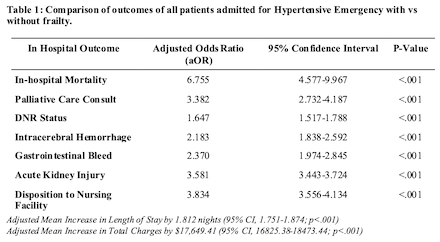
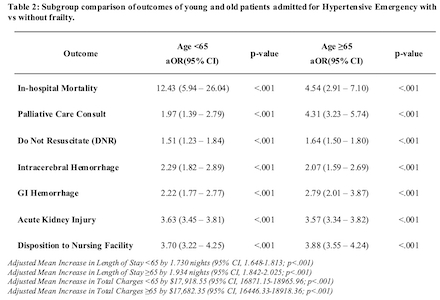
Results: Out of 337,335 patients admitted for HE, 48.6% were classified as frail and 51.4% classified as non-frail. The frail group had a higher average age (60.23 vs 57.93; p<.001) and were predominantly female (53% vs 47%; p<.001). Logistic regression showed frail patients had a significantly higher risk of in-hospital mortality (aOR 6.755, CI 4.577-9.967, p<.001), where similar trends can be seen for additional outcomes such as intracerebral hemorrhage, acute kidney injury, and GI hemorrhage demonstrated in Table 1. Moreover, linear regression showed frail patients experienced an increased adjusted mean length of stay by 1.812 nights (95% CI, 1.751-1.874; p<.001) and higher adjusted mean total charges by $17,649.41 (95% CI, 16,825.38-18,473.44; p<.001). Subgroup analysis stratified by age 65 demonstrated that frailty was still significantly associated with worse outcomes in both age groups (Table 2).

Conclusion: Clinical outcomes are significantly worse with higher resource utilization in frail patients versus non-frail patients admitted for HE. This study demonstrates that the impact of frailty transcends chronological age and challenges the notion that frailty is limited to geriatric populations. Clinicians should be vigilant about assessing the role of frailty in HE to gain crucial clinical insight to enhance patient well-being and appropriate resource allocation.
  • Ghay, Sahil  ( Mount Sinai Medical Center , Miami Beach , Florida , United States )
  • Shatanof, Rachel  ( Mount Sinai Medical Center , Miami Beach , Florida , United States )
  • Kaur, Baneet  ( Mount Sinai Medical Center , Miami Beach , Florida , United States )
  • Ghay, Pooja  ( University of Miami Miller School of Medicine , Miami , Florida , United States )
  • Delgado Lelievre, Maria  ( University of Miami Miller School of Medicine , Miami , Florida , United States )
  • Author Disclosures:
    Sahil Ghay: DO NOT have relevant financial relationships | Rachel Shatanof: DO NOT have relevant financial relationships | Baneet Kaur: No Answer | Pooja Ghay: No Answer | Maria Delgado Lelievre: DO have relevant financial relationships ; Consultant:Biobeat:Active (exists now) ; Consultant:Medtronic:Active (exists now)
Meeting Info:

Scientific Sessions 2025

2025

New Orleans, Louisiana

Session Info:

Hypertension: Spanning the Gamut

Monday, 11/10/2025 , 10:30AM - 11:30AM

Abstract Poster Board Session

More abstracts on this topic:

A Longitudinal 20-year Analysis Indicates Acceleration of Cardiometabolic Comorbidities on Dementia Risk

Lihua Huang, Danish Muhammad, Auyeung Tw, Jenny Lee, Kwok Timothy, Abrigo Jill, Wei Yingying, Lo Cecilia, Fung Erik

A 50% or Greater Reduction in LDL-Cholesterol Is Associated with Improved Long-Term Outcomes and Lower Health Care Utilization After Myocardial Infarction - a SWEDEHEART study

Reitan Christian, Watanabe Alexandre, Bash Lori, Galvain Thibaut, Arnet Urs, Jernberg Tomas

More abstracts from these authors:
Uncovering 24-Hour Hemodynamic Phenotypes: Synchronization Patterns in Cuff-less Ambulatory Blood Pressure Monitoring

Delgado Lelievre Maria, Chandra Sabrina, Valdes Jara Ramiro, Akcin Mehmet, Meyers Adam

Performance of a cuffless photoplethysmography-based device for continuous monitoring of blood pressure

Hellou Elias, Jamal Tamer, Zuroff Elchanan, Kalhor Parvin, Delgado Lelievre Maria, Lerman Lilach, Lerman Amir, Kachel Erez, Zoghby Ziad

You have to be authorized to contact abstract author. Please, Login
Not Available