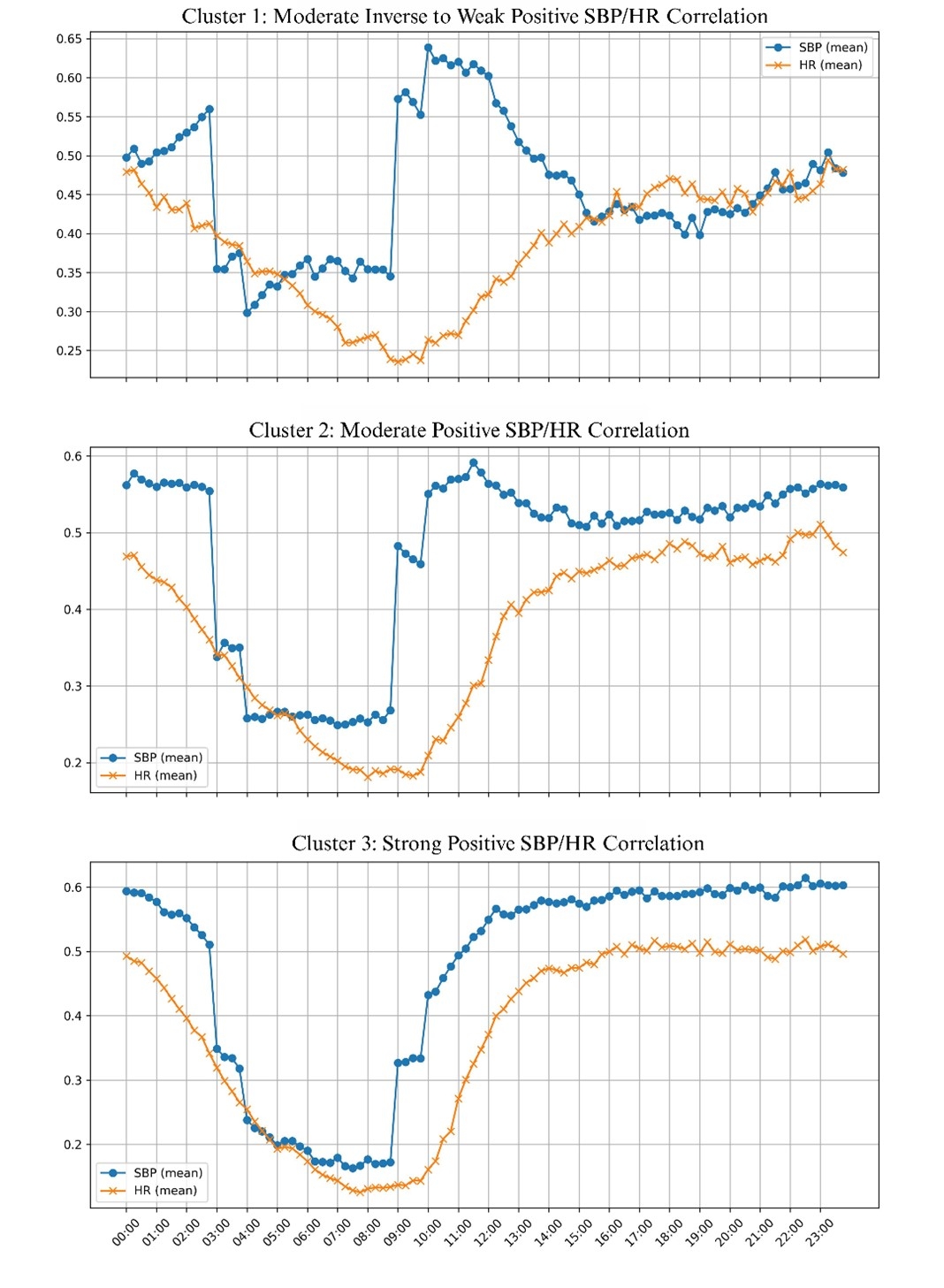
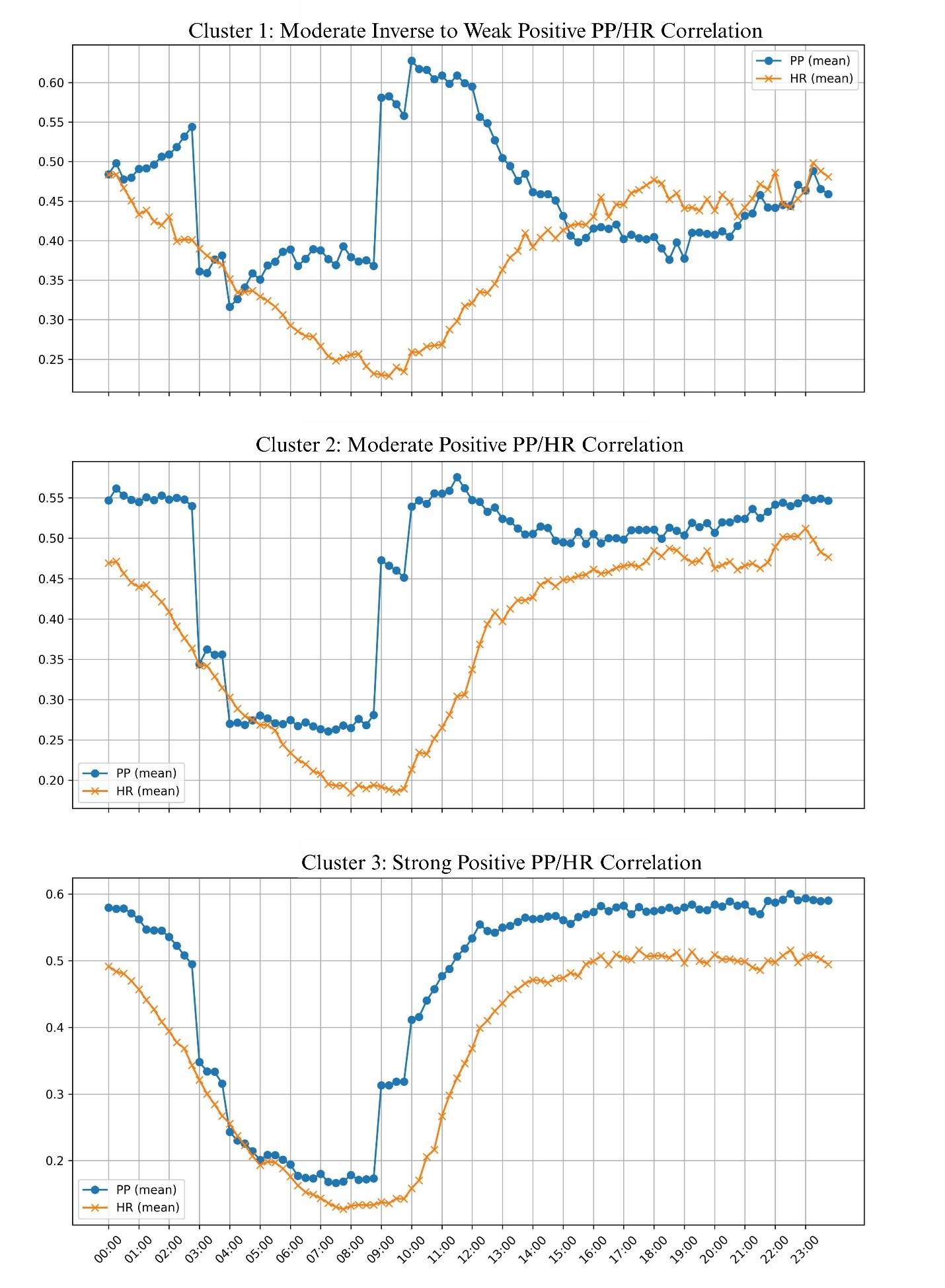
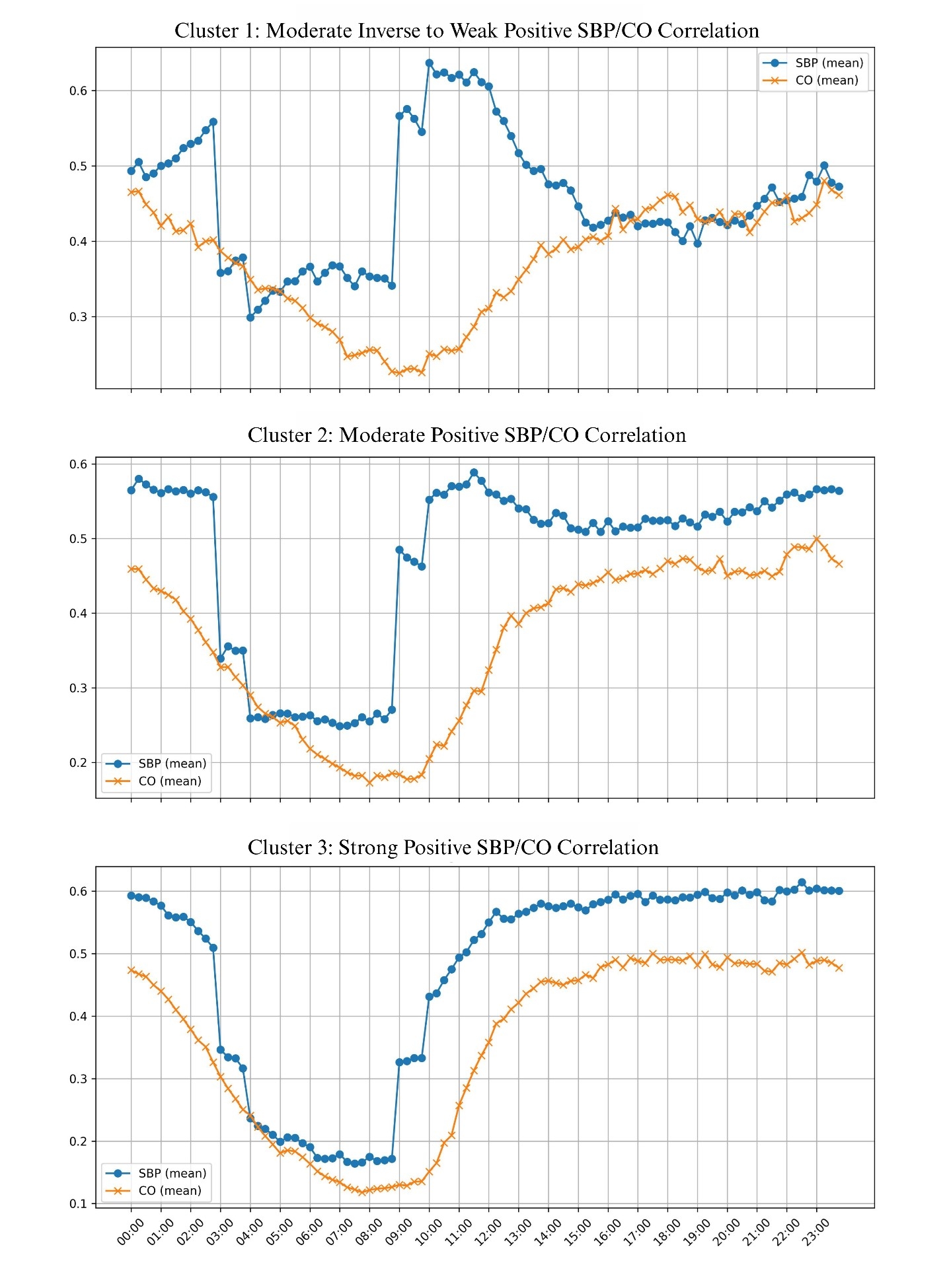
Abstract Body (Do not enter title and authors here): Introduction: Twenty-four-hour ambulatory blood pressure monitoring (ABPM) offers a more accurate reflection of blood pressure (BP) behavior and cardiovascular risk than office measurements. Cuff-less, FDA-cleared devices like Biobeat allow continuous, real-world tracking of systolic BP (SBP), diastolic BP (DBP), heart rate (HR), cardiac output (CO), and pulse pressure (PP = SBP − DBP). Studying the temporal correlation between these signals, especially SBP and HR, may help uncover dynamic cardiovascular phenotypes driven by autonomic regulation. Methods: We analyzed 24-hour hemodynamic data from 1,122 adults using the Biobeat ABPM at the AHA Comprehensive Hypertension Center, University of Miami (IRB #20210585). Data were sampled ~every 15 minutes. Participants were categorized as normotensive (NT), isolated systolic hypertensive (ISH), or hypertensive (HT), with ISH and HT combined into a single HT group. For each patient, Pearson correlation coefficients were calculated between SBP-HR, SBP-CO, and PP-HR time series after min-max normalization. K-Medoids clustering (k=2–9) was applied to group patients based on correlation values. Optimal cluster number was determined using silhouette scores. Results: Three clusters consistently emerged across all correlation analyses (Figures 1,2 and 3). Cluster 1 (−0.5 to 0.28, 17%) reflected inverse to weak positive correlations; Cluster 2 (0.28 to 0.64, 39%) moderate positive; and Cluster 3 (0.64 to 0.96, 44%) strong positive. Younger age and greater height were associated with stronger correlations (p<0.05), while BMI showed no clear trend. Baseline SBP decreased, and DBP increased across clusters. NT individuals were most frequent in Cluster 3, while HT individuals predominated in Cluster 2. Cluster 1 had the lowest representation from both groups, indicating fewer patients with weak or inverse synchronization. Distribution testing confirmed these differences were significant (p<0.01), revealing distinct BP-HR synchronization phenotypes linked to BP status. Conclusion: In a real-world ABPM cohort, stronger SBP-HR, SBP-CO, and PP-HR synchronization was associated with normotension, younger age, and taller stature. These physiologic phenotypes highlight the value of continuous wearable data in uncovering dynamic patterns beyond static BP thresholds.
Delgado Lelievre, Maria
( University of Miami Medical School
, Doral
, Florida
, United States
)
Chandra, Sabrina
( University of Miami
, Miami
, Florida
, United States
)
Valdes Jara, Ramiro
( University of Miami
, Miami
, Florida
, United States
)
Akcin, Mehmet
( University of Miami Medical School
, Doral
, Florida
, United States
)
Meyers, Adam
( University of Miami
, Miami
, Florida
, United States
)
Author Disclosures:
Maria Delgado Lelievre:DO have relevant financial relationships
;
Consultant:Biobeat:Active (exists now)
; Consultant:Medtronic:Active (exists now)
| Sabrina Chandra:No Answer
| Ramiro Valdes Jara:DO NOT have relevant financial relationships
| Mehmet Akcin:No Answer
| Adam Meyers:DO NOT have relevant financial relationships