Artificial Intelligence-Based Machine Learning to Understand the Future of Declining Myocardial Infarction-Related Mortality in the United States: A Time Series Modeling Approach
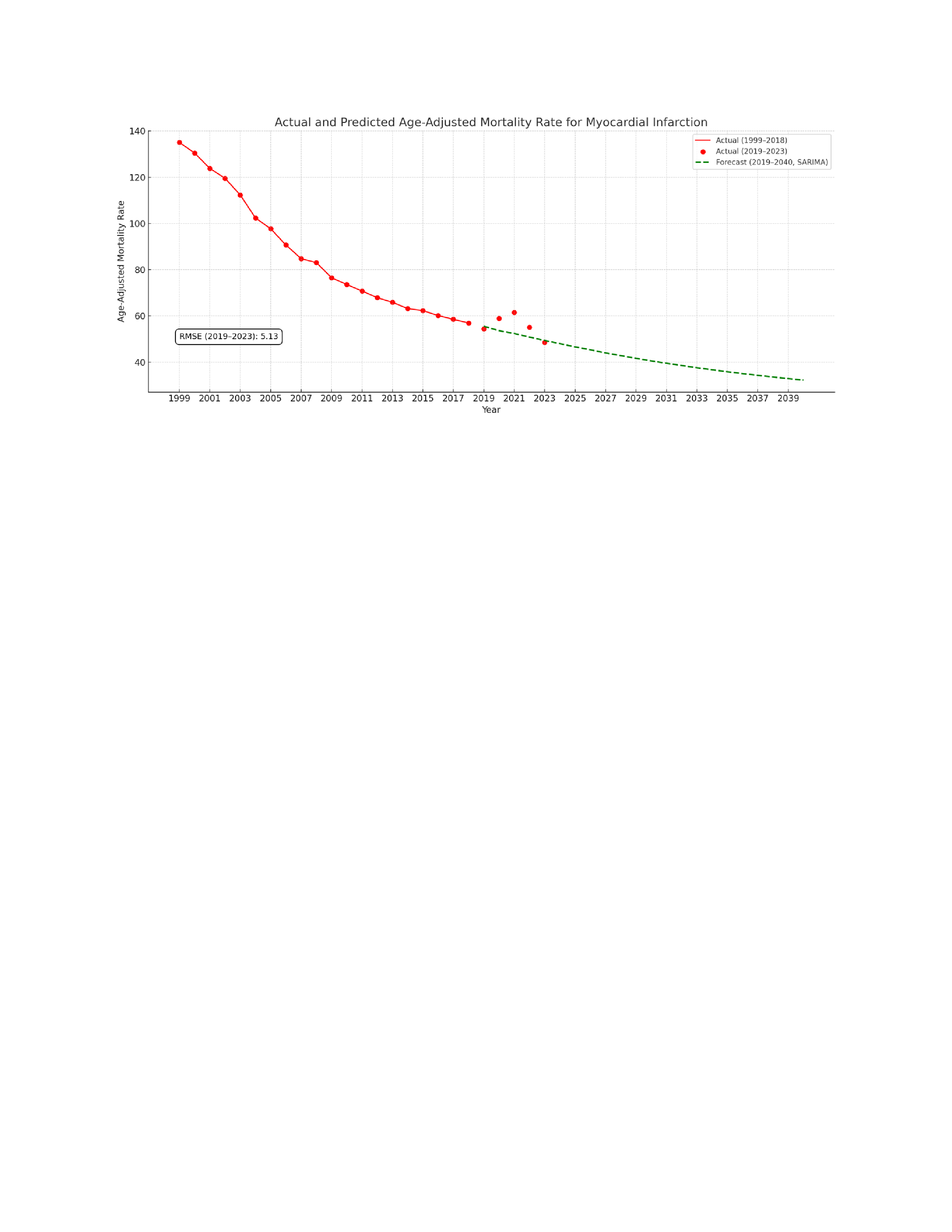
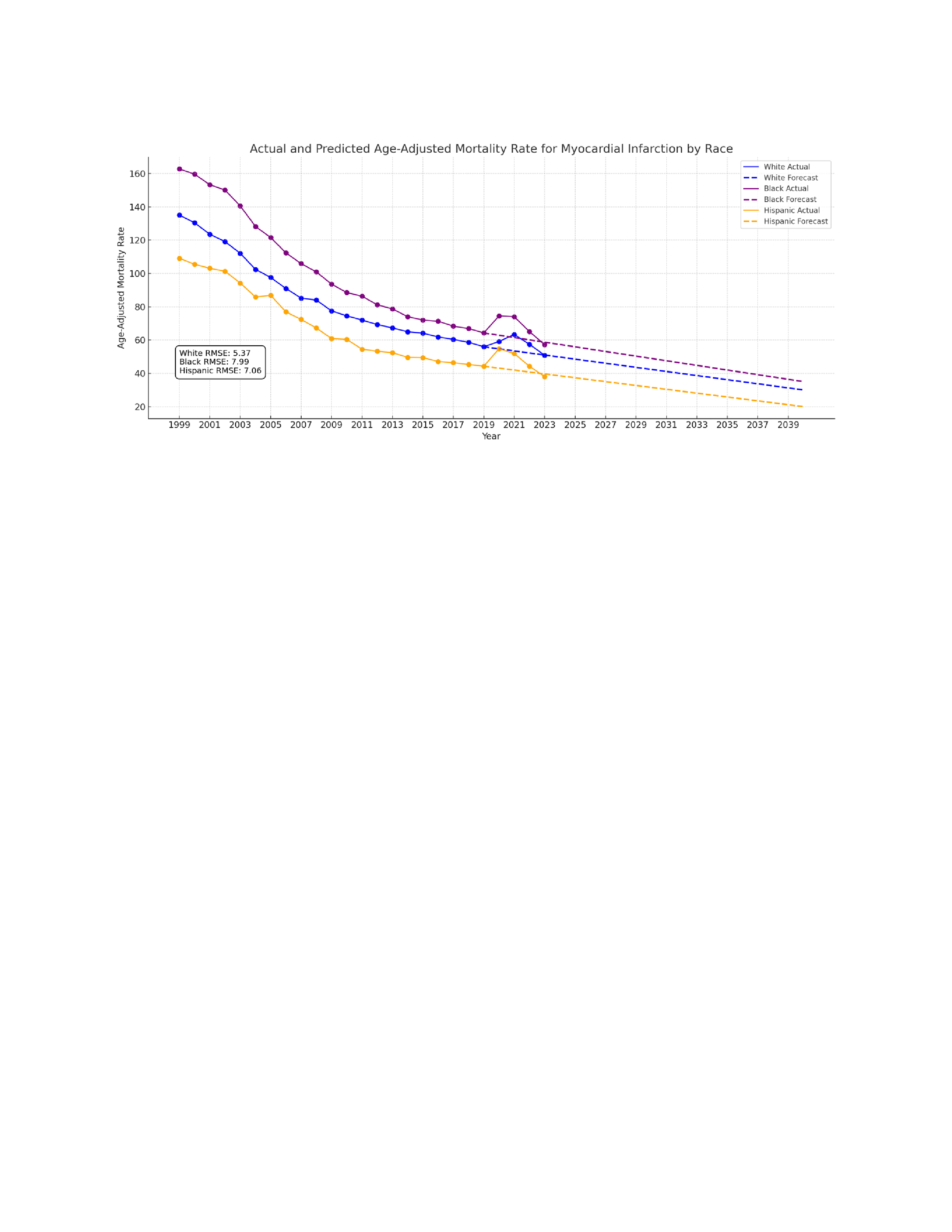
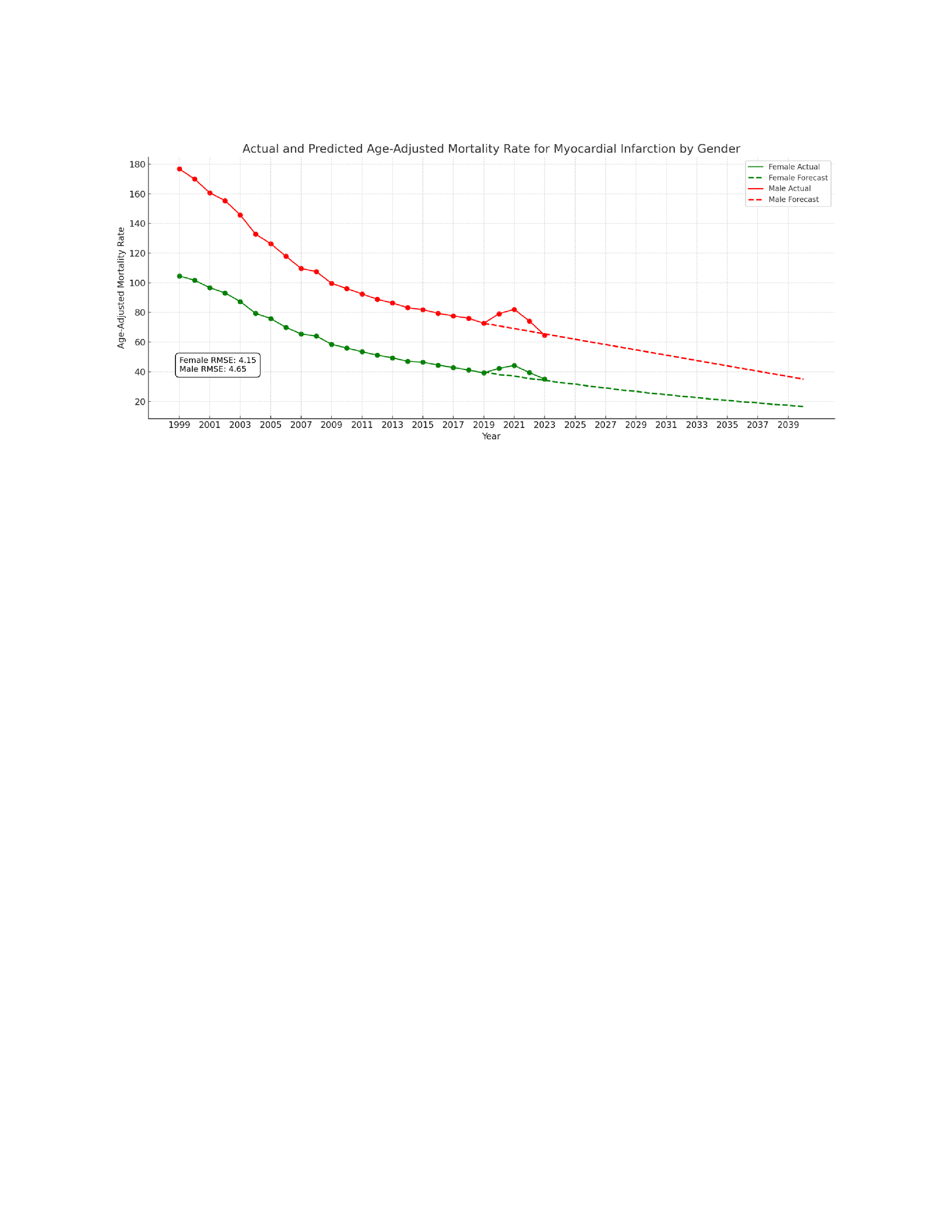
Abstract Body (Do not enter title and authors here): Introduction: CDC data indicate a steady decline in myocardial infarction (MI) mortality in the U.S. over the past 25 years. This study aims to forecast future MI mortality trends through 2040 and assess potential disparities across racial and gender groups. Accurate forecasting can inform public health strategies, improve resource allocation, and target high-risk populations. Methods: We analyzed MI-related mortality data from the CDC WONDER database from 1999 to 2023, identifying deaths using ICD-10 codes I21 and I22. Crude mortality rates (CMRs) per 100,000 population were calculated and stratified by age, sex, and race. Temporal trends were assessed using annual percent change (APC) and average annual percent change (AAPC), with confidence intervals derived via the empirical quantile method. A Seasonal Autoregressive Integrated Moving Average (SARIMA) model was used to forecast mortality trends through 2040. The model was trained on data from 1999 to 2018 and validated with data from 2019 to 2023 using time series cross-validation. Model accuracy was evaluated using root mean square error (RMSE), and projections were extended to 2040. Results: From 1999 to 2023, the age-adjusted mortality rate (AAMR) for MI declined from 135.04 to 48.55 per 100,000, with an AAPC of −4.32%. Annual MI deaths also dropped from 238,084 in 1999 to 134,187 in 2023. The SARIMA model projects the overall AAMR will decline to 32.33 by 2040, representing a relative reduction (RR) of 33.4% and an AAPC of −2.62% over the forecast period. Gender disparities are expected to widen. The AAMR for females is projected to decline to 16.47 by 2040, while males are expected to reach 35.00—more than twice the rate of females, up from a 1.69-fold difference in 1999 to 2.12-fold by 2040. Racial disparities will persist, though all groups are projected to experience declines. The AAMR for African Americans is forecasted to drop from 57.15 in 2023 to 35.00 in 2040 (AAPC: −2.70%, RR: −38.8%). Among White Americans, the AAMR is projected to decrease from 50.84 to 30.00 (AAPC: −2.81%, RR: −41.0%). Hispanic Americans will see the most significant decline, from 38.00 to 20.00 (AAPC: −3.60%, RR: −47.4%). Conclusions: MI-related mortality in the U.S. is projected to decline substantially through 2040. However, persistent and widening disparities—particularly among males and African Americans—highlight the need for targeted public health strategies to reduce the burden in these high-risk populations.
Cheema, Ameer Haider
(
University of Texas Southwestern
, Dallas , Texas , United States )
Murtaza, Sana
(
Punjab Medical College
, FAISALABAD , Pakistan )
Mansoor, Rubab
(
UPMC
, Pittsburgh , Pennsylvania , United States )
Anwer, Mian Uman
(
Punjab Medical College
, FAISALABAD , Pakistan )
Hashmat, Muhammad Bilal
(
Punjab Medical College
, FAISALABAD , Pakistan )
Khawar, Muhammad Hassan
(
Punjab Medical College
, FAISALABAD , Pakistan )
Qasim, Tahreem
(
Faisalabad Medical University
, Faisalabad , Pakistan )
Ahmed, Dawood
(
Punjab Medical College
, FAISALABAD , Pakistan )
Iman, Hafiza
(
Punjab Medical College
, FAISALABAD , Pakistan )
Allana, Salman
(
UT Southwestern Medical Center
, Dallas , Texas , United States )
Author Disclosures:
Ameer Haider Cheema:DO NOT have relevant financial relationships
| Salman Allana:No Answer
| Sana Murtaza:DO NOT have relevant financial relationships
| Rubab Mansoor:DO NOT have relevant financial relationships
| mian uman anwer:No Answer
| Muhammad Bilal Hashmat:DO NOT have relevant financial relationships
| Muhammad Hassan Khawar:No Answer
| Tahreem Qasim:DO NOT have relevant financial relationships
| Dawood Ahmed:No Answer
| Hafiza Iman:No Answer