Preoperative Anion Gap to Bicarbonate Ratio is Associated with Elevated Risk of Delirium After Cardiac Surgery
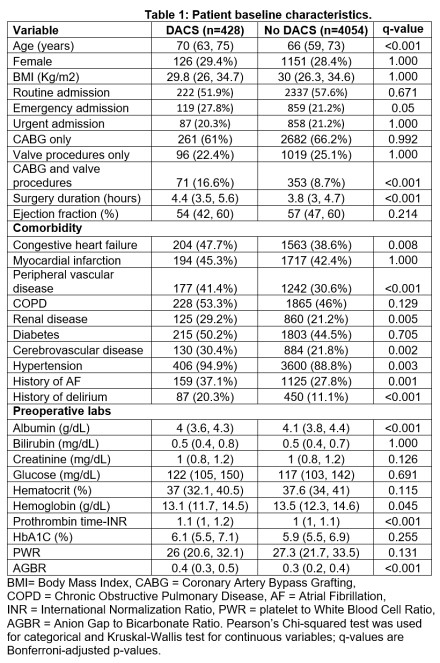
Abstract Body (Do not enter title and authors here): Background: Delirium, a common and multifactorial complication after cardiac surgery, is influenced by several factors including inflammation, metabolic disturbances, and cerebral hypoperfusion. Because these factors can be reflected in an elevated anion gap, we hypothesized that a higher preoperative anion gap to bicarbonate ratio (AGBR) is associated with increased risk of delirium after cardiac surgery (DACS). Methods: A retrospective cohort of adult patients who underwent cardiac surgery within our healthcare system between 2014 and 2022 was created. Patients were excluded if they had documented preoperative delirium during the index hospital admission, a history of dementia, or no recorded Confusion Assessment Method for the ICU (CAM-ICU) evaluation. The final cohort included 4,482 patients. Preoperative laboratory values were defined as the most recent measurements obtained within 48 hours prior to surgery. The primary outcome was DACS, defined as delirium occurring within postoperative days 1 through 5. The secondary outcome was all-cause 1-year mortality. Results: The incidence of DACS and 1-year mortality were 9.5% and 4.8%, respectively. The univariable analysis (summarized in Table 1) showed that several baseline characteristics were associated with increased risk of DACS, including older age (Bonferroni-adjusted p-value (q)<0.001), combined CABG and valve procedures (q<0.001), longer procedure duration (q<0.001), history of delirium (q<0.001), and higher preoperative AGBR (q<0.001). A multivariable logistic regression model adjusting for baseline characteristics showed that AGBR was significantly associated with higher risk of DACS (adjusted odds ratio (AOR) = 1.34, 95% Confidence Interval (CI) = 1.21-1.48, p<0.001). Other predictors of DACS included increasing age (AOR=1.32, CI=1.17-1.50, p<0.001), surgery duration (AOR=1.36, CI=1.23-1.50, p<0.001), hypertension (AOR=1.73, CI=1.11-2.85, p=0.022), and history of delirium (AOR=1.66, CI=1.25-2.18, p<0.001). Moreover, AGBR was also associated with 1-year mortality (AOR=1.23, CI=1.07-1.48, p=0.006).
Conclusions: Higher preoperative AGBR was associated with elevated risk for DACS and 1-year mortality. Preoperative AGBR is an accessible and cost-efficient biomarker that may improve risk stratification for cardiac surgery patients.
Abbas, Mostafa
(
Geisinger
, Danville , Pennsylvania , United States )
Morland, Thomas
(
Geisinger
, Danville , Pennsylvania , United States )
Sharma, Rohit
(
Mass General Brigham
, Salem , Massachusetts , United States )
Bitton, Neria
(
Geisinger
, Danville , Pennsylvania , United States )
Lichtenstein, Maya
(
Geisinger
, Danville , Pennsylvania , United States )
Kirchner, H Lester
(
Geisinger
, Danville , Pennsylvania , United States )
Lemaire, Scott
(
Geisinger
, Danville , Pennsylvania , United States )
El-manzalawy, Yasser
(
Geisinger
, Danville , Pennsylvania , United States )
Author Disclosures:
Mostafa Abbas:No Answer
| Thomas Morland:No Answer
| ROHIT SHARMA:No Answer
| Neria Bitton:DO NOT have relevant financial relationships
| Maya Lichtenstein:No Answer
| H Lester Kirchner:DO NOT have relevant financial relationships
| Scott LeMaire:No Answer
| Yasser El-Manzalawy:DO NOT have relevant financial relationships
Haseeb Shahan, Ansari Umair, Zulqarnain Muhammad, Qureshi Muhammad Ahmad, Ahmed Omair, Munir Shafia, Siddiqui Taha, Gehres Eric, Zaman Muhammad, Ali Raiyan, Dwivedi Manu